

When residents of Three Crabs ask for help with flooding, when citizens request answers about public safety, or when constituents seek meetings with county officials, they often report silence. Yet public records show Commissioner Mark Ozias regularly making time for private meetings, research discussions, and information-sharing with a network of environmental activists working on timber and trust land issues. The records raise a larger question: are Clallam County commissioners serving all residents equally, or have certain activist and special-interest groups become the county’s preferred stakeholders?
Who Gets a Seat at the Table?
The oath of office taken by elected officials is simple. They swear to faithfully and impartially serve the public.
“I, Mark Ozias, do solemnly swear or affirm, that I am a citizen of the United States and the State of Washington, and that I am legally qualified to assume the office of Clallam County Commissioner District 1, that I will support the constitution and the laws of the United States and the State of Washington, and the charter and ordinances of Clallam County, and that I will faithfully and impartially discharge the duties of this office to the best of my ability.” – Commissioner Mark Ozias, December 29th, 2015
But in Clallam County, many residents are beginning to wonder whether some voices carry more weight than others.
A pair of recent Washington State Standard articles published in the Peninsula Daily News highlighted the growing influence of environmental activist networks working to reshape the future of state-managed forests on the Olympic Peninsula.
One article detailed how the Elwha Legacy Forests Coalition raised $32,000 in just four days to halt logging around the Sadie Creek Campground.

Another reported on litigation seeking to stop nearly 400 acres of logging in the Elwha Watershed.
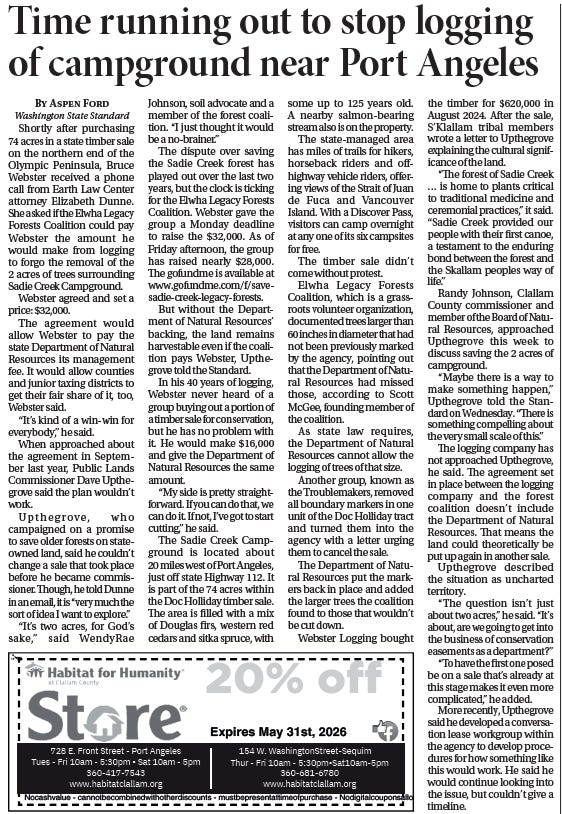
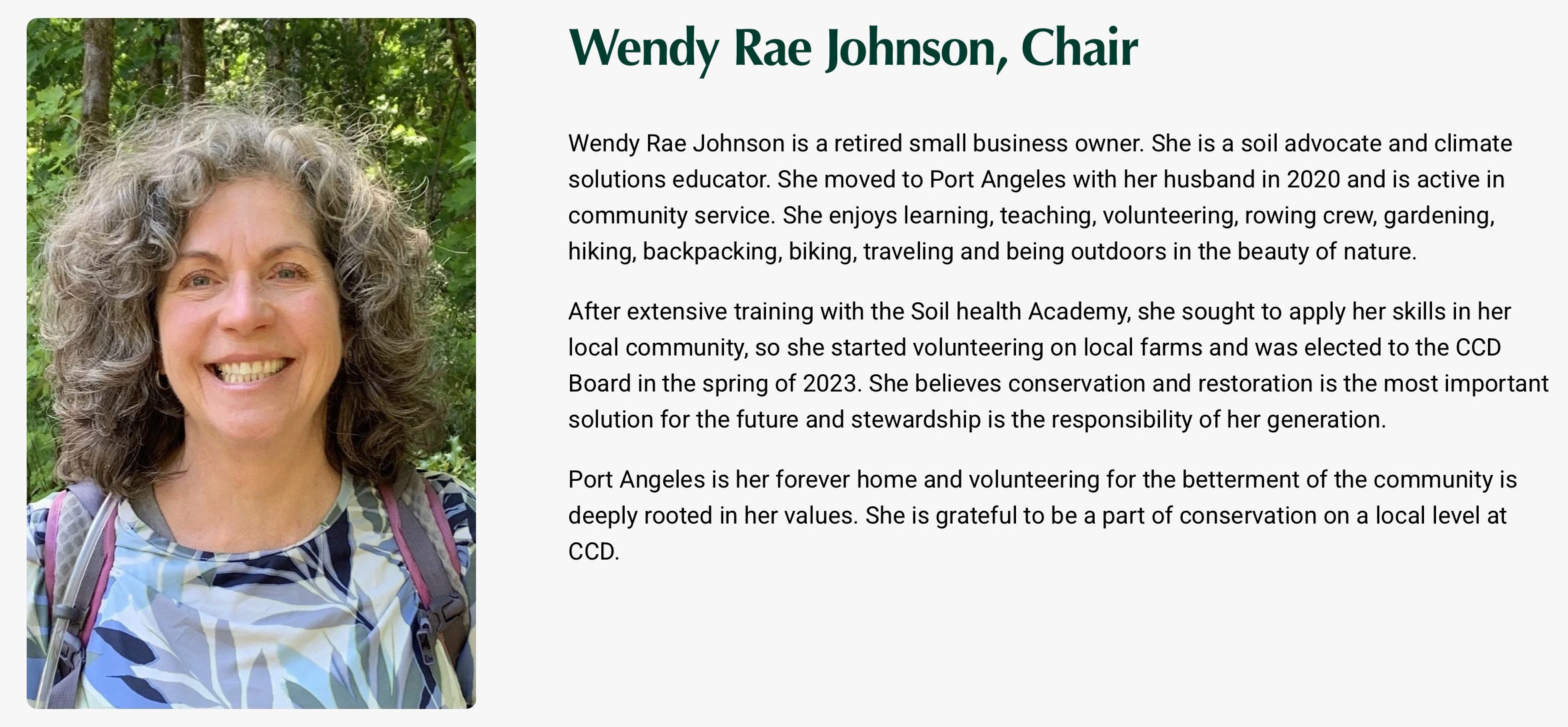
Among the most visible advocates quoted in the coverage is WendyRae Johnson, a member of the Elwha Legacy Forests Coalition and the recently reelected Chair of the Clallam Conservation District.
There is nothing improper about advocacy. Citizens have every right to organize, lobby government, and pursue policy goals they believe benefit the community.
The question is whether everyone enjoys the same access.
The Activist Network
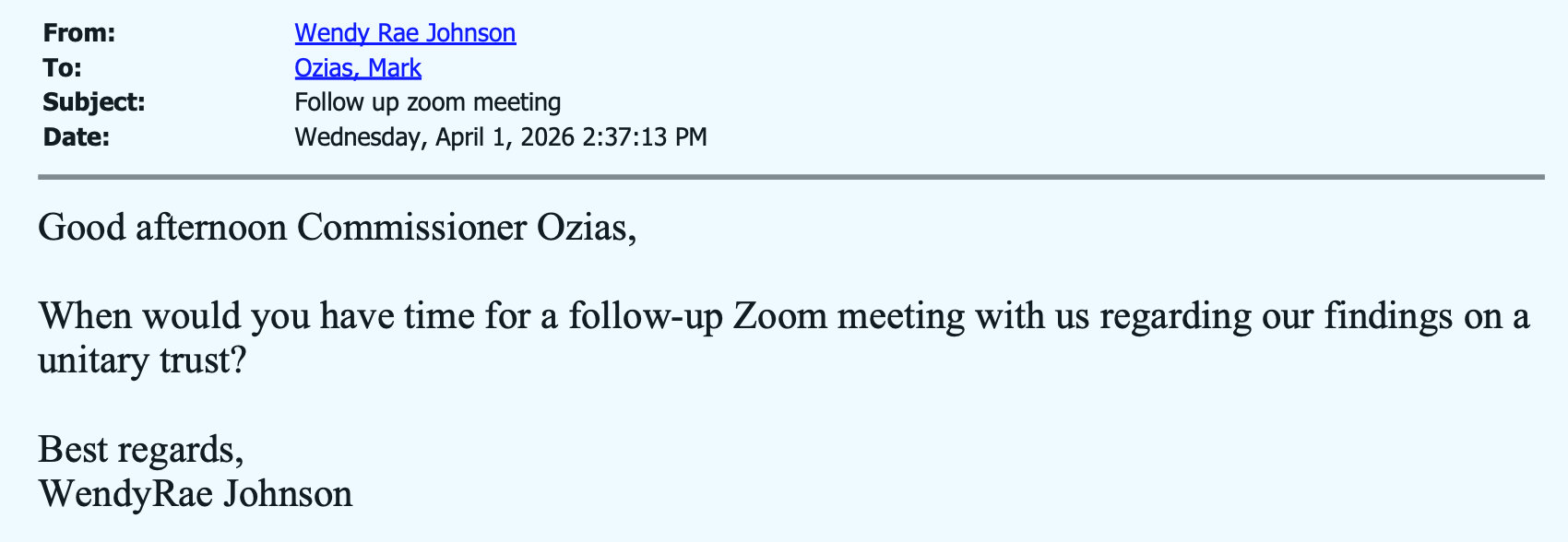
Public records obtained by Clallam County Watchdog show Johnson communicating directly with Commissioner Mark Ozias regarding trust land issues, timber revenues, and meetings concerning what emails describe as their “findings on a unitary trust.”
The records also show the involvement of Ed Chadd, a local political organizer and activist who has helped organize Indivisible demonstrations attended by Commissioner Mark Ozias.

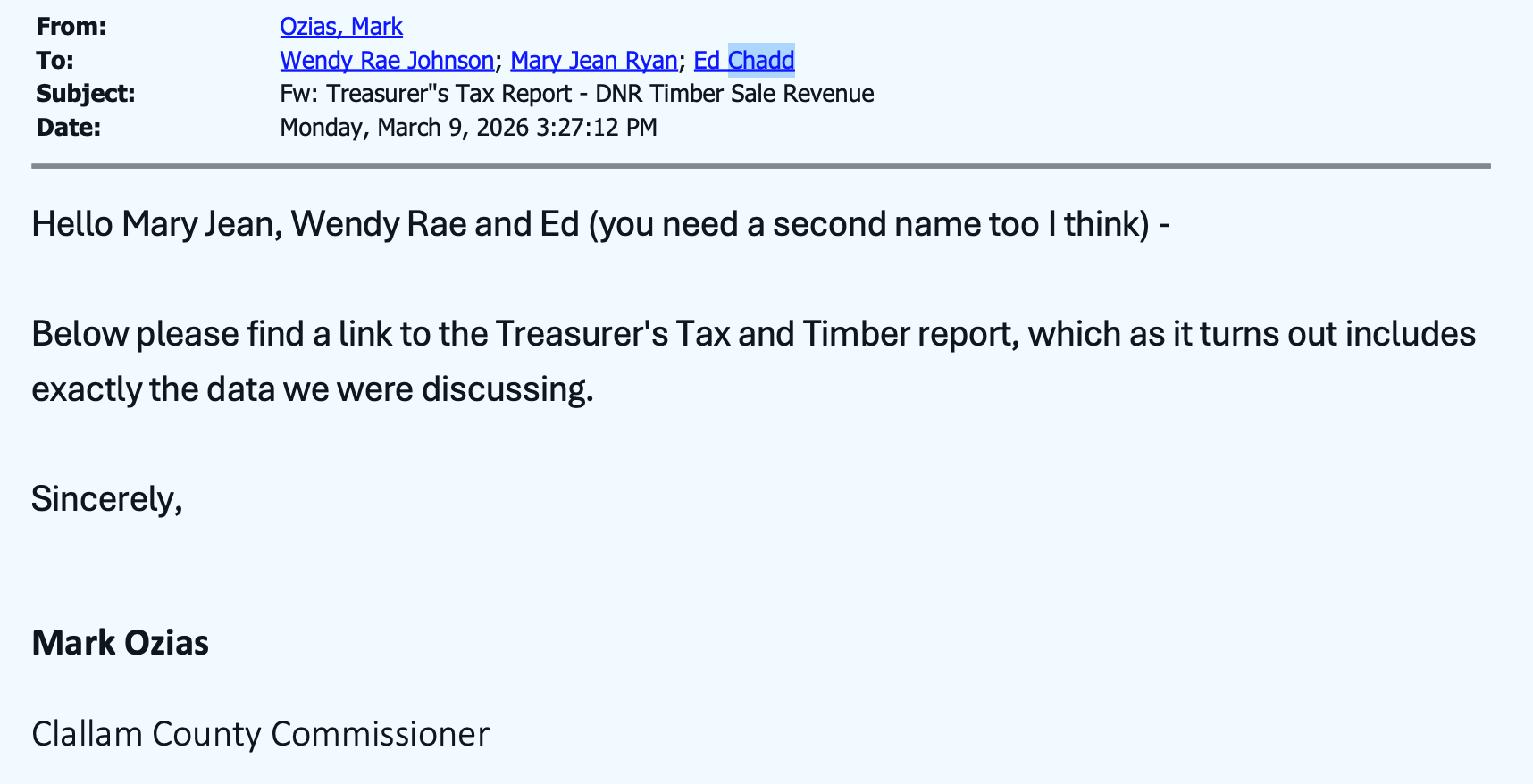
Chadd was included in discussions alongside Johnson and Mary Jean Ryan regarding timber revenue data and trust land issues.
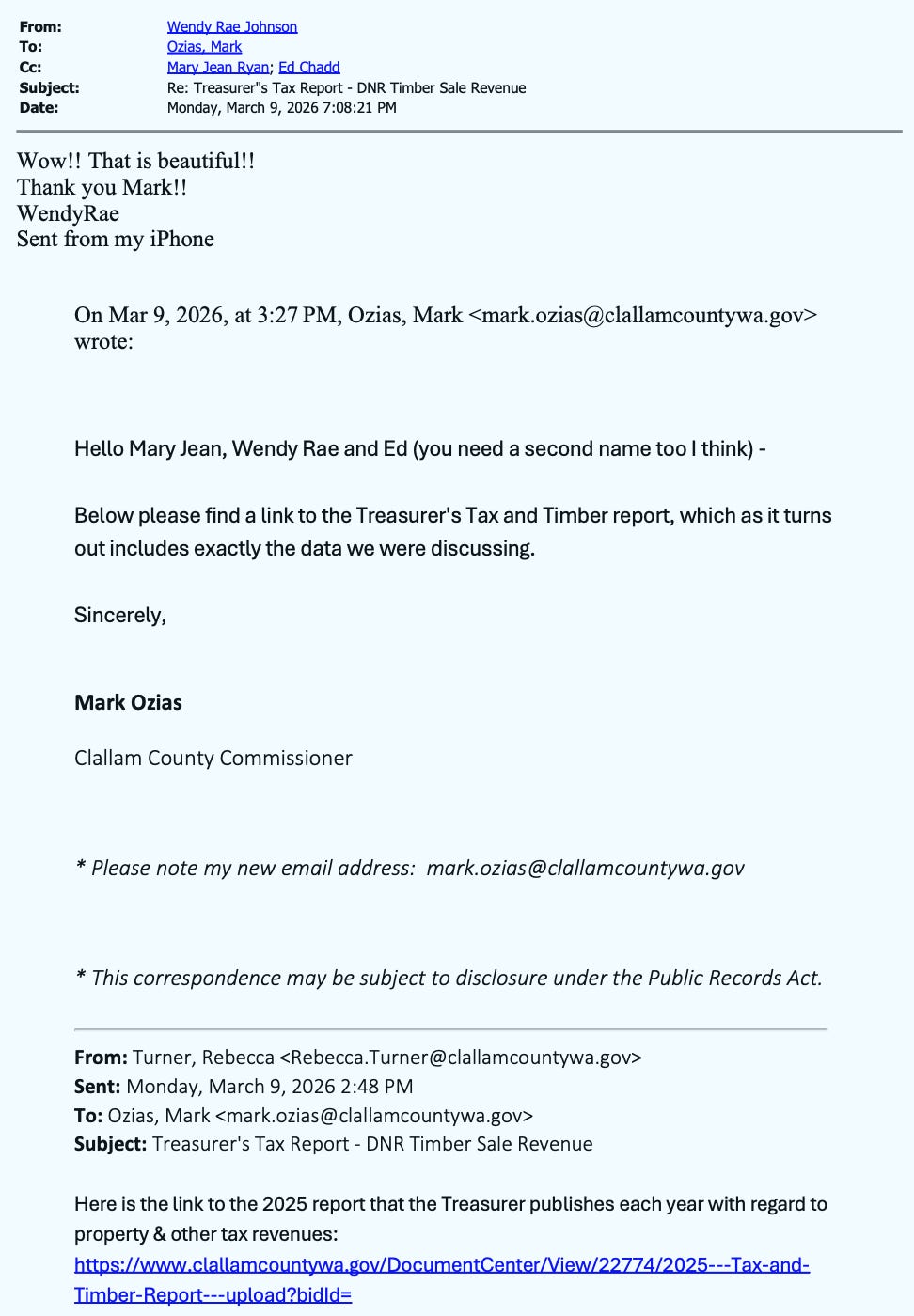
On March 9, Ozias obtained county financial information regarding timber revenues and forwarded it directly to Johnson, Ryan, and Chadd after locating data they had discussed. He described the information as containing “exactly the data we were discussing.”
A month later, Johnson requested a follow-up meeting with Ozias regarding the group’s research. Ozias worked around scheduling conflicts, proposed multiple dates, and ultimately arranged a dedicated Zoom meeting involving Johnson, Ryan, and Chadd.
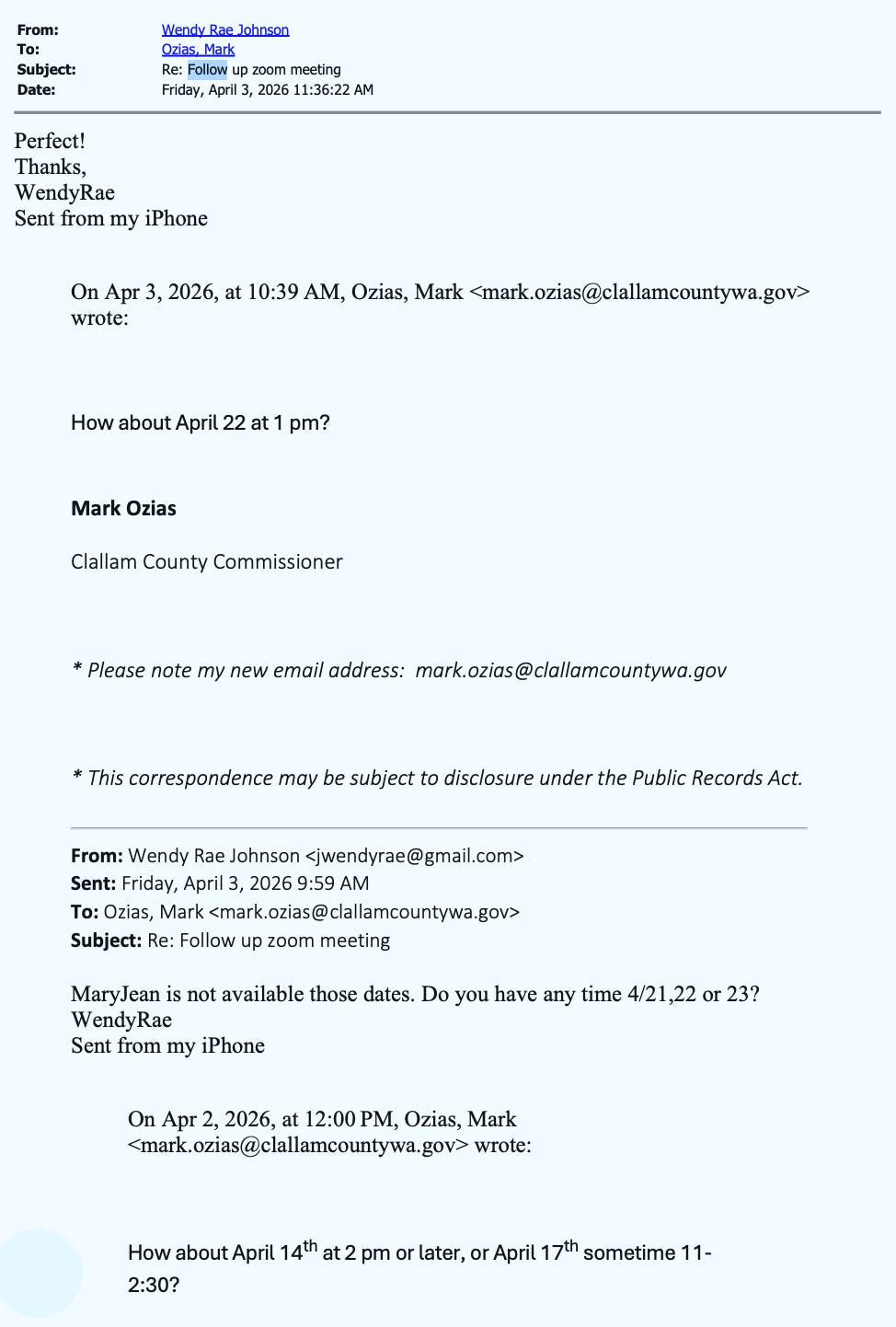
The meeting wasn’t squeezed into a crowded public comment period. It wasn’t limited to a three-minute statement before the board. It wasn’t a request submitted through a county website.
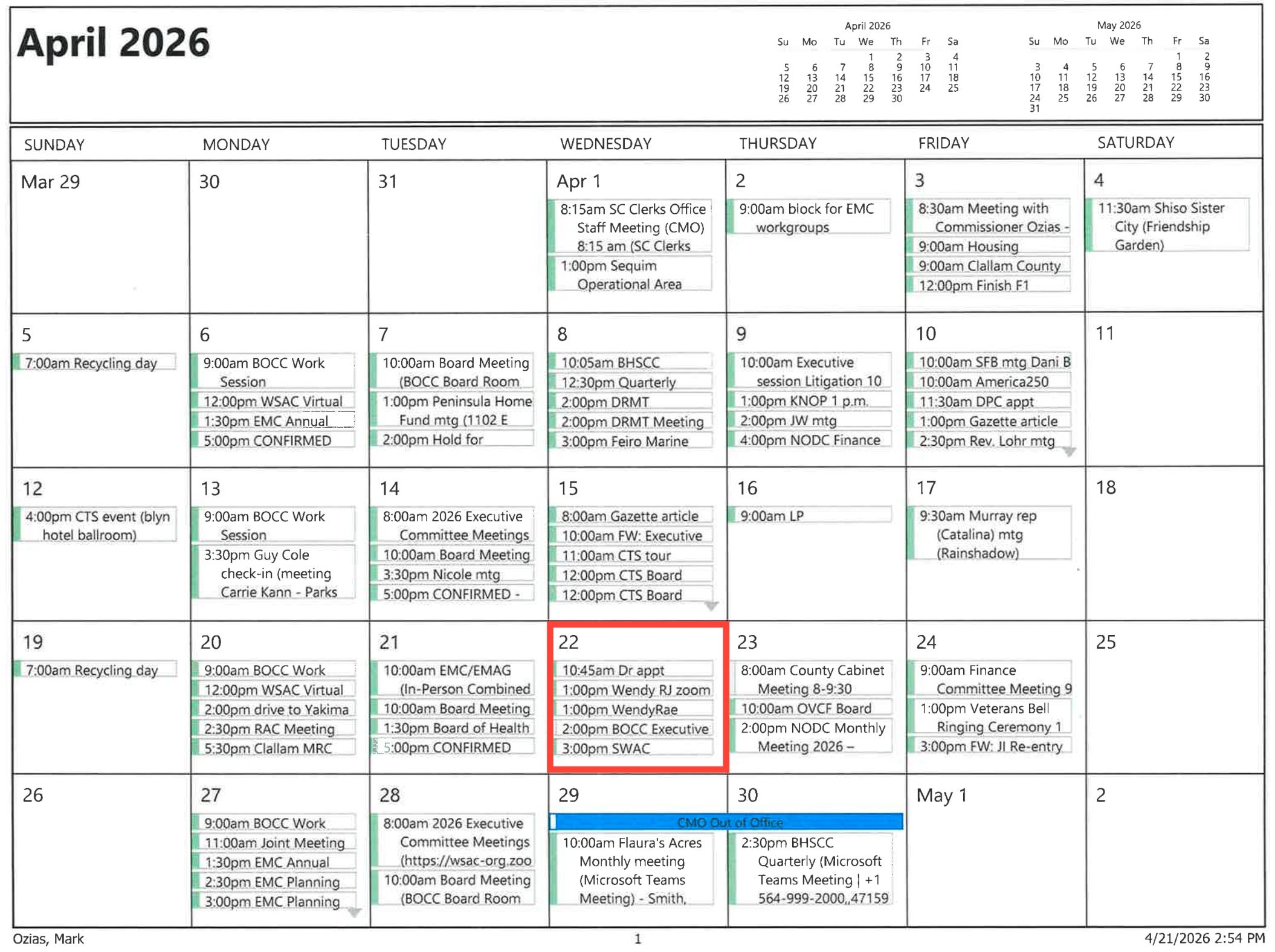
It was a private hour-long Zoom meeting scheduled directly with a county commissioner. The meeting appeared on Ozias’ calendar for April 22, 2026.
A Concierge Service?
Again, none of this is illegal. Commissioners routinely meet with constituents. They should. What stands out is the level of assistance being provided.
The emails show Ozias gathering county data on behalf of the group, forwarding outside reports related to trust lands, coordinating schedules, and maintaining an ongoing dialogue about issues they were actively researching.
For activists seeking information about timber revenues and trust land management, the county commissioner appears highly responsive.
Many other residents would likely welcome similar treatment.
Meanwhile, Other Residents Wait
Residents in Three Crabs have spent years raising concerns about flooding following restoration projects and dike removal in the area. Some report recurring seasonal flooding, property impacts, and difficulty getting meaningful responses from decision makers.
Citizens concerned about public safety, homelessness, drug use, and county policies frequently report unanswered emails and unreturned requests for comment.
Commissioner Ozias has also declined invitations to several community forums and public discussions where residents hoped to ask questions directly.
The contrast is difficult to ignore.
One group receives direct access, research support, scheduling accommodations, and ongoing conversations with elected officials.
Others struggle simply to get a response.
The Bigger Question
The issue isn’t WendyRae Johnson.
The issue isn’t Ed Chadd.
The issue isn’t environmental advocacy.
The issue is whether access to elected officials is being distributed fairly.
Every resident of Clallam County pays for county government. Every resident helps fund the salaries, staff, and resources that support elected officials. Every resident deserves to know that their concerns will receive the same attention regardless of whether they belong to a well-connected activist network, a political organization, a tribe, a nonprofit, a business association, or simply happen to be an individual citizen.
Commissioners are not elected to represent the people who already agree with them. They are elected to represent everyone.
When public records repeatedly show special access for organized interests while ordinary residents struggle to be heard, it raises an uncomfortable question:
Is county government serving the public equally—or has access itself become a privilege reserved for those who already have a seat at the table?
Editor’s Note: Public records reviewed for this article show communications between Commissioner Mark Ozias, Clallam Conservation District Chair WendyRae Johnson, Mary Jean Ryan, and Ed Chadd concerning trust land issues, timber revenues, and related meetings. The records do not establish that Commissioner Ozias coordinated litigation or advocacy efforts, only that he provided information and participated in discussions regarding those issues.
Today’s Tidbit: School Board to Consider Censure of Director Nancy Hamilton
The Port Angeles School District Board of Directors is scheduled to consider a resolution on June 18 that would formally censure board member Nancy Hamilton. The item appears on the board’s agenda as “Approval of Resolution 2526-18 – Censure of Board Director, Nancy Hamilton,” with administration recommending approval.
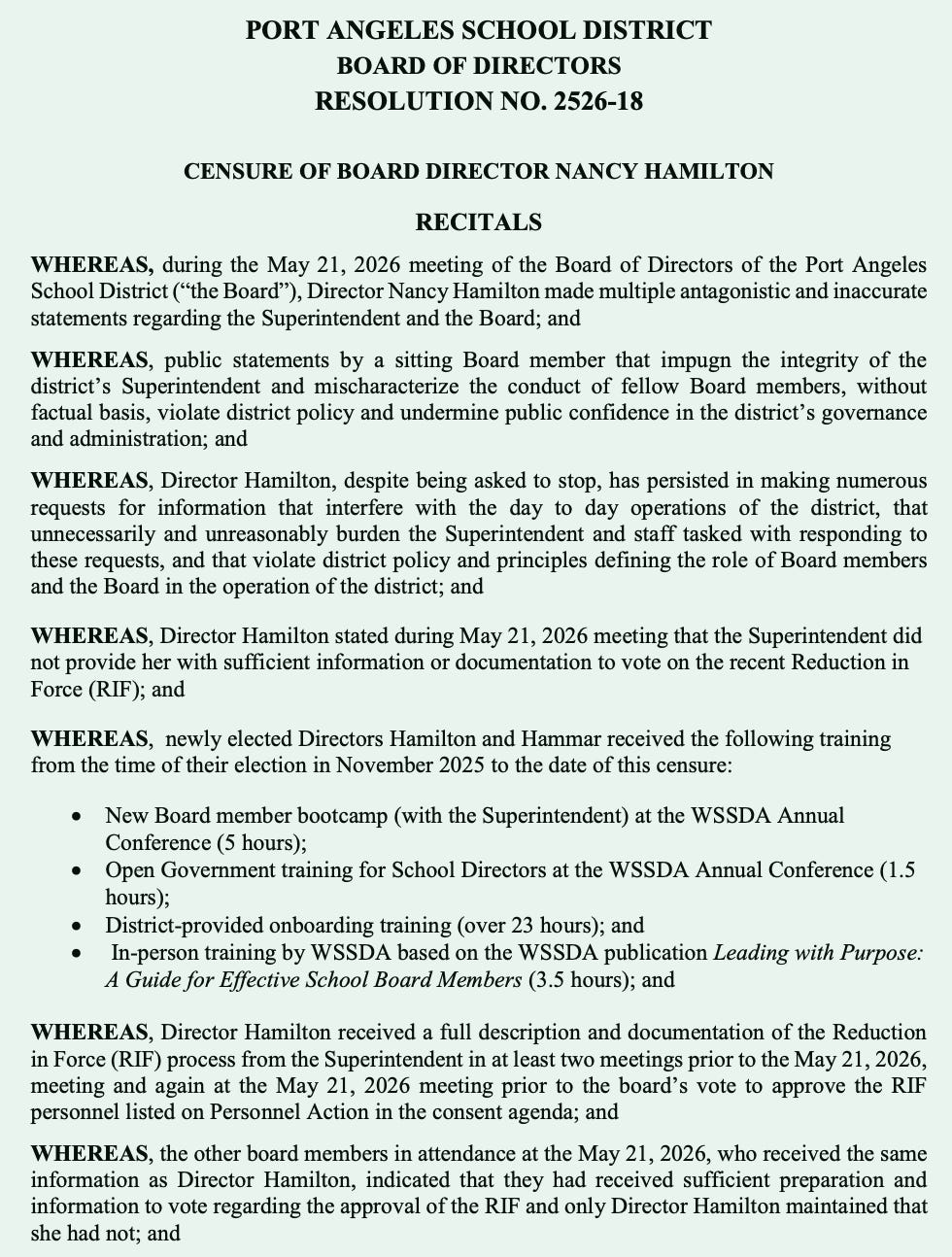
A censure is a formal statement of disapproval by a governing body. It does not remove an elected official from office, but it serves as an official reprimand and can limit certain board privileges. According to the proposed resolution, the board alleges Hamilton violated board policies and standards of conduct through a pattern of actions that the resolution says undermined board governance and district operations.
Hamilton was elected to the board in November 2025 and was sworn into office in December. In recent months, she has frequently asked questions about district finances, staffing reductions, and decision-making processes. She cast the lone vote against a recent reduction-in-force resolution, stating she did not have enough information about how staffing priorities had been determined.
The meeting is scheduled for Thursday, June 18 at 5pm, and is expected to draw significant public interest. Whether residents support the censure or oppose it, this may be an important opportunity to hear the board’s rationale, Hamilton’s response, and public comment on the matter. As always, readers are encouraged to review the resolution themselves and attend the meeting if they wish to see the discussion firsthand.
Commissioner Randy Johnson Agrees to Participate in This Week’s Town Hall
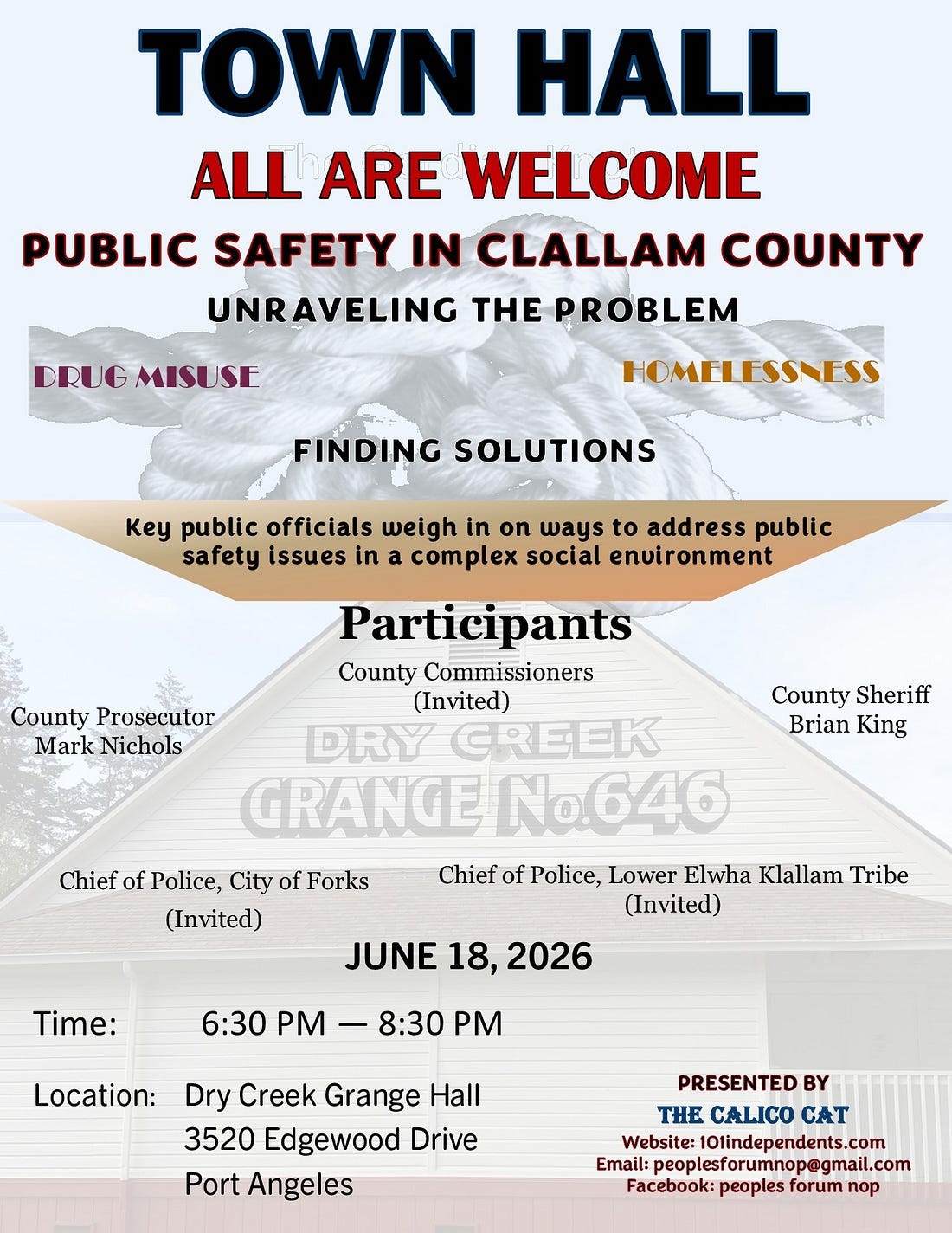
This Weekend