
A Port Angeles resident in recovery is urging Clallam County to shift its focus from drug-use supplies to treatment and accountability. In response, Health Officer Dr. Allison Berry defended the county’s harm reduction efforts, cited declining overdose rates, and accused Clallam County Watchdog and County Commissioner candidate Jake Seegers of misrepresenting her work. The exchange highlights a growing divide between public health officials and residents—including people in recovery—over whether current policies are producing the results taxpayers were promised. The full correspondence is published below.
A Letter to a Leader
For years, Clallam County has expanded its harm reduction efforts in an attempt to reduce overdose deaths, prevent the spread of infectious disease, and connect people struggling with addiction to services.
Supporters argue the strategy saves lives.
Critics argue the county has become increasingly focused on making addiction safer rather than helping people escape it.
That debate took center stage yesterday in an exchange between Port Angeles resident David Rogers and Clallam County Health Officer Dr. Allison Berry.
Rogers, who says he is in long-term recovery from addiction and has lost both his sister and numerous friends to overdose, wrote to county officials urging them to reconsider the county’s current approach.
Dear Clallam County Health and Human Services Leadership,
I am writing as a Clallam County resident, someone in long term recovery from addiction, and someone who regularly spends time talking with people who are currently struggling with substance use disorder on our streets. I understand that the goal of your department is to reduce overdose deaths and improve public health. I believe those are goals we all share. Unfortunately, I also believe it is time to honestly acknowledge that the current approach is not producing the results our community was promised.
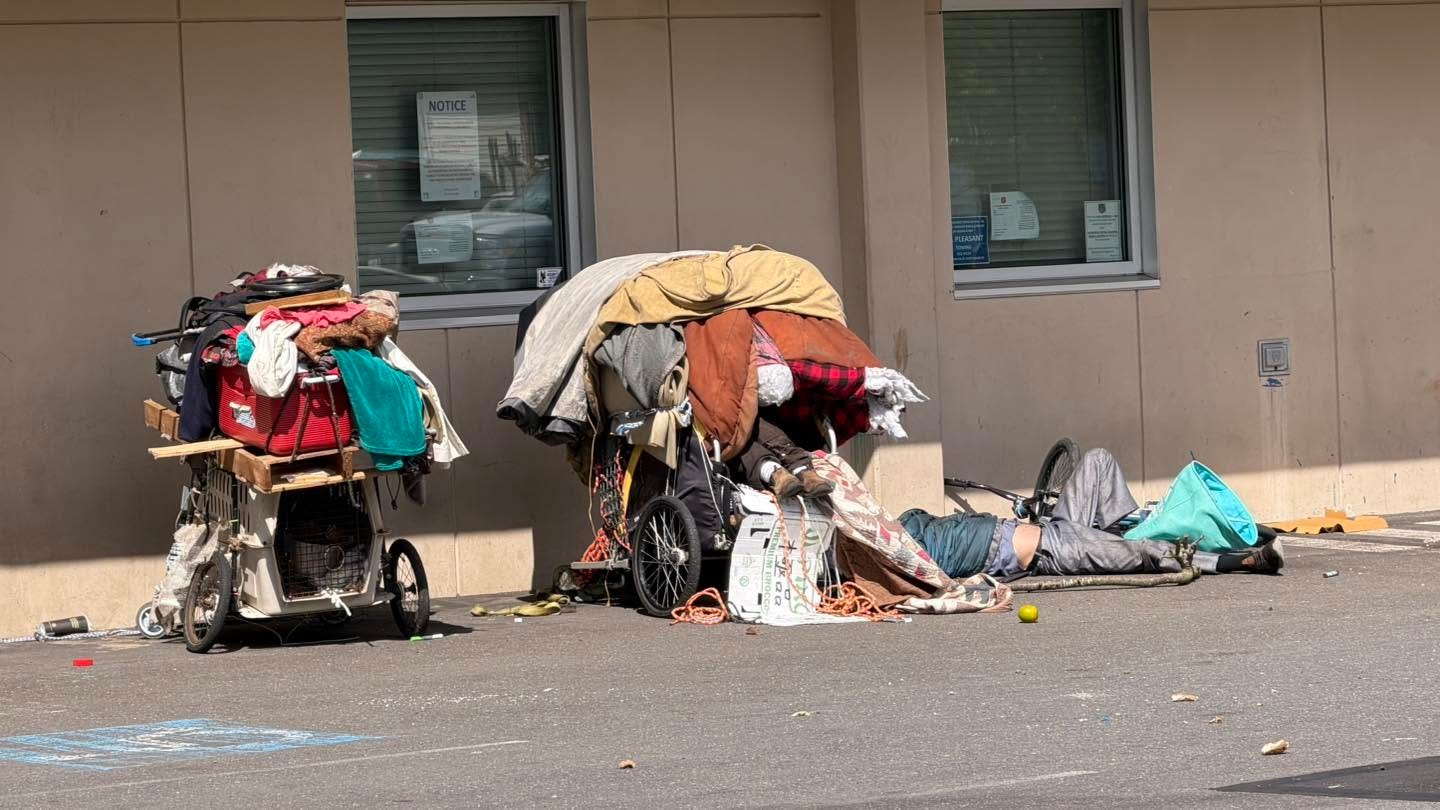
Despite the continued expansion of harm reduction services and the distribution of drug use supplies, Clallam County continues to experience overdose rates that exceed state and national averages. At the same time, families, business owners, and residents are watching open drug use, drug dealing, and public disorder become increasingly common. Many people in our community feel like there is little accountability and that these programs are unintentionally making it easier to remain in active addiction.
I respectfully ask that Clallam County discontinue the distribution of all drug use supplies except for a one for one syringe exchange. Exchanging used syringes for clean ones helps reduce discarded needles in our community while still addressing the risk of disease transmission. Beyond that, I believe the county should stop handing out supplies that support continued drug use without also moving people toward treatment and recovery.
Compassion and accountability are not opposites. In my experience, they work best together. Nearly every successful recovery program includes accountability because real recovery often requires someone to be challenged to make a different choice. We should absolutely meet people where they are, but we should also be helping them move forward rather than making it easier to stay exactly where they are.
As someone who has lived through addiction, I can honestly say that what changed my life was accountability combined with access to treatment. It was not having my addiction made easier. I have now spent years talking with others in recovery, and I continue to hear that same story over and over again.
I would much rather see our resources invested in treatment, recovery support, transportation to treatment, case management, and housing that encourages recovery. Every dollar we spend should move someone one step closer to getting their life back.
I also ask that Health and Human Services publicly report measurable outcomes for each of its harm reduction programs. If we are investing taxpayer dollars into these services, the public deserves to know what results they are producing. If a program is reducing overdose deaths, increasing treatment participation, or improving long term recovery, that should be demonstrated with clear data. If it is not, then we have a responsibility to reconsider how those resources are being used.
Finally, I want to address something that has become increasingly frustrating for many of us in the community.
My sister died from an overdose. I have also lost countless friends to addiction. When Dr. Alison Berry suggests that those of us advocating for changes to the county’s current approach lack compassion or somehow want to see people die or contract HIV, it is deeply hurtful and disrespectful.
Nothing could be further from the truth.
Those of us asking for change are often the very people who have buried loved ones, lived through addiction ourselves, or both. We are speaking because we are tired of watching people die. We simply disagree on what the most effective path forward is.
There is room for honest disagreement about public policy without questioning each other’s compassion or motives. Suggesting that anyone who advocates for greater accountability is somehow indifferent to human suffering only divides our community and shuts down meaningful conversation.
I respectfully ask that Health and Human Services engage with those of us who have lived experience, even when we disagree. Recovery is possible. Our voices deserve to be heard, and they deserve to be treated with the same respect afforded to any other stakeholder in this conversation.
We all want the same outcome: fewer overdose deaths, healthier families, and more people finding lasting recovery. We will get there faster by listening to one another instead of dismissing those whose experiences lead them to different conclusions.
Sincerely
David Rogers
Port Angeles, Washington
His letter is notable because it comes not from a politician or activist, but from someone who says he has personally experienced addiction and recovery.
“Compassion and accountability are not opposites,” Rogers wrote. “In my experience, they work best together.”
Rogers argued that the county should discontinue distributing drug-use supplies beyond a one-for-one syringe exchange program and instead direct more resources toward treatment, recovery support, transportation, case management, and housing programs that encourage recovery.
He also called on county officials to publicly report measurable outcomes demonstrating whether harm reduction programs are producing the results taxpayers are funding.
Perhaps most significantly, Rogers challenged what many residents have increasingly described as a dismissive attitude toward those who question the county’s approach.
“My sister died from an overdose,” Rogers wrote. “I have also lost countless friends to addiction.”
“Those of us asking for change are often the very people who have buried loved ones, lived through addiction ourselves, or both.”
Berry Responds
Dr. Allison Berry responded an hour later.
Hi Mr. Rogers,
Thank you for reaching out. First of all, I want to say congratulations on your recovery. That is such hard work and I am so happy for you. Secondly, I want to say I am so very sorry to hear about the loss of your sister. I’m sending you peace as you grapple with that incredible loss. Preventing overdose deaths like her own is a major motivator for the work that we do.
Given the timing of your email and some of the references in it, I suspect that you are getting your information about me and my work on Clallam County Watchdog. It has been a challenge these last few months to have Mr. Tozzer and Mr. Seegers so dedicated to misrepresenting me, my work, and my words. Luckily, every meeting they draw their material from is recorded and publicly available. Before you get angry at something you’ve been told I said, I strongly encourage you to go listen to the original tape. You can find them on the Clallam County website under the board of health here: https://www.clallamcountywa.gov/677/Board-of-Health
For an example - one of the misquotes that you share upset you, the one where I reportedly equate accountability with wanting people to get HIV and die. I actually said the exact opposite - that I don’t think that is what people mean when they ask for accountability. As a drug treatment professional, I agree with you - accountability is an incredibly important part of long term recovery. I was making the point that nothing we do gets in the way of that. We just prevent infectious diseases. I shared the example of if a person commits violence while using drugs, nothing we do will prevent them from facing the consequences of that - nor frankly do I wish to. You can find that specific meeting here:https://clallamcowa.portal.civicclerk.com/event/292/files/agenda/6053
Similarly, on the subject of metrics, we have shared many and continue to. I gave a 50 minute presentation on why we practice harm reduction and shared quite a few metrics there. You can find that in our BOH recordings too: https://clallamcowa.portal.civicclerk.com/event/289/files/agenda/4746. When reporting on that presentation, unfortunately Mr. Tozzer didn’t share any of those data, instead focusing on falsely claiming that I said 4PA steals. We also have numerous publicly available reports on our website. One metric I can share with you here - when I took this job in 2018, we were leading the state in opiate overdoses. Now, we are ranked 16th. We’ve made substantial progress, faster than other counties in the state and the nation. That has been the result of focused and coordinated effort - to expand treatment, to expand harm reduction services and naloxone availability, to improve connections to care, and social supports for people who use drugs, to facilitate treatment in jail and connections to care afterwards. We have a long way to go, but I am hopeful that as a community, we can continue this progress.
I appreciate your engagement in this work. I encourage you, as you move forward, to vet your source, listen to the original recordings, and expand the sources of information you are drawing from. Mr. Tozzer and Mr. Seegers have a particular political goal in mind with their content and have unfortunately demonstrated a willingness to manipulate and misrepresent reality to get it.
Hang in there,
Allison Berry, MD, MPH
Health Officer for Clallam County and Jefferson County
She began by congratulating Rogers on his recovery and expressing condolences for the loss of his sister. Berry then suggested Rogers may have been receiving information about her work through Clallam County Watchdog.
“It has been a challenge these last few months to have Mr. Tozzer and Mr. Seegers so dedicated to misrepresenting me, my work, and my words,” Berry wrote.
Berry encouraged Rogers to review original Board of Health recordings and public records rather than relying on secondhand reporting. She specifically challenged criticism surrounding comments she previously made regarding accountability and infectious disease prevention. According to Berry, critics have mischaracterized her remarks. However, readers can review her exact words for themselves.
During a Board of Health discussion, Berry stated:
“I’ve heard a lot of this conversation about this idea that we need, like, more accountability for folks and — what’s the phrase? — compassion without accountability, and it’s strange that we’ve gotten wrapped into that in some way, because all that we do is help people not get AIDS and make them less likely to die.”
She then added:
“I hope that when people are asking for accountability, they’re not saying that people who use drugs deserve to get AIDS and die.”
Many residents interpreted those comments as suggesting that criticism of harm reduction programs is closely associated with a desire to deny services to people suffering from addiction.
Berry maintains that the interpretation is incorrect.
Rogers Pushes Back
Rogers replied shortly after receiving Berry’s response, challenging her assumption that his concerns originated with Clallam County Watchdog or any single political figure.
Hi,
Thank you for your response.
I’ll get back to everything you raised, but I wanted to quickly address your assumption that my information comes from Mr. Tozzer.
My perspective comes from being an engaged citizen. I attend City Council meetings, County Commissioner meetings, and Public Health hearings, and I’m adjusting my schedule so I can attend even more of them in person. I’ve also spent time walking and talking with leaders like Mike French, Mark Hodgson, Amy Miller, and Drew Schwab. Together we’ve walked Veterans Park, Tumwater Creek, and other troubled areas, speaking directly with people who are struggling with substance use and homelessness.
To immediately dismiss my perspective as simply repeating one other person’s opinions is exactly the kind of behavior many people in our county are growing frustrated with. These concerns are not coming from one individual or one political group. They come from citizens, business owners, first responders, elected officials, and people with lived experience who are all seeing the same problems firsthand.
If we aren’t willing to take an honest look at what’s happening, we won’t move forward.
One statement Commissioner Mike French made during one of our walks has stuck with me: often the strongest criticism of our current approach comes from people who have successfully changed their lives and recovered from substance use disorder. I think that should speak volumes. Those of us who have lived through addiction are often the very people questioning policies that, from our perspective, make it easier to remain in active addiction rather than move toward recovery.
I’ll review the links you sent and respond in more detail as soon as I can.
Thank you,
David Rogers
“My perspective comes from being an engaged citizen,” Rogers wrote.
He described regularly attending City Council meetings, County Commissioner meetings, and public health hearings. He also said he has spent time walking through areas such as Veterans Park and Tumwater Creek with community leaders including County Commissioner Mike French, Mark Hodgson, Amy Miller, and Drew Schwab, speaking directly with people experiencing addiction and homelessness.
“To immediately dismiss my perspective as simply repeating one other person’s opinions is exactly the kind of behavior many people in our county are growing frustrated with,” Rogers wrote.
He argued that concerns about the county’s current approach are not coming from a single individual or political group, but from residents, business owners, first responders, elected officials, and people with lived experience who are observing the same issues firsthand.
“If we aren’t willing to take an honest look at what’s happening, we won’t move forward,” he wrote.
Rogers also referenced a comment he said was made by Commissioner French during one of their discussions:
“Often the strongest criticism of our current approach comes from people who have successfully changed their lives and recovered from substance use disorder.”
“I think that should speak volumes,” Rogers added. “Those of us who have lived through addiction are often the very people questioning policies that, from our perspective, make it easier to remain in active addiction rather than move toward recovery.”
The “Theft” Controversy
Berry also accused County Commissioner candidate Jake Seegers of falsely claiming that she said the volunteer group 4PA steals supplies from homeless encampments. Here again, readers can evaluate the original statement for themselves.
During a Board of Health meeting, Berry stated:
“I live here. Have kids in PA. I don’t want needles on the ground, so we work hard to get them back. I think it’s important to acknowledge that some of our supplies that are turned in by people who find them are folks who are cleaning up encampments that people still live in. So, that cleaning up is actually theft. It’s taking supplies that someone is still using.”
Whether that statement was directed at 4PA specifically remains a matter of interpretation, but it is the statement that generated the controversy.
The Data Debate
Berry pointed to what she describes as measurable success.
“When I took this job in 2018, we were leading the state in opiate overdoses. Now, we are ranked 16th,” she wrote.
That claim is important context. But it is also true that Clallam County continues to experience overdose rates above both state and national averages.
The debate is no longer whether overdose deaths matter. Everyone agrees they do. The debate is whether current policies deserve credit for improvements that have occurred and whether different approaches could achieve better results.
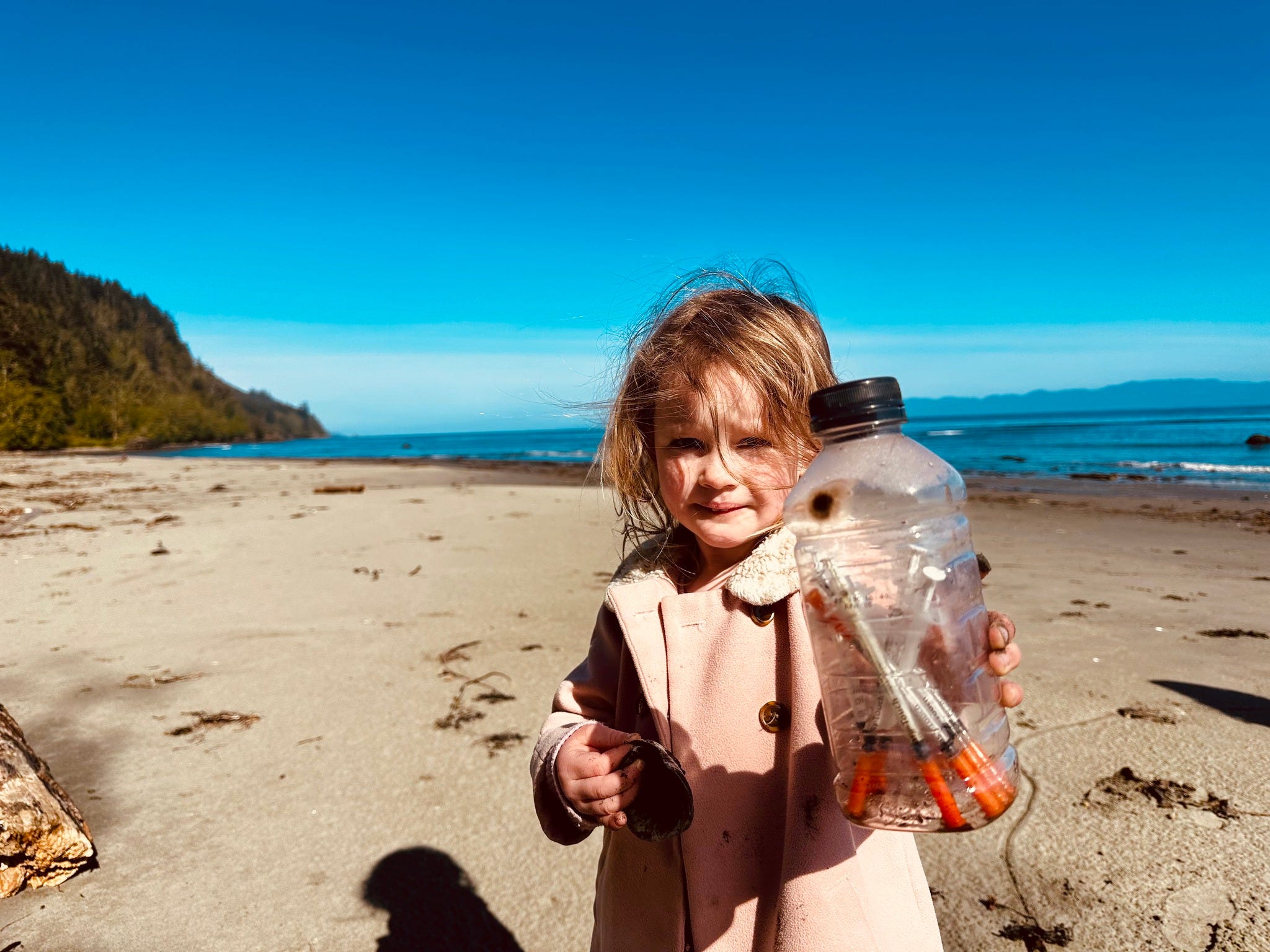
One program frequently cited by recovery advocates is Operation Shielding Hope. Unlike traditional harm reduction efforts focused primarily on distributing supplies, Operation Shielding Hope connects overdose survivors with paramedics and peer recovery specialists immediately after an overdose event. The goal is to move people into treatment and recovery services while they are most receptive to help.
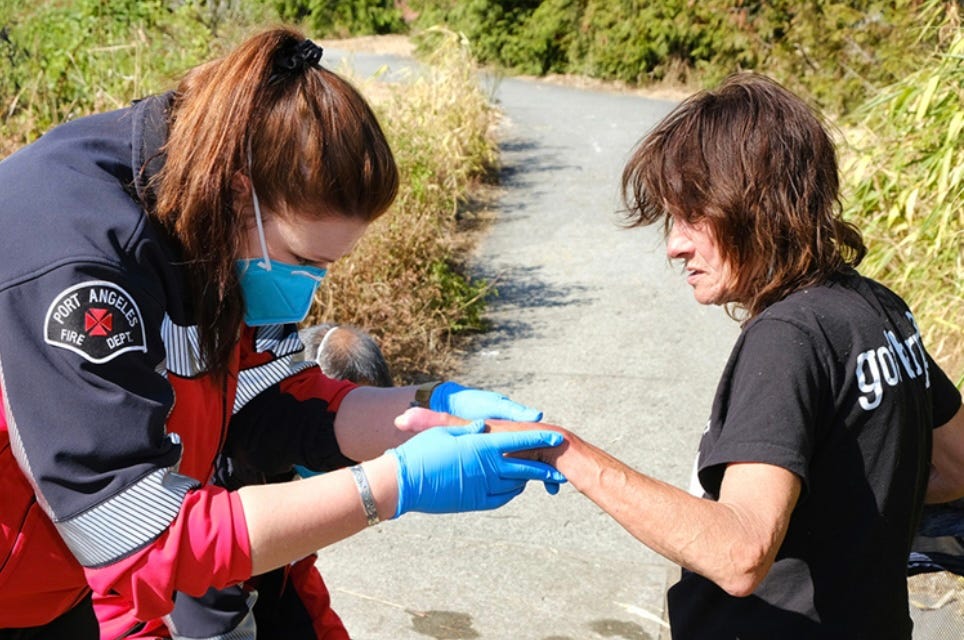
County data previously reviewed by Jake Seegers showed dramatically higher engagement rates among individuals contacted through Operation Shielding Hope than among those who were not. Supporters argue that the program demonstrates that treatment-focused intervention can achieve measurable results without relying primarily on distributing drug-use supplies.
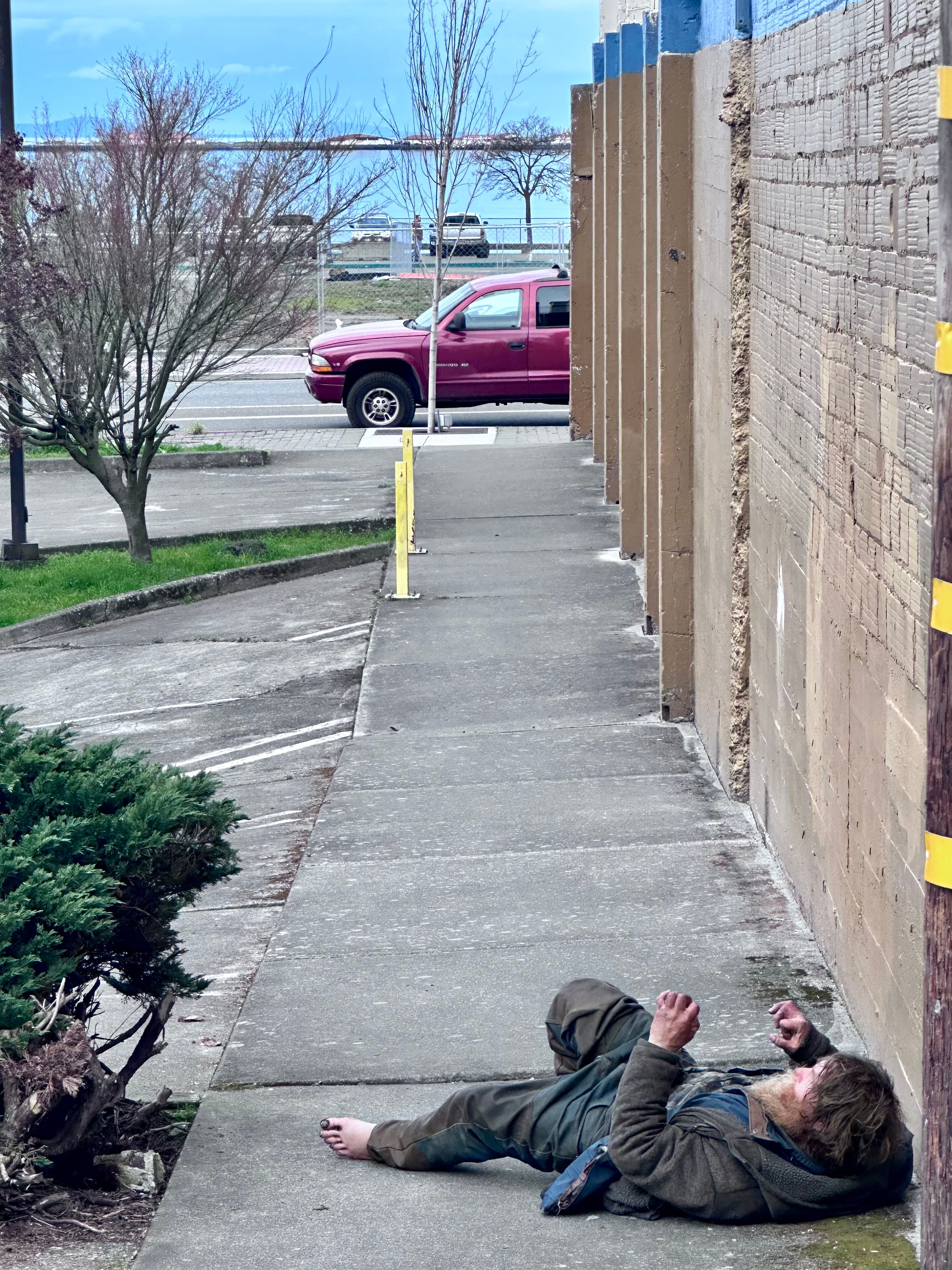
Critics of the county’s broader harm reduction strategy argue officials have been too quick to credit improvements to programs that distribute meth pipes, crack pipe cleaning kits, foil, and other drug-use supplies while giving insufficient attention to treatment-centered programs producing measurable outcomes.
Questions That Remain
Berry’s email also raises a broader question. If Clallam County Watchdog is repeatedly misrepresenting her statements, why has the Health Officer declined multiple requests for clarification and follow-up questions?
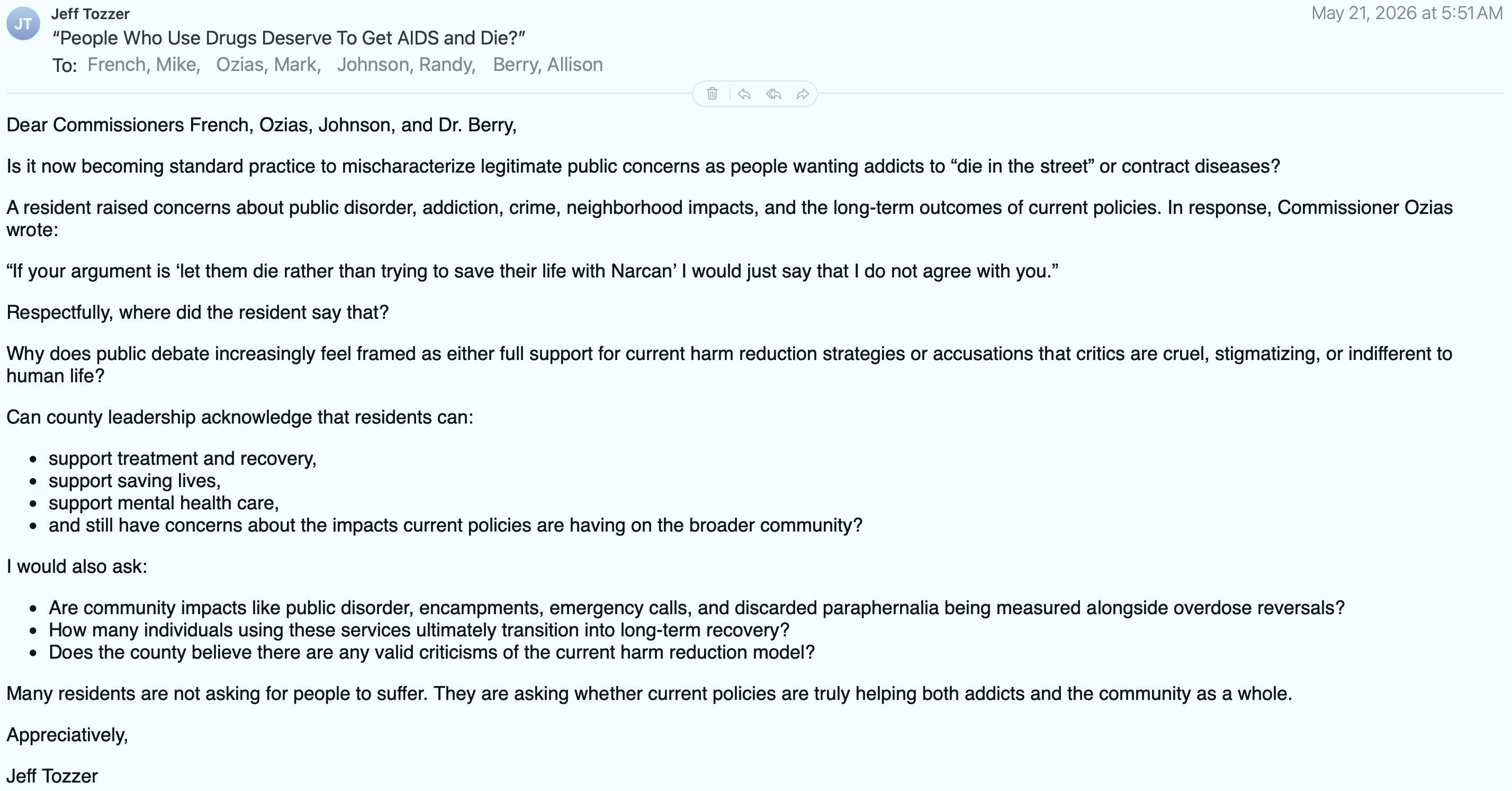
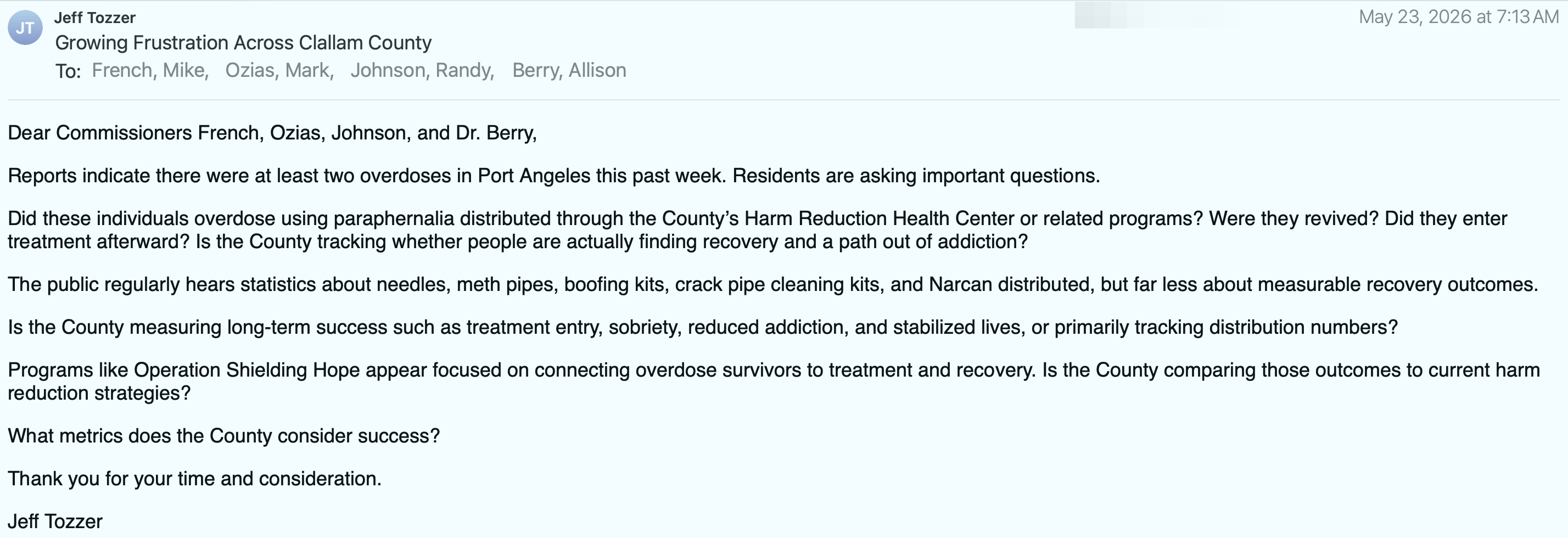
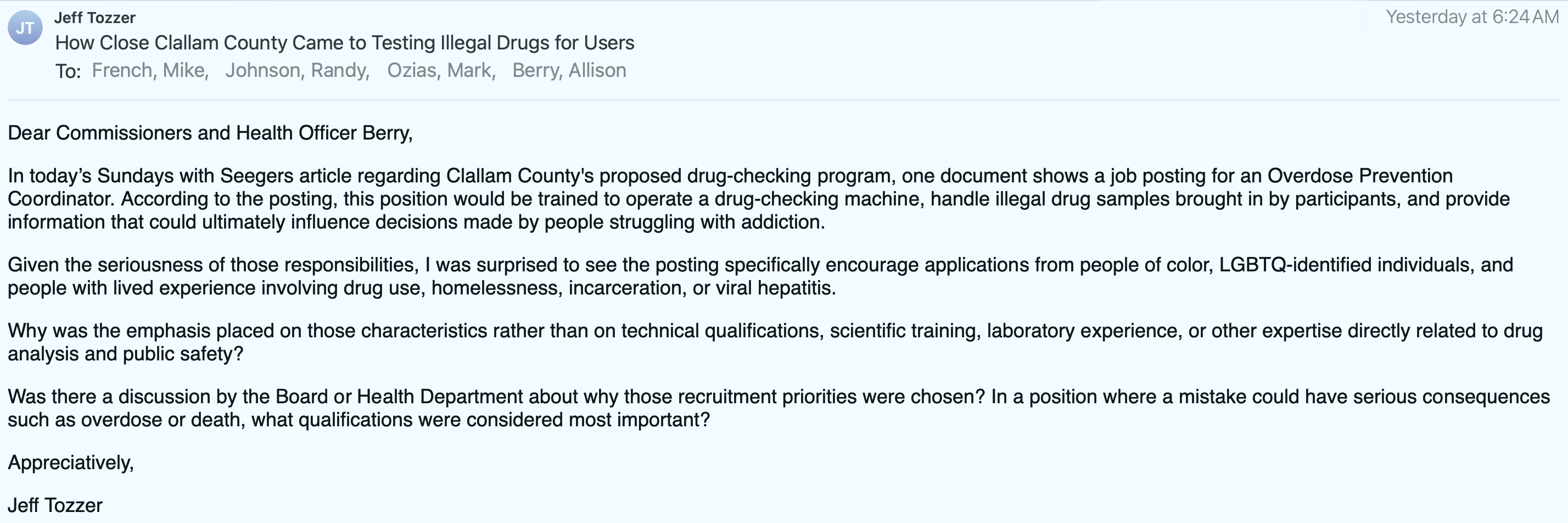
Public officials certainly have no obligation to answer. However, when they choose not to engage, citizens are left to rely on public meetings, public records, official presentations, and direct quotations.
Meanwhile, Rogers’ central question remains unanswered:
How much of the county’s addiction-response budget should be devoted to making drug use safer, and how much should be devoted to helping people stop using drugs altogether?
As overdose deaths, homelessness, and public disorder continue to dominate local conversations, it’s going to become harder for local leadership to dodge that question.
What Can You Do?
The future direction of harm reduction in Clallam County will ultimately be determined by elected officials and public health leaders—but they need to hear from the people they serve.
If you have thoughts about the county’s approach to harm reduction, drug testing, overdose prevention, or the use of taxpayer resources, consider sharing them with the Board of County Commissioners and Health Officer Dr. Allison Berry.
All three county commissioners can be reached through the Clerk of the Board at loni.gores@clallamcountywa.gov.
Dr. Berry can be reached directly at allison.berry@clallamcountywa.gov.
You can also make your voice heard during public comment at the next Board of Health meeting today, Tuesday, June 16, at 1:30 p.m. in the Commissioners Boardroom at the Clallam County Courthouse in Port Angeles. Public comment is available both in person and via Zoom.
Whether you support the county’s current approach, oppose it, or believe changes are needed, local government works best when citizens participate. Make your voice part of the conversation.
Today’s Tidbit: A Look Back
The debate over public health and misinformation is not new in Clallam County. In September 2021, the Board of Health unanimously passed a resolution praising Dr. Allison Berry's leadership during the COVID-19 pandemic, describing her as a patient, compassionate, science-based voice during a difficult time. Board members also warned that misinformation was undermining public health efforts and condemned threats and intimidation directed at county staff. Five years later, many of the same questions about expertise, public trust, and dissent remain at the center of public debate.