

According to an attendee’s emails, obtained through a public records request, Sequim Deputy Mayor Nicole Hartman told a Habitat for Humanity focus group that CC Watchdog’s author was out to harm community organizations, then brought up a play that portrayed me as a dog who eats human feces. Hartman’s comment “was met with laughter” according to the atttendee. Hartman used her city email to set up a coffee meeting with that attendee to talk it over. When CC Watchdog asked the same questions, she cited confidentiality and said not to use her city email. This isn’t a story about hurt feelings. It’s about what our leaders say about the public when they think we aren’t listening.
A Focus Group That Changed the Subject
Earlier this year, Habitat for Humanity of Clallam County hired Beam Consulting to gauge community support for a possible capital campaign for its two planned housing developments. Part of that work was a series of focus groups with “potential donors, civic leaders, and other community members familiar with Habitat’s work,” according to Habitat CEO Colleen Robinson.
Port Angeles resident David Rogers was invited to one of them. According to his account, the virtual session included Sequim Deputy Mayor Nicole Hartman, Sequim City Councilmember Harmony Rutter, and two other people. Rogers says he had never met any of them. The others seemed to know each other, and several seemed to know the facilitator.
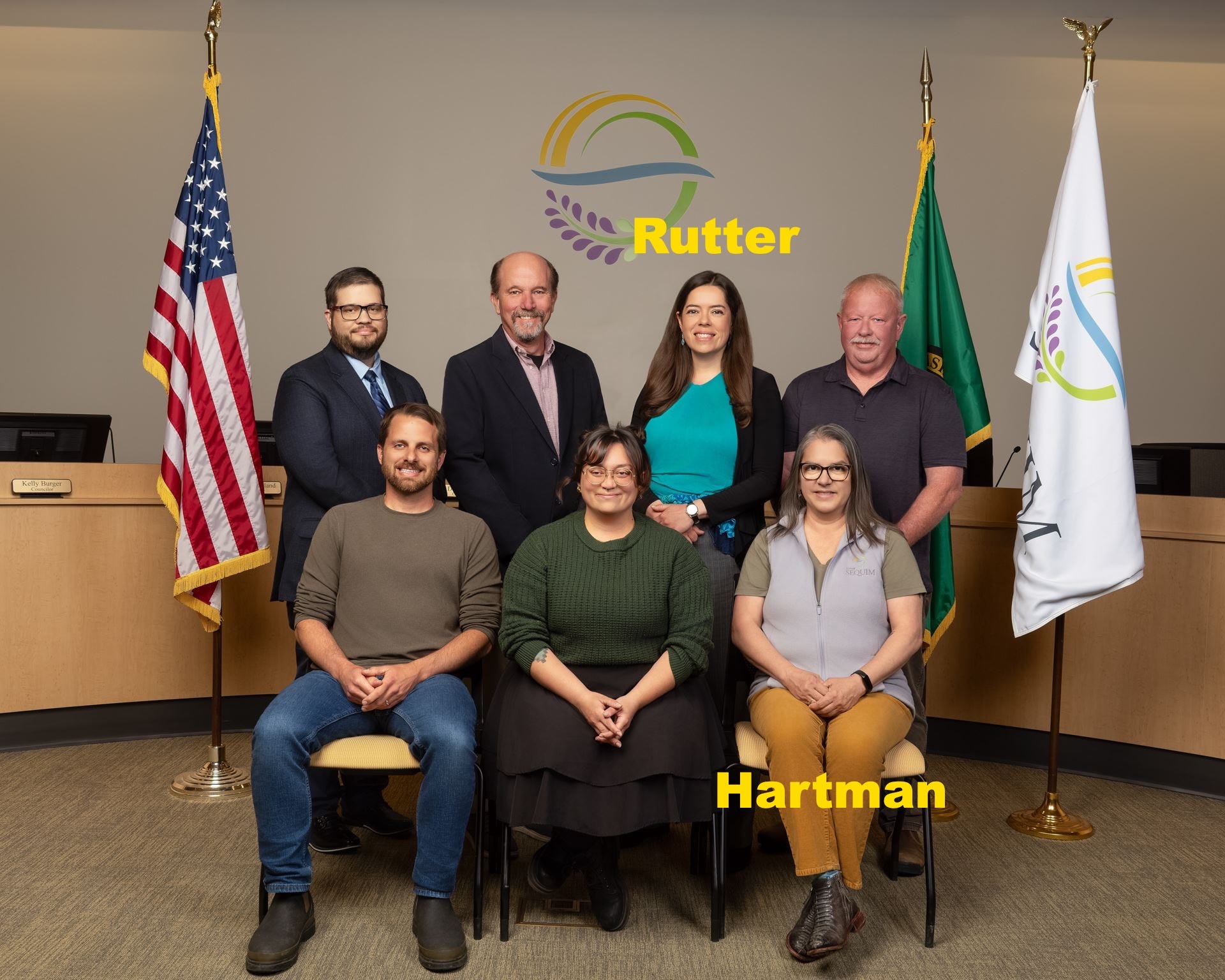
“Shortly after the meeting began, the conversation shifted toward Mr. Tozer and his work with Clallam County Watchdog,” Rogers wrote in a Nov. 18 statement to CC Watchdog. “Ms. Hartman expressed concerns about Mr. Tozer, suggesting that he had a history of disrupting or attempting to harm community organizations such as Habitat for Humanity.”
The session was supposed to be about Habitat’s fundraising. Instead, a sitting deputy mayor steered it toward a private citizen who writes about local government.
“As someone unfamiliar with the other participants,” Rogers wrote, “I was particularly struck by how naturally the conversation moved in that direction.”
The Play, the Dog, and the Punchline
Then the talk turned to the Lavender Melodrama.
Olympic Theatre Arts staged the play during this year’s Lavender Festival. It featured “The Watchdog,” a floppy-eared dog who spread rumors as facts, cried whenever he was challenged, and happily carried off a paper bag of human excrement to eat. Many people who saw it, including a CC Watchdog subscriber who emailed me before Clallamity Jen and I ever bought tickets, took the character as a stand-in for Clallam County Watchdog. CC Watchdog wrote about the production in July:
When Your Hometown Theater Turns You Into a Villain

In a front-row seat at Olympic Theatre Arts’ 2026 Lavender Melodrama, I watched a thinly veiled caricature of myself — dressed as a floppy-eared dog — devour a bag of human excrement, sob about his lineage, and conspire with “Pioneer Pete,” a stand-in for old Sequim families who dare resist change. What began as local satire revealed itself as a deliber…
To be fair to the theater: the playwright, OTA Executive Director David Herbelin, died before the play was performed. When CC Watchdog asked whether the character was based on a real person, OTA Operations Manager Deanna Eickhoff replied that guessing at Herbelin’s intentions “would be conjecture on all of our parts,” and added, “As the character is not named specifically I would guess that the character is purely fictional, but we will never know.”
The theater didn’t claim a connection. Deputy Mayor Hartman apparently made one.
According to Rogers, Hartman “asked who had seen the performance and spoke about how humorous she found it, seemingly connecting the play and its portrayal of a character known as the Watchdog to Mr. Tozer.” In his Aug. 6 email to her, he wrote that the play “seemed to be mentioned in connection with Mr. Tozzer and was met with laughter.”
So the sequence, as Rogers describes it, went like this. First, the critic is cast as a threat to community organizations. Then a play showing him eating human feces is brought up, and the room laughs.

No Examples
Rogers didn’t let it go. On Aug. 6, he emailed Hartman at her city address and asked her directly: “If you believe Mr. Tozzer’s work has been intended to harm community organizations, I would genuinely appreciate hearing specific examples.”
She offered to meet. They met on Aug. 11.
According to Rogers, she couldn’t give him that example.
“As I recall, she was unable to provide an example demonstrating malicious intent,” Rogers wrote. “She acknowledged that she had never personally met Mr. Tozer and explained that her concerns were more related to how he sometimes presents information.”
Hartman told him she couldn’t confirm the character was meant to be Tozzer because she hadn’t written the play. She also said that even if it was, she didn’t believe it was necessarily malicious. Rogers’ answer: “intent and impact are two different things.”
So an elected official told a room of community leaders that a citizen was trying to harm local organizations. She had never met him. When she was asked for an example, according to the only account on the record, she didn’t have one.
Fine Over Email for Him. “Confidential” for Us.
On Nov. 12, CC Watchdog emailed Deputy Mayor Hartman. The email laid out what the records showed and asked six questions, including whether Rogers’ account matched her memory and whether she was attending as deputy mayor, a Habitat volunteer, or a private citizen. It also offered a phone call or coffee.
Her full reply, on Nov. 15:
“Mr. Tozzer
I attended a focus group session on my own personal behalf, NOT as a city representative, at which the facilitator indicated that the discussion was confidential. Therefore I will not be sharing anything further. In the future please contact me about anything personal via a means outside of my city email.”
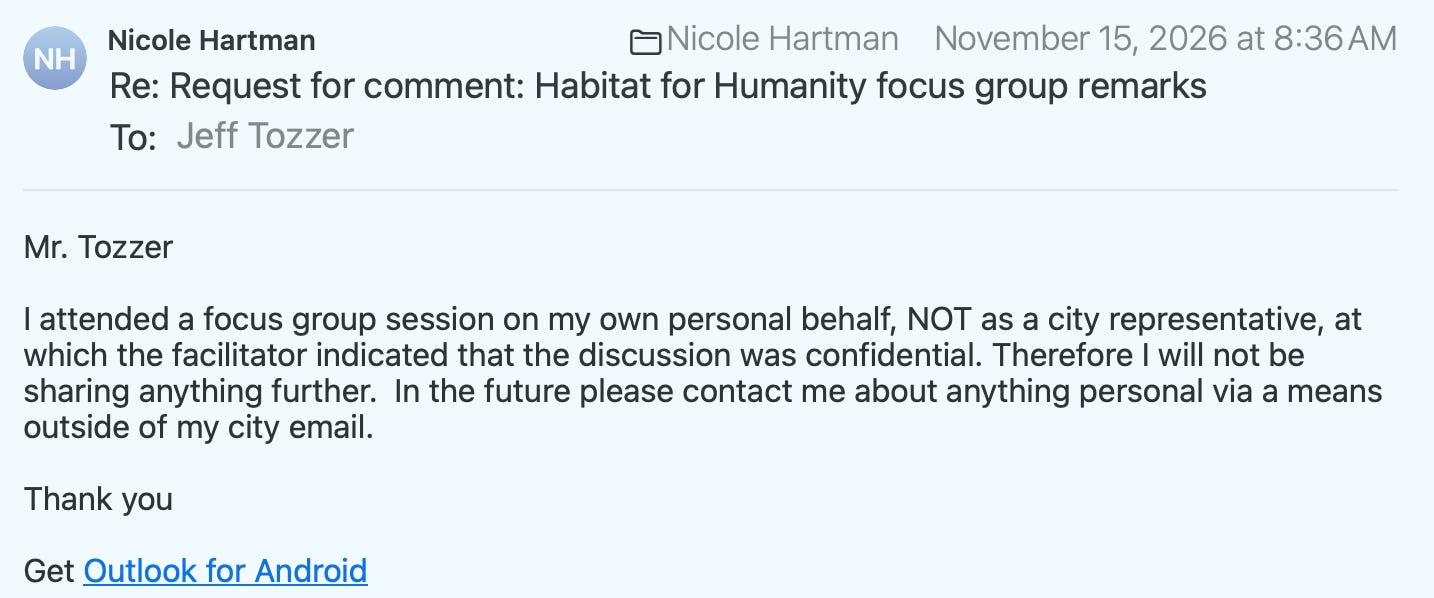
Hartman did not provide means to communicate outside her city email. Now compare that with the public records.
When David Rogers emailed her city address about the very same focus group, she didn’t cite confidentiality. She didn’t tell him the matter was personal. She didn’t ask him to use another account. Within seven hours, she replied from nhartman@sequimwa.gov: “I would be happy to meet with you to discuss.”

Over the next four days, she used that same city account to set the time and place. Her last message: “That sounds perfect. See you tomorrow!”
So the same topic, the same session, and the same city email account got two very different responses. When the questions came from one attendee, she offered coffee. When they came from the person who was talked about, she called it confidential.
If the subject was too personal for a city inbox, why did she use her city inbox to arrange a meeting about it? Those emails exist because they were released in response to a public records request.
Habitat doesn’t back her up on confidentiality either. Asked whether its focus groups normally require it, Robinson wrote:
“Our affiliate had not previously conducted focus groups, so we have no prior practice to point to. I can’t confirm what participants were told about confidentiality in the session you describe.”
Then there’s the “personal behalf” claim. Rogers, who had never met Hartman, says she was “introduced and identified by her title as deputy mayor.”
“In fact, I would not have recognized her or known her position had she not been identified by her public title,” Rogers wrote. “From my perspective, she was participating as Deputy Mayor Nicole Hartman, not simply as a private citizen.”
The study sought out “civic leaders.” Hartman was introduced as one. She was speaking about a citizen who reports on the government she helps run. It is hard to see how that was a purely personal matter.
Even Rogers, who had praised her for meeting with him, says he has had second thoughts. He wrote that her response to CC Watchdog “raises questions for me about whether the preference for in-person or private communication was motivated entirely by a desire for constructive dialogue or, at least in part, by a desire to keep these conversations outside the public record.”
Not the First Unanswered Email
This isn’t the first time a question to Deputy Mayor Hartman has gone unanswered.
In March, public records showed that Jamestown Tribe Chairman and CEO Ron Allen emailed Sequim’s mayor a pre-written letter of support for federal legislation to transfer the Dungeness and Protection Island National Wildlife Refuges into trust for the Tribe. The letter the City prepared to send was identical to Allen’s draft, word for word. CC Watchdog reported it here:
Sequim’s “Letter of Support” Wasn’t Written by Sequim

A letter supporting the transfer of federal refuge land wasn’t drafted by Sequim officials—it was handed to them. Emails show the Mayor moved quickly to put it on the agenda, unchanged, until public pushback forced a pause.
Every public commenter on the issue opposed it. In April, the council approved the letter anyway:
Sequim Council Backs Tribal Takeover of Wildlife Refuges

On Monday night, the Sequim City Council approved a Jamestown-drafted letter backing a refuge transfer—despite unanimous public opposition. Federal filings show the Jamestown Corporation opposes added restrictions and favors a streamlined trust process, leaving future access and use subject to change. And there’s a local precedent: land once open to the…
CC Watchdog wrote to the full council at the time through the Sequim city clerk, the official contact for all councilmembers, including Hartman. The email criticized the council for rubber-stamping a template written by the party that stood to gain the land. It argued that the council was putting a sovereign nation’s interests ahead of the people who elected it, and it asked questions. Hartman never replied.
So Ron Allen sent a draft letter, and the City adopted it as written. A resident sent questions and got no answer. A focus group attendee sent concerns and was offered coffee. CC Watchdog was told the matter was confidential.
Habitat’s Answers, and Habitat’s History
To its credit, Habitat answered CC Watchdog this time, and its answers belong in this story.
In a Nov. 17 reply, Robinson said Beam Consulting wrote the questions and ran the sessions “without any Habitat team members or Board members present.” She said Habitat expects “people to speak respectfully about others in discussions held as part of Habitat’s work,” but has no firsthand knowledge of what was said. And she wrote that “No public funds paid for Beam Consulting’s feasibility study or its focus groups.”
She also addressed the $800,000 in Clallam County Opportunity Funds approved for Lyon’s Landing in Carlsborg. When Habitat chose to focus on its Sequim Avenue project, she wrote, the money couldn’t be shifted, so Habitat released it back to the Opportunity Fund. “HFH did not draw on any of the funds,” she wrote. Local news reports from October confirm that Habitat let the expired agreement go without drawing any of the money. Habitat’s news release said the decision followed, among other things, “the findings of an independent capital campaign feasibility study.”
After CC Watchdog sent Robinson the full email exchange, she wrote back on Nov. 18: “I understand why the account raised questions for you.”
That’s a fair and professional response, and it should be acknowledged. It is also more than CC Watchdog got from Habitat the last time it asked questions.
In late 2024, Habitat announced what it called the nation’s first “Native American Housing Liaison.” It followed a $50,000 donation from the Jamestown S’Klallam Tribe. CC Watchdog asked to see the job description. The concern was simple. A race-specific position, partly paid for with public grant money, might be discriminatory. The job description could have put that concern to rest in five minutes. Habitat declined to share it. As a nonprofit, that was its right.
Habitat for who, exactly?

Habitat for Humanity’s good intentions are clear—but as millions in public funding flow in and political partnerships deepen, the questions get harder to ignore.
In early March 2025, Habitat invited CC Watchdog to meet with then-board president Mark Hodgson, CEO Colleen Robinson, and then-Vice President Danny Steiger, who has since succeeded Hodgson as president. CC Watchdog accepted. The meeting never happened. Habitat never scheduled it.
Commissioners to award $800k to Habitat this week

Clallam County is poised to grant $800,000 in public funds to Habitat for Humanity—but key questions about transparency remain unanswered. Despite promises of openness, Habitat has withheld documents, backed out of a meeting, and cited questionable incidents to justify cutting off dialogue. The line between nonprofit mission and public accountability ha…
With no meeting and no job description, the only option left was to lay out the facts for readers and let them decide. That’s what CC Watchdog did:
Missed opportunity?

With the County’s economy on life support, are the right demographics being targeted with resources? Prioritizing those who are “further from privilege.” A single mother’s story. If Ozias says so, it must be true. One week in, Habitat for Humanity stumbles in its commitment to transparency.
Habitat for Humanity or Habit for Hypocrisy?

Habitat for Humanity of Clallam County says it's making history with the creation of a "Native American Housing Liaison"—but refuses to release the job description, raising serious questions about transparency, favoritism, and the real intent behind the role. As taxpayer dollars and donor funds swirl around no-bid contracts and race-specific outreach, r…
Is that what “harming community organizations” looks like? Asking for a job description, accepting a meeting, and publishing the organization’s own response in full?
Response from Habitat for Humanity

Habitat for Humanity of Clallam County’s Board Vice President sent the following letter to Clallam County Watchdog.
Whose Money, Whose Room?
Habitat may not have paid for this study with public money. But Habitat is not a private hobby club. It has drawn millions in public funding.
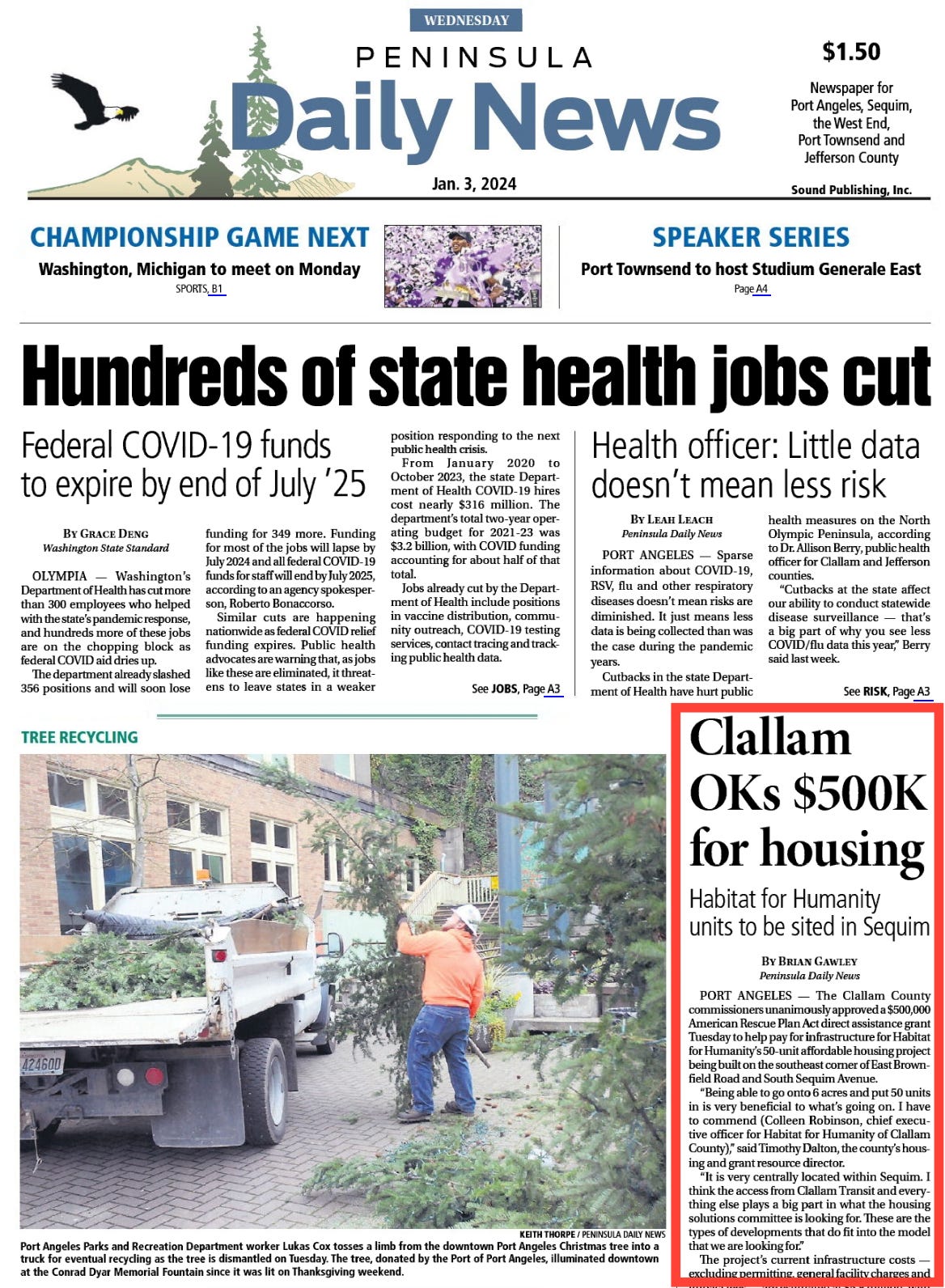
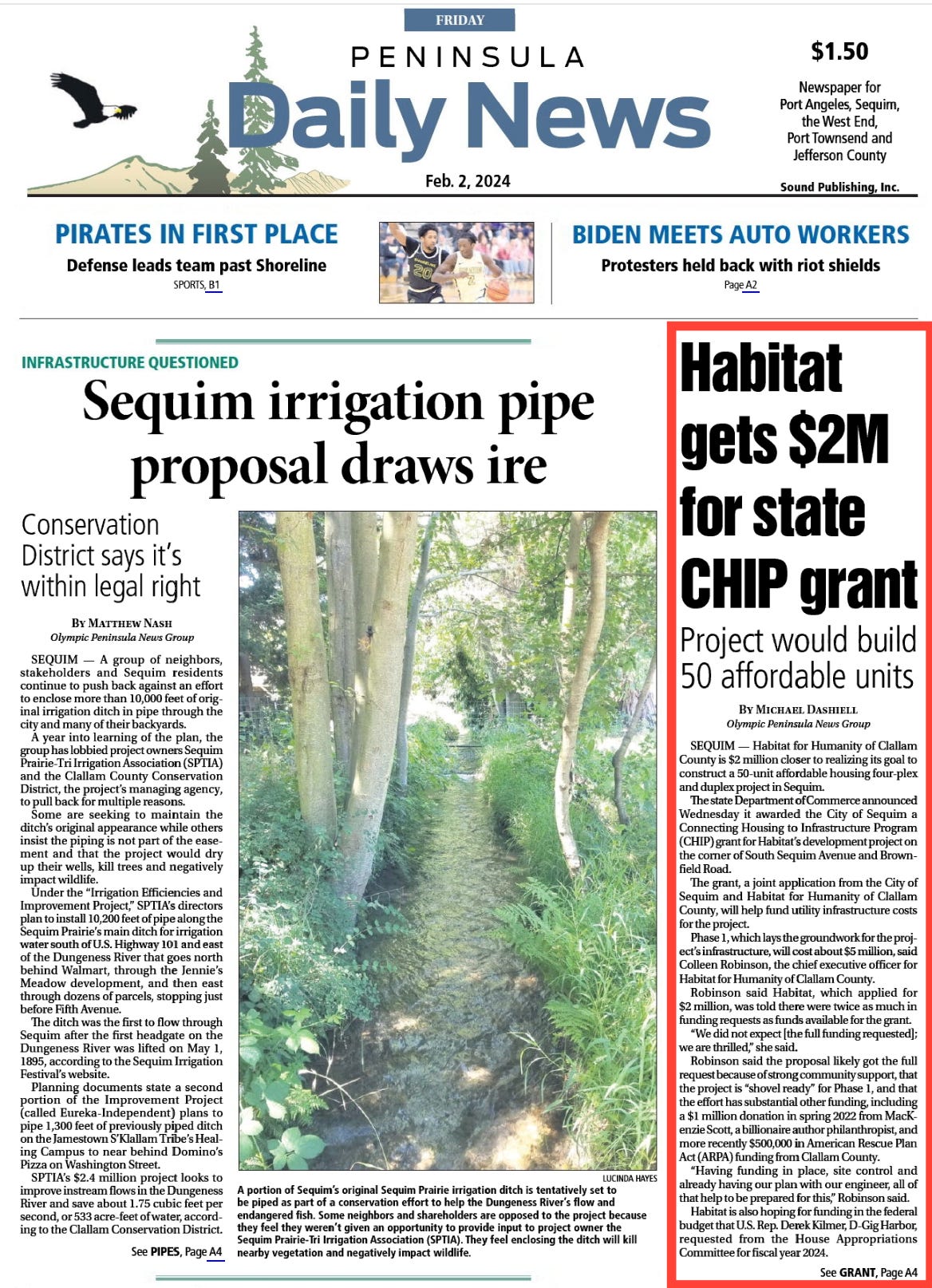
The City of Sequim is Habitat’s partner on that $2 million state grant. Two Sequim councilmembers sat in that focus group.
Habitat says it expects people to speak respectfully. Nobody is saying Habitat scripted what happened. But when an organization that runs on taxpayer money invites elected officials into a closed-door session, and the session turns into a roast of a taxpayer who asks questions, it is fair to ask:
Should taxpayer-funded organizations be holding confidential sessions with elected officials at all?
If they do, who protects the citizens who get discussed there and can’t respond?
And does an elected official who is introduced by her title get to call it private when someone asks her about it later?
The Real Problem: A County That Only Talks to Itself
This story isn’t really about one deputy mayor, one focus group, or one bad joke. It’s about how local governments in Clallam County are run.
Here is how the system works:
NGOs come to see public money as theirs by right.
Elected officials hand it over, often with few questions.
Because the money keeps coming, the NGOs never have to answer the public.
And because the officials who hand it over sit in the same rooms, on the same boards and at the same fundraisers, nobody on the inside has much reason to answer the public either.
In that system, the taxpayer who asks a question isn’t treated as the person paying the bills. He’s treated as the problem. He’s a pest who gets in the way of people who have already decided that they know best. That’s why a deputy mayor can describe a citizen she has never met as a threat to community organizations, and it takes an outsider, later, to ask for a single example. It’s why a play showing that citizen eating human feces is something to laugh about rather than something to question.
Our community leaders have built a whole network of focus groups, committees, task forces, advisory boards and nonprofit boards, and they fill the seats with people who already agree with them. Inside those rooms, almost nobody pushes back. Members nod along and egg each other on, reassuring one another that their views are the only reasonable ones and that anyone outside the room is ignorant, hateful or stupid. For a live example, attend a Board of Health meeting chaired by Commissioner Mike French, alongside the other commissioners and Health Officer Dr. Allison Berry. Then they walk out of those rooms and make decisions about our money, our land and our towns.
That’s an echo chamber. It isn’t governance.
The best evidence for this didn’t come from CC Watchdog. It came from someone outside the club. David Rogers had never met anyone in that room. He was there to talk about Habitat’s fundraising. What he saw was a group of people who already knew each other drift “naturally,” in his words, into mocking a citizen. And he saw that it drew laughter.
“The ease with which the discussion shifted toward criticizing a local citizen left me wondering whether this reflects the type of conversations that occur when the public is not present,” Rogers wrote to Hartman in August.
That question is the whole point of this story. What else gets said, and decided, in rooms the public can’t see?
Rogers also put it in a way that should apply to everyone who holds public office or spends public money: “Outside scrutiny should not automatically be viewed as an attack.”
In Clallam County, too often, it is.
What Happens Now
Rogers asked for something simple: a real conversation. “I encouraged her to consider that having an actual conversation with someone can sometimes change how we perceive them,” he wrote. The offer for coffee in CC Watchdog’s Nov. 12 email still stands.
Until then, readers can do what this county’s leaders seem to dislike most. They can ask questions.
Call to action:
Email the Sequim City Council at clerk@sequimwa.gov. Ask whether councilmembers who are introduced by their titles at taxpayer-funded nonprofits’ events are speaking as officials. Ask whether a deputy mayor should describe a constituent she has never met as a threat to community organizations. And ask why one citizen’s concerns were worth a coffee meeting while another’s were “confidential.”
Email Habitat for Humanity of Clallam County at info@habitatclallam.org. Ask it to adopt a written policy for future focus groups that protects private citizens from being targeted, and to make clear whether participants are told the sessions are confidential.
Show up at Sequim City Council meetings and speak during public comment. They can decline your email. They have a harder time ignoring you in person.
Share this article with anyone who has ever asked a local official a question and gotten silence back.
The full email exchange appears below so readers can judge it for themselves.
The Full Email Exchange
Emails are reproduced as received. Security banners have been removed. Times are Pacific. The August 2026 emails were obtained through a public records request.
* * *
1. David Rogers to Deputy Mayor Nicole Hartman
From: David Rogers
To: Nicole Hartman <nhartman@sequimwa.gov>
Sent: Thursday, Aug. 6, 2026, 7:56 AM
Subject: Comments regarding Mr Tozzer
Dear Deputy Mayor Hartman,
I am writing regarding comments you made about Jeff Tozzer during the Habitat for Humanity focus group in which we both participated. I have spent considerable time reflecting on those remarks and have tried to move past them, but they continue to weigh on me.
During the discussion, you suggested that Mr. Tozzer is attempting to harm or undermine community organizations. I respectfully disagree with that characterization. In my view, those who seek transparency are not the ones creating problems for these organizations. Rather, resistance to transparency poses a far greater threat, particularly at a time when public trust in institutions is already strained.
Do you believe journalists and engaged citizens should not examine the spending and decision making of government agencies and nonprofit organizations? Are you suggesting that oversight is best left entirely to those within the organizations themselves, without independent review or public reporting?
I do not know Mr. Tozzer well, nor do I agree with him on every issue. What I have observed, however, is someone who brings a different perspective and is willing to ask difficult questions when others may not. He has also helped build a community of residents who submit public records requests, attend meetings, and raise concerns when they believe something deserves closer scrutiny. When those concerns are dismissed simply because they originate with Mr. Tozzer, it can feel as though the voices of many engaged citizens are being dismissed as well.
If you believe Mr. Tozzer’s work has been intended to harm community organizations, I would genuinely appreciate hearing specific examples. Our community has recently experienced significant issues, including the fraud case involving the Port Angeles pool, which serves as a reminder of why independent oversight and accountability remain so important.
I was also surprised when the conversation shifted to the “Lavender Melodrama,” which seemed to be mentioned in connection with Mr. Tozzer and was met with laughter. I am not sure what connection you were drawing. My understanding is that OTA has stated the production was not intended to target Mr. Tozzer. If you have information that suggests otherwise, I would appreciate hearing it. Likewise, if there were aspects of the production that you found humorous in relation to Mr. Tozzer, I would be interested in understanding your perspective.
What concerned me most was not simply the comments themselves, but that they occurred in a room of local community leaders during a meeting intended to focus on Habitat for Humanity’s future. The ease with which the discussion shifted toward criticizing a local citizen left me wondering whether this reflects the type of conversations that occur when the public is not present. That possibility concerns me because respectful engagement with differing viewpoints is essential to maintaining public trust.
I am not writing to create conflict. Rather, I hope to better understand your perspective and to encourage a broader conversation about the importance of transparency, accountability, and respectful dialogue, even when we disagree.
Thank you for your time and consideration. I look forward to your response.
Sincerely,
David Rogers
2. Hartman to Rogers
From: Nicole Hartman <nhartman@sequimwa.gov>
To: David Rogers
Sent: Thursday, Aug. 6, 2026, 2:44 PM
Subject: Re: Comments regarding Mr Tozzer
I would be happy to meet with you to discuss. I do have some flexibility in my schedule so we could meet for coffee before or after your work schedule?
Nicole
Sent from my Verizon, Samsung Galaxy smartphone
Get Outlook for Android
3. Rogers to Hartman
From: David Rogers
To: Nicole Hartman <nhartman@sequimwa.gov>
Sent: Monday, Aug. 10, 2026, 8:05 AM
Subject: Re: Comments regarding Mr Tozzer
Sorry for the delayed response! The weekend flew by, and I realized this morning that I never got back to you.
It looks like I could meet tomorrow, Tuesday the 11th, in the afternoon between work and my daughter’s BMX. Would around 3:30 PM work for you?
If tomorrow doesn’t work, I could also meet next Tuesday around the same time. Let me know if either of those options works for you. If not, I’m sure we can find another time that does!
Thanks,
David
4. Hartman to Rogers
From: Nicole Hartman <nhartman@sequimwa.gov>
To: David Rogers
Sent: Monday, Aug. 10, 2026, 9:15 AM
Subject: Re: Comments regarding Mr Tozzer
3:30 tomorrow works great. Where is a convenient place for you?
Sent from my Verizon, Samsung Galaxy smartphone
Get Outlook for Android
5. Rogers to Hartman
From: David Rogers
To: Nicole Hartman <nhartman@sequimwa.gov>
Sent: Monday, Aug. 10, 2026, 9:37 AM
Subject: Re: Comments regarding Mr Tozzer
Im open to suggestions. First thought was Dungeness River Nature center. They have a coffee stand and I believe it is open until 4pm. Might be easier to find a nice quiet spot to talk outside there than a traditional coffee shop.
David
6. Hartman to Rogers
From: Nicole Hartman <nhartman@sequimwa.gov>
To: David Rogers
Sent: Monday, Aug. 10, 2026, 9:40 AM
Subject: Re: Comments regarding Mr Tozzer
That sounds perfect. See you tomorrow!
Sent from my Verizon, Samsung Galaxy smartphone
Get Outlook for Android
7. CC Watchdog to Deputy Mayor Hartman
From: Jeff Tozzer
To: Nicole Hartman <nhartman@sequimwa.gov>
Sent: Thursday, Nov. 12, 2026, 4:26 PM
Subject: Request for comment: Habitat for Humanity focus group remarks
Dear Deputy Mayor Hartman,
I’m Jeff Tozzer, author of Clallam County Watchdog (ccwatchdog.com). I’m writing because I’m working on a story, and I’d like to include your perspective.
Through a public records request, I obtained an email exchange from August 2026 between you and David Rogers. In his Aug. 6 email, Mr. Rogers described remarks about me made during a Habitat for Humanity focus group you both attended. He wrote that you suggested I was trying to “harm or undermine community organizations,” and that the Lavender Melodrama came up in connection with me and “was met with laughter.” The records also show you offered to meet with him, and the two of you arranged to talk on Aug. 11.
I want to be fair, and I know an email gives only one person’s account of a conversation. So I’d welcome your side of it. Any or all of these questions would help:
How do you recall the discussion at the focus group, and does Mr. Rogers’ description match your memory?
Do you believe my reporting has harmed, or been intended to harm, community organizations? If so, which ones, and how?
What led to the Lavender Melodrama coming up in that discussion? For context, I wrote about the production here: When Your Hometown Theater Turns You Into a Villain (https://www.ccwatchdog.com/p/when-your-hometown-theater-turns).
Was the focus group a Habitat for Humanity event, and were you attending as deputy mayor, a Habitat volunteer, or a private citizen?
How did your meeting with Mr. Rogers go, and did it change your view?
Is there anything else you’d like readers to know?
If possible, please reply by this Sunday, Nov. 15, at noon. If I don’t hear back by then, I’ll note that you declined to comment. I’m also glad to talk by phone or meet for coffee if you’d prefer that to writing.
Thank you for considering it. I’d genuinely like to hear your perspective.
Respectfully,
Jeff Tozzer
Clallam County Watchdog
8. Hartman’s reply to CC Watchdog (Nov. 15, 2026)
Mr. Tozzer
I attended a focus group session on my own personal behalf, NOT as a city representative, at which the facilitator indicated that the discussion was confidential. Therefore I will not be sharing anything further. In the future please contact me about anything personal via a means outside of my city email.
Thank you
9. CC Watchdog to Habitat for Humanity of Clallam County
From: Jeff Tozzer
To: info@habitatclallam.org; colleen@habitatclallam.org
Sent: Sunday, Nov. 15, 2026, 1:50 PM
Subject: Request for comment: Habitat focus group and public funding
Hello,
I’m Jeff Tozzer, author of Clallam County Watchdog (ccwatchdog.com). I’m working on a story and would like to include Habitat for Humanity’s perspective.
Through a public records request, I obtained an August 2026 email exchange about a Habitat for Humanity focus group. In that exchange, one attendee described a discussion in which I was named, said I was trying to “harm or undermine community organizations,” and wrote that a local theater production featuring a character based on me “was met with laughter.” Sequim City Councilmember Nicole Hartman, who attended, has told me she was there on her own behalf and that the facilitator said the discussion was confidential.
I’d appreciate Habitat’s answers to any or all of these questions:
Was this focus group a Habitat for Humanity event? Who organized and facilitated it?
Do Habitat focus groups normally ask participants to keep the discussion confidential? If so, why?
How were participants chosen? Were any invited because of their roles as elected officials or community leaders?
Does Habitat consider it appropriate for a private citizen to be named and discussed at one of its sessions? Does it have a policy on that?
Does any public funding support Habitat’s focus groups or community outreach?
Is there anything else you’d like readers to know?
If possible, please reply by Friday, Nov. 20, at noon. If I don’t hear back by then, I’ll note that Habitat did not respond. I’m also happy to talk by phone if you’d prefer.
Thank you for your time.
Respectfully,
Jeff Tozzer
Clallam County Watchdog
10. Colleen Robinson’s reply to CC Watchdog (Nov. 17, 2026)
Hi Jeff,
Thank you for reaching out. I understand why you’d have questions after reading an account that mentioned you by name. I appreciate the opportunity to explain Habitat’s role.
Who organized the sessions and why? Habitat hired Beam Consulting to assess community support for a possible capital campaign for two proposed affordable housing developments in Clallam County. A capital campaign raises money toward a specific goal over a set period of time. Beam Consulting developed the questions and led the sessions without any Habitat team members or Board members present.
Confidentiality. Our affiliate had not previously conducted focus groups, so we have no prior practice to point to. I can’t confirm what participants were told about confidentiality in the session you describe.
Who participated. The study sought perspectives from potential donors, civic leaders, and other community members familiar with Habitat’s work. I can speak to why those perspectives mattered to the study, but I can’t confirm the reason for any individual invitation.
The reported remarks. We expect people to speak respectfully about others in discussions held as part of Habitat’s work. I don’t have firsthand knowledge of the conversation you describe, so I can’t say how your name came up or what was said.
Public funding. No public funds paid for Beam Consulting’s feasibility study or its focus groups. Government funding is nearly always specific to a project or initiative; for example, the Opportunity Funds that were approved for Lyon’s Landing – when it became clear that HFH needed to focus on a single project, these funds for Lyon’s Landing could not be internally reallocated to Sequim Avenue, and as such, Habitat Clallam released the funding back to CC Opportunity Fund. It’s worth noting that HFH did not draw on any of the funds, so the full $800,000 was not actually drawn upon at any point.
Would you be willing to share the August email exchange? I’d appreciate the chance to read the account that prompted your concern.
Thank you,
Colleen Robinson
Chief Executive Officer
Habitat for Humanity of Clallam County
Note: CC Watchdog shared the Rogers/Hartman email exchange with Robinson.
11. Statement from David Rogers to CC Watchdog (Nov. 18, 2026)
Statement Regarding the Habitat for Humanity Focus Group and Subsequent Correspondence with Deputy Mayor Nicole Hartman
Mr. Tozer [sic] recently contacted me requesting additional context regarding an email exchange between myself and Sequim Deputy Mayor Nicole Hartman, which he obtained through a public records request. The correspondence originated from concerns I raised following a Habitat for Humanity focus group in which both Ms. Hartman and I participated.
I appreciate the opportunity to provide some additional context, not only regarding the incident itself but also the broader concerns it raised for me about transparency, accountability, and the relationship between elected officials and the communities they represent.
The Habitat for Humanity Focus Group
In approximately August or September, I participated in a virtual focus group facilitated by Beam Consulting as part of Habitat for Humanity’s preparations for an upcoming capital campaign. Participants included myself, Deputy Mayor Nicole Hartman, Sequim City Council member Harmony Rutter, and two other individuals.
I had never met any of the other participants before this meeting. However, it appeared that the other participants were familiar with one another, and several seemed familiar with the facilitator as well.
Shortly after the meeting began, the conversation shifted toward Mr. Tozer and his work with Clallam County Watchdog. Ms. Hartman expressed concerns about Mr. Tozer, suggesting that he had a history of disrupting or attempting to harm community organizations such as Habitat for Humanity.
The conversation then transitioned to the Lavender Melodrama performed during this year’s Lavender Festival. Ms. Hartman asked who had seen the performance and spoke about how humorous she found it, seemingly connecting the play and its portrayal of a character known as the Watchdog to Mr. Tozer.
I found both portions of this conversation troubling.
We were gathered to provide insight into Habitat for Humanity’s fundraising efforts and its relationship with the community. Instead, the conversation had shifted toward discussing a local citizen and portraying his efforts to scrutinize community organizations as something potentially harmful.
As someone unfamiliar with the other participants, I was particularly struck by how naturally the conversation moved in that direction.
Transparency Should Be Welcomed, Not Feared
My understanding of Mr. Tozer’s work with Clallam County Watchdog is that much of it focuses on bringing greater transparency to local government and organizations that work closely with government agencies or receive public funding.
I believe transparency and accountability are essential to maintaining public trust, particularly when taxpayer dollars are involved.
If an organization is concerned that someone might investigate or publish information about its activities, I believe the appropriate response should be to ensure those activities are being conducted responsibly, ethically, and in accordance with applicable laws and regulations.
Outside scrutiny should not automatically be viewed as an attack.
In fact, I believe organizations should welcome accountability, even when it comes from individuals who may disagree with their leadership or decisions.
Organizations can become so focused on their missions that mistakes or oversights occur. Sometimes it takes someone outside the organization to recognize those issues and bring them forward.
When that happens, the appropriate response should be to acknowledge the concern, investigate it, and make corrections where necessary.
Even when correcting an issue is inconvenient or costly, doing so demonstrates integrity and a commitment to responsible stewardship.
I find it concerning when an individual asking questions or bringing attention to potential problems is characterized as a threat to an organization rather than someone contributing to public accountability.
My Meeting With Deputy Mayor Hartman
Following the focus group, I emailed Ms. Hartman requesting clarification regarding her statements about Mr. Tozer and the Lavender Melodrama.
Ms. Hartman responded by suggesting that we meet in person to discuss my concerns.
I want to emphasize that I genuinely appreciated her willingness to sit down with me and have what could have been a difficult conversation. I believe those types of face-to-face discussions are incredibly valuable, particularly when people have differing perspectives.
During our meeting, I asked Ms. Hartman whether she could provide specific examples of Mr. Tozer maliciously targeting or attempting to harm community organizations.
As I recall, she was unable to provide an example demonstrating malicious intent. She acknowledged that she had never personally met Mr. Tozer and explained that her concerns were more related to how he sometimes presents information.
Specifically, she expressed frustration that some of his articles leave questions or implications unresolved, creating what she perceived as a somewhat conspiratorial tone.
I can understand how that style of reporting might frustrate someone who feels their actions or intentions are being questioned.
However, I also attempted to explain why some community members may feel compelled to question the actions of local leadership.
When citizens feel excluded from conversations, dismissed for expressing opposing viewpoints, or treated differently because they question decisions, it naturally creates distrust.
That distrust is only reinforced when someone attends what should be a neutral community discussion and witnesses participants speaking negatively about a citizen whose primary offense, from their perspective, appears to be asking uncomfortable questions.
I believe the best way to address those concerns is through greater transparency, open communication, and a willingness to engage with people who hold opposing viewpoints.
Avoiding those conversations only creates more opportunities for speculation and misunderstanding.
The Lavender Melodrama
Another significant portion of our discussion involved the Lavender Melodrama and its apparent portrayal of Mr. Tozer.
I recognize that the individual who wrote this year’s production unfortunately passed away before the play was performed. As a result, we cannot definitively establish the writer’s intentions without additional evidence.
However, many people familiar with Mr. Tozer and Clallam County Watchdog interpreted the Watchdog character as a portrayal of him.
The fact that Ms. Hartman brought up the performance immediately following her comments about Mr. Tozer, and appeared to find that portrayal humorous, further reinforced my impression that the connection was understood by others as well.
During our meeting, Ms. Hartman explained that she could not confirm whether the character was intended to represent Mr. Tozer because she had not written the play. She also expressed that, even if it was intended to portray him, she did not believe it was necessarily done with malicious intent.
I explained that intent and impact are two different things.
Regardless of the writer’s intentions, the performance was received by some members of our community as an attempt to mock, belittle, and discredit an individual for his involvement in local civic issues.
I believe that deserves serious consideration.
If a similarly unflattering portrayal were created about another community member, particularly someone with different political or social views, I suspect many people would recognize how hurtful and inappropriate that could feel.
More importantly, Clallam County Watchdog is not simply Jeff Tozer.
It represents a broader network of engaged citizens who follow local issues, raise concerns, share information, and seek accountability from both governmental and nongovernmental organizations.
When we publicly ridicule or attempt to discredit someone who serves as a voice for those citizens, we risk sending a message to the broader community that speaking up may result in similar treatment.
I believe that type of behavior can discourage civic participation and deepen divisions within our community.
Disagreement is healthy. Public ridicule intended to silence or intimidate opposing viewpoints is not.
Concerns Regarding Public Communication
One aspect of this situation that has become increasingly concerning to me is the difference between my experience communicating with Ms. Hartman and what I have subsequently been told about her correspondence with Mr. Tozer.
I initially viewed her willingness to meet with me in person as a positive example of an elected official engaging directly with a concerned citizen.
However, I have since been informed that Ms. Hartman declined to discuss the matter with Mr. Tozer through her official email and suggested that the issue should be addressed through personal communication channels because she was not acting in her official capacity during the focus group.
If that characterization of her response is accurate, I find it disappointing.
It raises questions for me about whether the preference for in-person or private communication was motivated entirely by a desire for constructive dialogue or, at least in part, by a desire to keep these conversations outside the public record.
I cannot speak to Ms. Hartman’s intentions, and I do not want to suggest that I know her motivations. However, the circumstances have caused me to reconsider my initial impression of how the situation was handled.
I also find the distinction between her personal and official capacities difficult to reconcile with my experience during the focus group.
I understand that Ms. Hartman may not have been performing official city duties or participating on city time.
However, she was introduced and identified by her title as deputy mayor. Her role in local government was part of the context of her participation, and she spoke from the perspective of someone involved in local leadership.
I had never met Ms. Hartman before that meeting. In fact, I would not have recognized her or known her position had she not been identified by her public title.
From my perspective, she was participating as Deputy Mayor Nicole Hartman, not simply as a private citizen whose public position was unrelated to the discussion.
I am not attempting to make a legal determination regarding which communications are subject to public disclosure. However, I believe public officials should recognize that the distinction between their personal and official roles is not always as clear to the citizens interacting with them.
When a public title and position are used to establish someone’s role or credibility in a community discussion, I believe that comes with an expectation of accountability and transparency.
The Importance of Direct Dialogue
I remain disappointed to hear that Ms. Hartman has reportedly been unwilling to engage directly with Mr. Tozer regarding this incident.
During our conversation, she acknowledged that she had never met him personally. I encouraged her to consider that having an actual conversation with someone can sometimes change how we perceive them.
In my own interactions with Mr. Tozer, I have found him to be calm, approachable, and willing to have meaningful discussions.
I believe a conversation in which Ms. Hartman could explain her concerns, acknowledge any statements she might reconsider, and hear Mr. Tozer’s perspective would be far more productive than allowing this situation to remain unresolved.
None of us are perfect. We all make mistakes, say things we later regret, or form opinions about people without fully understanding their perspectives.
What matters is how we respond when those situations are brought to our attention.
A simple acknowledgment that something could have been handled differently, accompanied by a willingness to listen, can go a long way toward rebuilding trust.
Avoiding difficult conversations, on the other hand, often reinforces the very suspicions and divisions that make those conversations necessary in the first place.
Moving Forward as a Community
Ultimately, my concerns extend beyond this particular incident, Ms. Hartman, or Mr. Tozer.
I believe our community has developed an increasingly unhealthy tendency to divide people into opposing groups based on their political beliefs, personal associations, or willingness to support particular decisions.
Too often, disagreement is interpreted as hostility, questions are treated as attacks, and individuals who challenge established viewpoints are dismissed rather than heard.
I do not believe that approach serves anyone well.
Our elected officials, community organizations, and engaged citizens all have a responsibility to help create an environment where people can participate without feeling that their opinions will result in exclusion, ridicule, or retaliation.
That responsibility exists on all sides of the political spectrum.
We should be able to disagree strongly about policies, leadership decisions, and community priorities while still recognizing the humanity and good intentions of those with whom we disagree.
We should also be willing to acknowledge mistakes, accept constructive criticism, and extend the same understanding to others that we would hope to receive ourselves.
I appreciate that Ms. Hartman took the time to meet with me and discuss my concerns. That conversation was meaningful, and I do not want to diminish its value.
At the same time, I believe the concerns surrounding the original focus group and the subsequent handling of this issue deserve to be addressed openly.
My hope is that this experience can serve as an opportunity for reflection rather than another reason for division.
Our community will be better served when we stop viewing those who question us as adversaries and start recognizing that meaningful accountability, respectful disagreement, and open dialogue are essential parts of a healthy community.
We do not have to agree with one another to treat each other with dignity and respect.
David Rogers
12. Colleen Robinson’s follow-up after receiving the exchange (Nov. 18, 2026)
Hi Jeff,
Thank you for sending the exchange. I’ve read it, and I understand why the account raised questions for you. I appreciate you sharing it and giving Habitat the opportunity to explain our role in the study.
Respectfully,
Colleen Robinson
Chief Executive Officer
Habitat for Humanity
Your description of how the NGO system operates leaves out three important steps: 5. All the members of the NGO, the NGO’s Board of Directors, and the beneficiaries of the NGO’s projects, love all the money the elected officials throw their way so they all support those elected officials in their next elections. 6. The elected officials love all the support the members of the NGO, the NGO’s Board of Directors, and the beneficiaries of the NGO’s projects give them in their elections, so the elected officials continue to throw more money to the NGO. 7. Because of the difficulty of applying the Public Records Act and the Open Meetings Act to NGOs these safeguards of good government are lost, and the merry-go-round continues.