


The Marine Resources Committee just told Commissioner Mark Ozias how to write Clallam County’s next 20 years: replace “should” with “shall,” treat climate forecasts as binding, and put a biologist on every Critical Areas and shoreline file. Chair LaTrisha Suggs signed the letter. Commissioners sell housing affordability while this blueprint makes property parcels, wells, and bulkheads cost more in consutlants and time — and leaves trust land, including the Tribe’s 122-acre golf course, off the same rulebook.
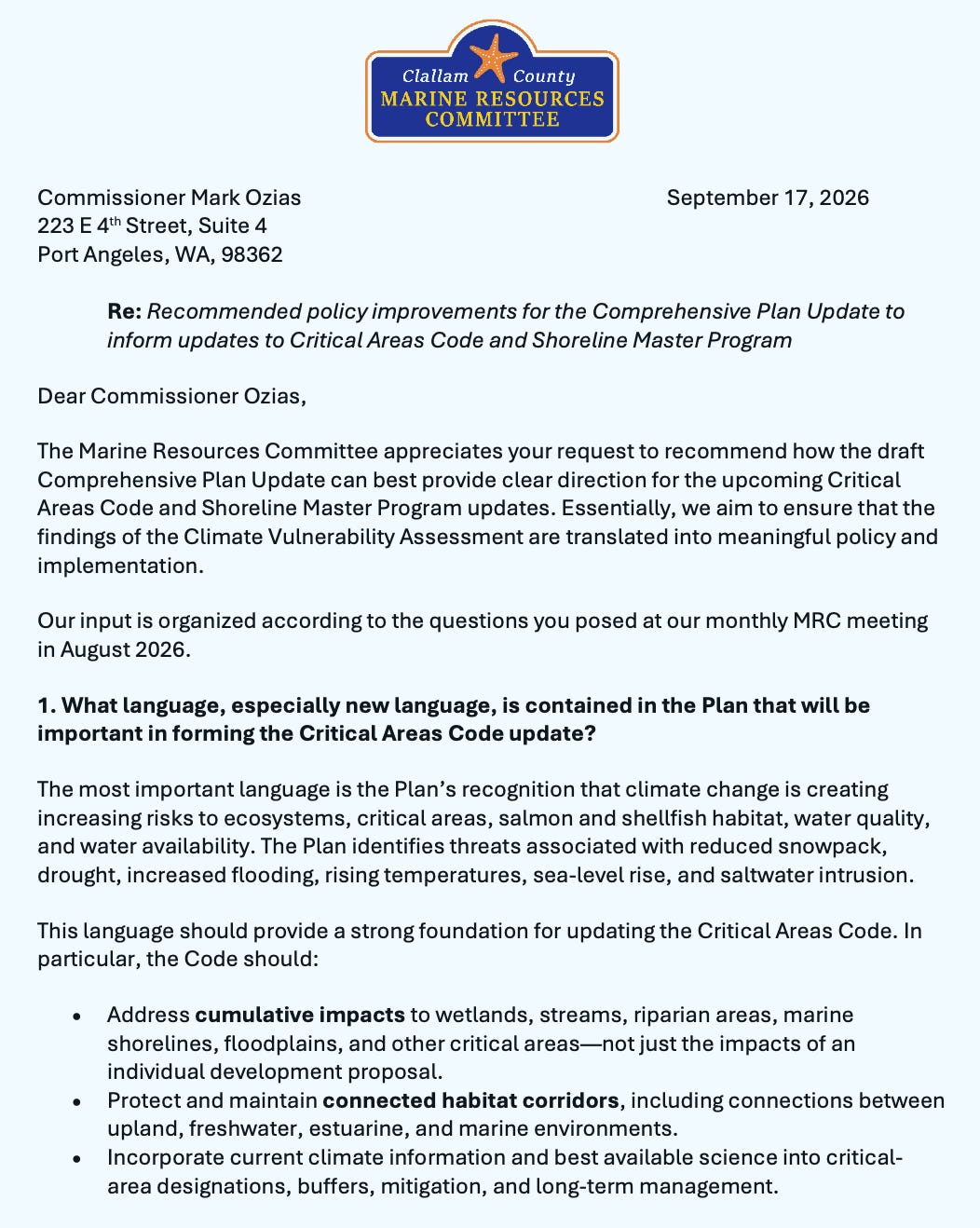
On September 17, 2026, the Clallam County Marine Resources Committee sent Commissioner Mark Ozias Recommended policy improvements for the Comprehensive Plan Update to inform updates to Critical Areas Code and Shoreline Master Program. The letter is not a mild suggestion. The intent is to hard-wire the 2026 Comp Plan so later codes have no room to dodge.
What the letter actually says
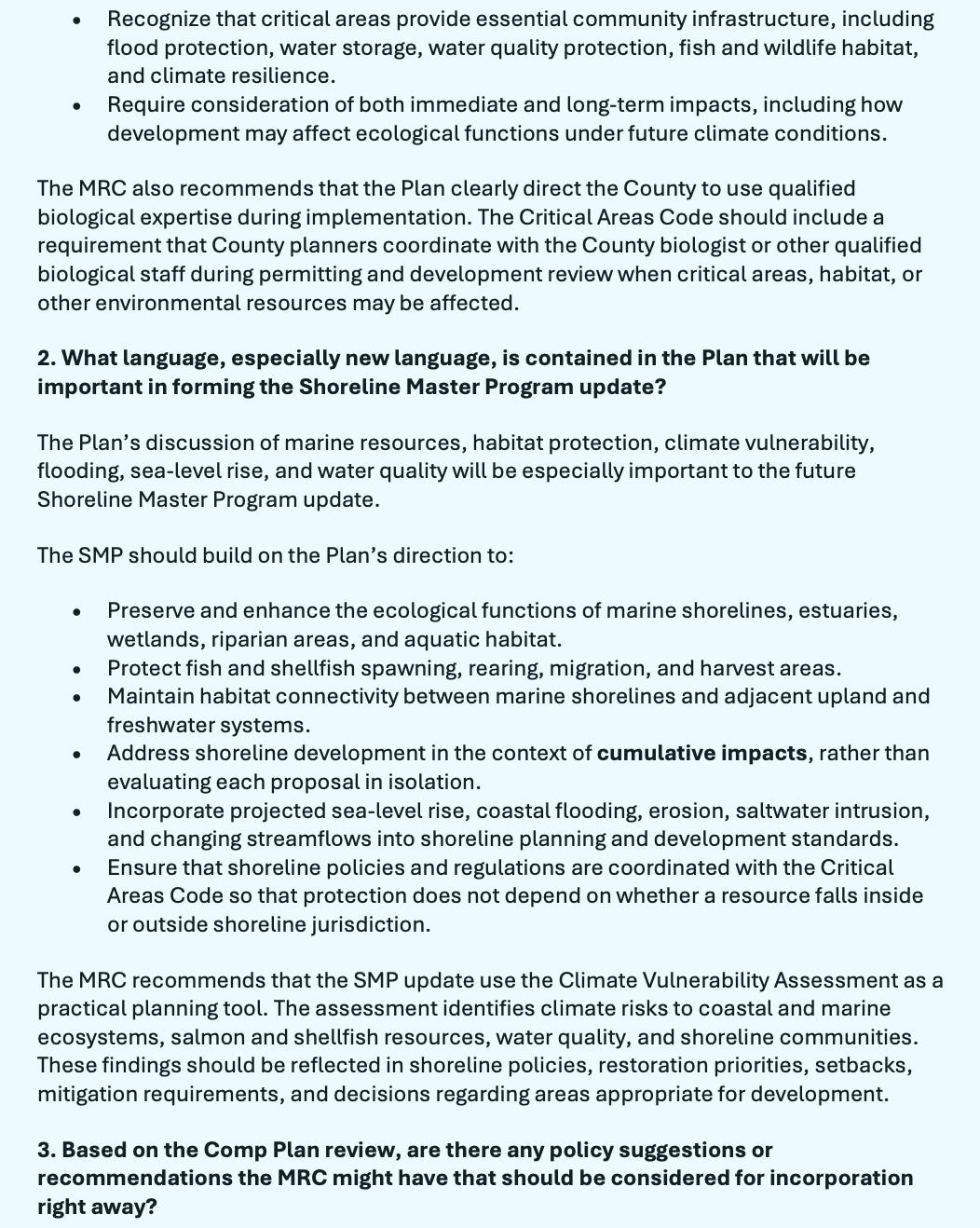
Suggs writes that the most important Comp Plan language is the recognition that climate change is creating “increasing risks to ecosystems, critical areas, salmon and shellfish habitat, water quality, and water availability,” including “reduced snowpack, drought, increased flooding, rising temperatures, sea-level rise, and saltwater intrusion.”
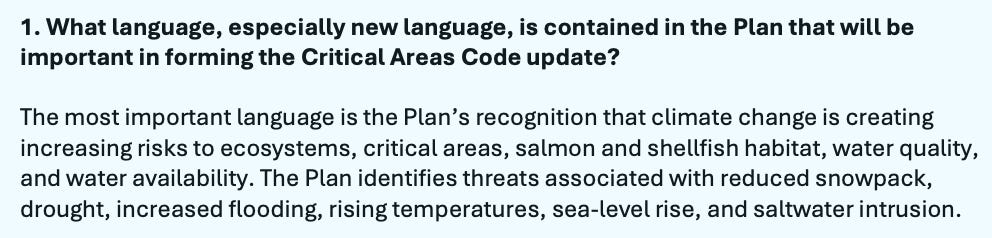
That language, the MRC says, “should provide a strong foundation for updating the Critical Areas Code.”
Then come the demands:
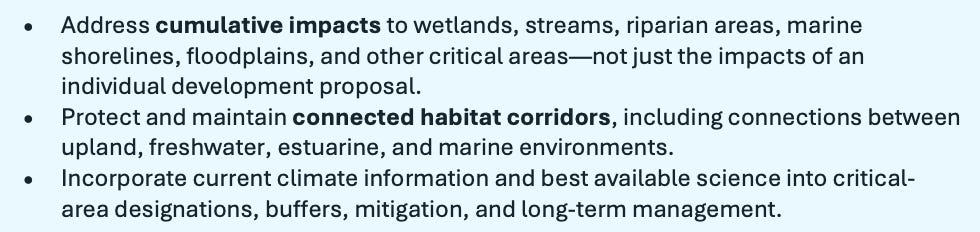
The Code should “Address cumulative impacts to wetlands, streams, riparian areas, marine shorelines, floodplains, and other critical areas—not just the impacts of an individual development proposal.” It should “Protect and maintain connected habitat corridors” from upland through marine environments. It should “Incorporate current climate information and best available science into critical-area designations, buffers, mitigation, and long-term management.”
And it should “Require consideration of both immediate and long-term impacts, including how development may affect ecological functions under future climate conditions.”

The MRC also wants the County to “use qualified biological expertise during implementation” and to put in the Critical Areas Code a requirement that “County planners coordinate with the County biologist or other qualified biological staff during permitting and development review when critical areas, habitat, or other environmental resources may be affected.”

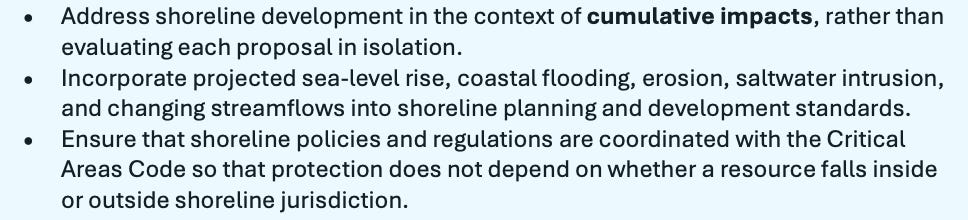
For the Shoreline Master Program, the letter wants the SMP to “Address shoreline development in the context of cumulative impacts, rather than evaluating each proposal in isolation,” and to “Incorporate projected sea-level rise, coastal flooding, erosion, saltwater intrusion, and changing streamflows into shoreline planning and development standards.”
Six asks that turn guidance into code
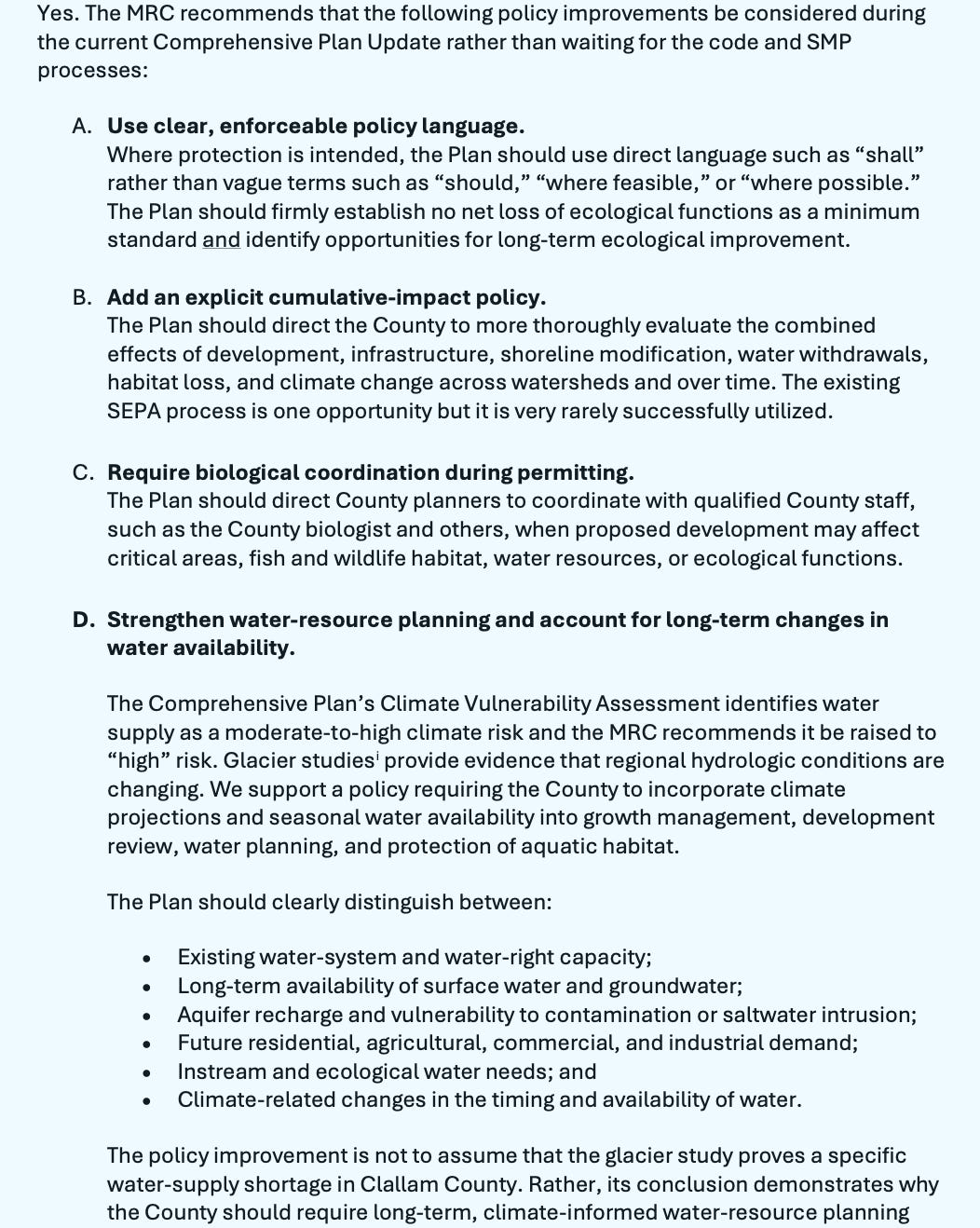
The policy punch list is even plainer:
A. Use clear, enforceable policy language.
“Where protection is intended, the Plan should use direct language such as ‘shall’ rather than vague terms such as ‘should,’ ‘where feasible,’ or ‘where possible.’ The Plan should firmly establish no net loss of ecological functions as a minimum standard and identify opportunities for long-term ecological improvement.”
B. Add an explicit cumulative-impact policy covering development, infrastructure, shoreline modification, water withdrawals, habitat loss, and climate change “across watersheds and over time.”
C. Require biological coordination during permitting with the County biologist whenever critical areas, habitat, or water resources “may be affected.”
D. Strengthen water-resource planning and raise water supply from “moderate-to-high” to “high” climate risk. Distinguish existing water-system and water-right capacity from long-term surface and groundwater availability, aquifer recharge, future demand, instream needs, and “Climate-related changes in the timing and availability of water.”
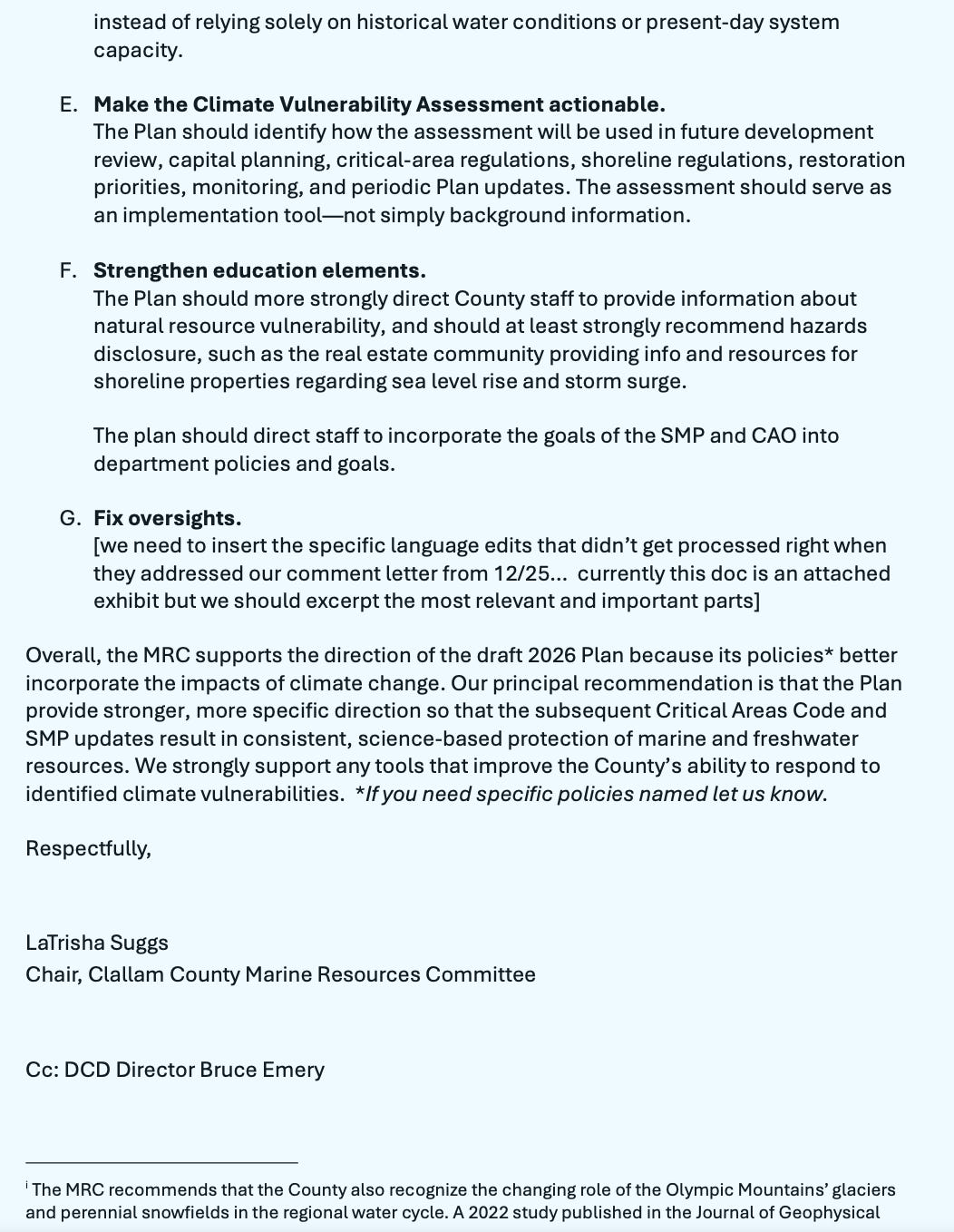
E. Make the Climate Vulnerability Assessment “an implementation tool—not simply background information.”
F. Push hazards disclosure so real estate agents tell shoreline owners about sea-level rise and storm surge.
A footnote: “The MRC recommends that the County also recognize the changing role of the Olympic Mountains’ glaciers and perennial snowfields in the regional water cycle.” A 2022 JGR Earth Surface study is attached: Olympic glaciers lost about 45 percent of their area between 1980 and 2015 and “will largely disappear by 2070.”
The closer: “Overall, the MRC supports the direction of the draft 2026 Plan because its policies better incorporate the impacts of climate change. Our principal recommendation is that the Plan provide stronger, more specific direction so that the subsequent Critical Areas Code and SMP updates result in consistent, science-based protection of marine and freshwater resources.”
Signed, LaTrisha Suggs, Chair. Cc: DCD Director Bruce Emery.

Affordability speeches, consultant invoices
A Comp Plan is the 20-year constitution of county land use. “Should” is guidance. “Shall,” “no net loss,” mandatory climate projections, countywide cumulative-impact review, and a biologist on every file that “may” touch habitat are instructions to planners and hearing examiners.
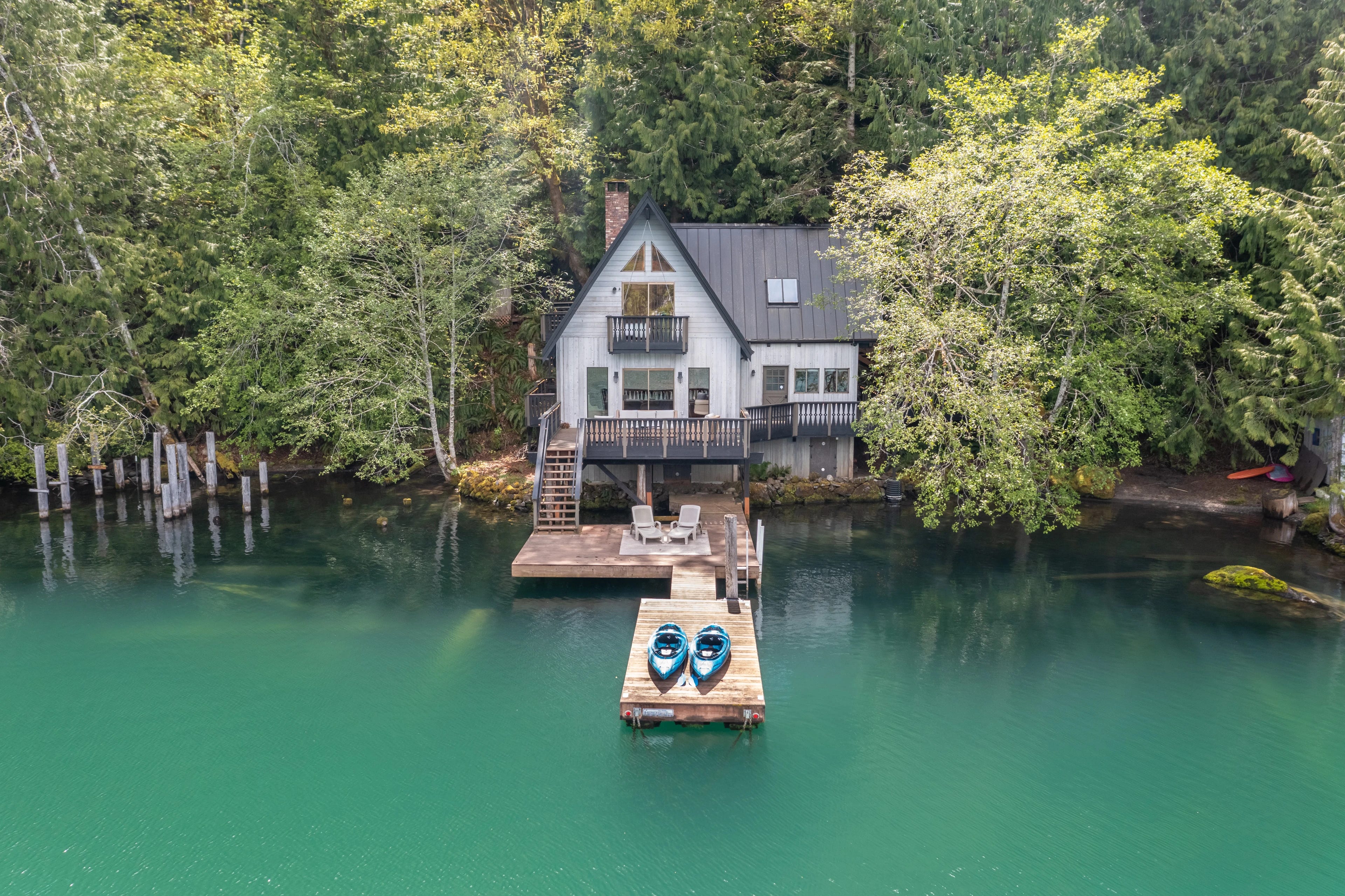
That is not free housing policy. It is staff time, third-party biologists, hydrology memos, climate addenda, mitigation plans, and appeal insurance. Every extra sign-off is months and thousands of dollars on a house, a shop, a well, or a shoreline repair. County commissioners run the campaigns on “housing affordability,” but this letter is how you price the next generation out of the lot they already own.
Who is exempt
Land held in federal trust is not Clallam County’s Critical Areas Code and not the Shoreline Master Program in the same way your tax parcel is. Sovereign land does not sit in the same permit line. The letter never says that. It never has to. The two-tier system is already the law.
The Jamestown Tribe bought the 122-acre Dungeness Golf Course in 2007, renamed it Cedars at Dungeness, and placed the course in trust in 2012. It is a water-intensive 18-hole operation in the same Dungeness basin where private wells get mitigation fees, metering lectures, and drought sermons.

The MRC letter raises water supply to “high” climate risk and wants the County to plan around glaciers, seasonal availability, and instream needs. It does not mention the golf course. It does not ask whether a 122-acre irrigated landscape should face the same “shall” standard as a family well.
That is not science. That is favortism.
How the land moves
Make private property expensive to use. Layer “shall,” no-net-loss, future-climate findings, and paid experts onto every permit. People leave, downsize, or sell. A well-capitalized buyer with federal acquisition dollars and a published Land Consolidation Area can purchase fee land and petition to convert it to trust. Once it is trust land, the new owner does not live under the same county codes imposed on the seller. That is an economic advantage over every other resident and enterprise that still pays property tax and still needs a county permit.
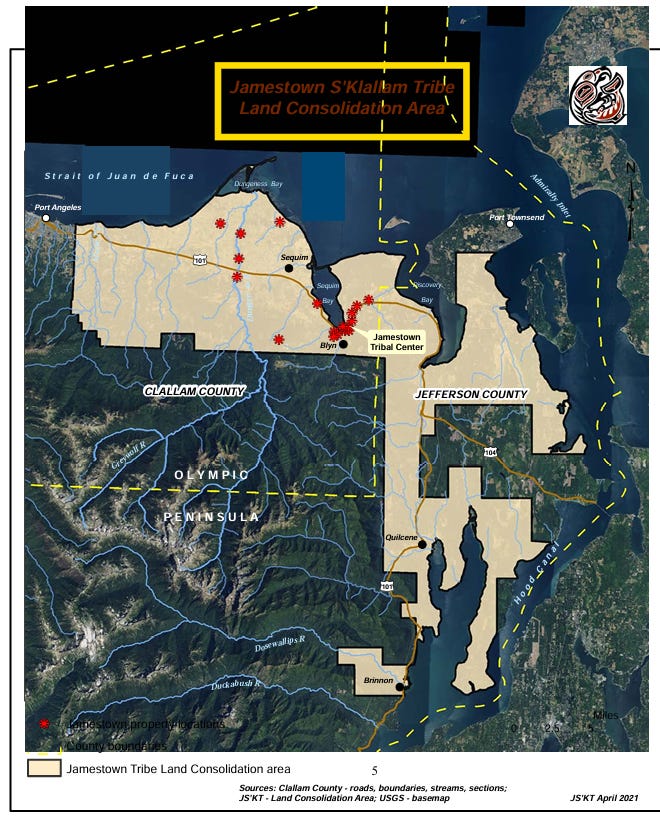
The Jamestown Tribe has already mapped a Land Consolidation Area across portions of Clallam and Jefferson — described in its own planning documents as spanning tens of miles and hundreds of square miles, with a Service Area matching those boundaries, from the Port Angeles / Morse Creek side of the map toward Hood Canal and Brinnon. Comp Plan language does not have to say “land back.” It only has to make private parcels harder to keep and easier to acquire.
The 3 Crabs precedent they already set
This is the same MRC that previously urged commissioners to consider “retreat or removal” of roads and homes along Three Crabs Road. That letter blamed climate and sea-level rise. It did not mention that the County and the Tribe removed an armored dike that the project’s own materials described as the barrier separating the estuary from the neighborhood.
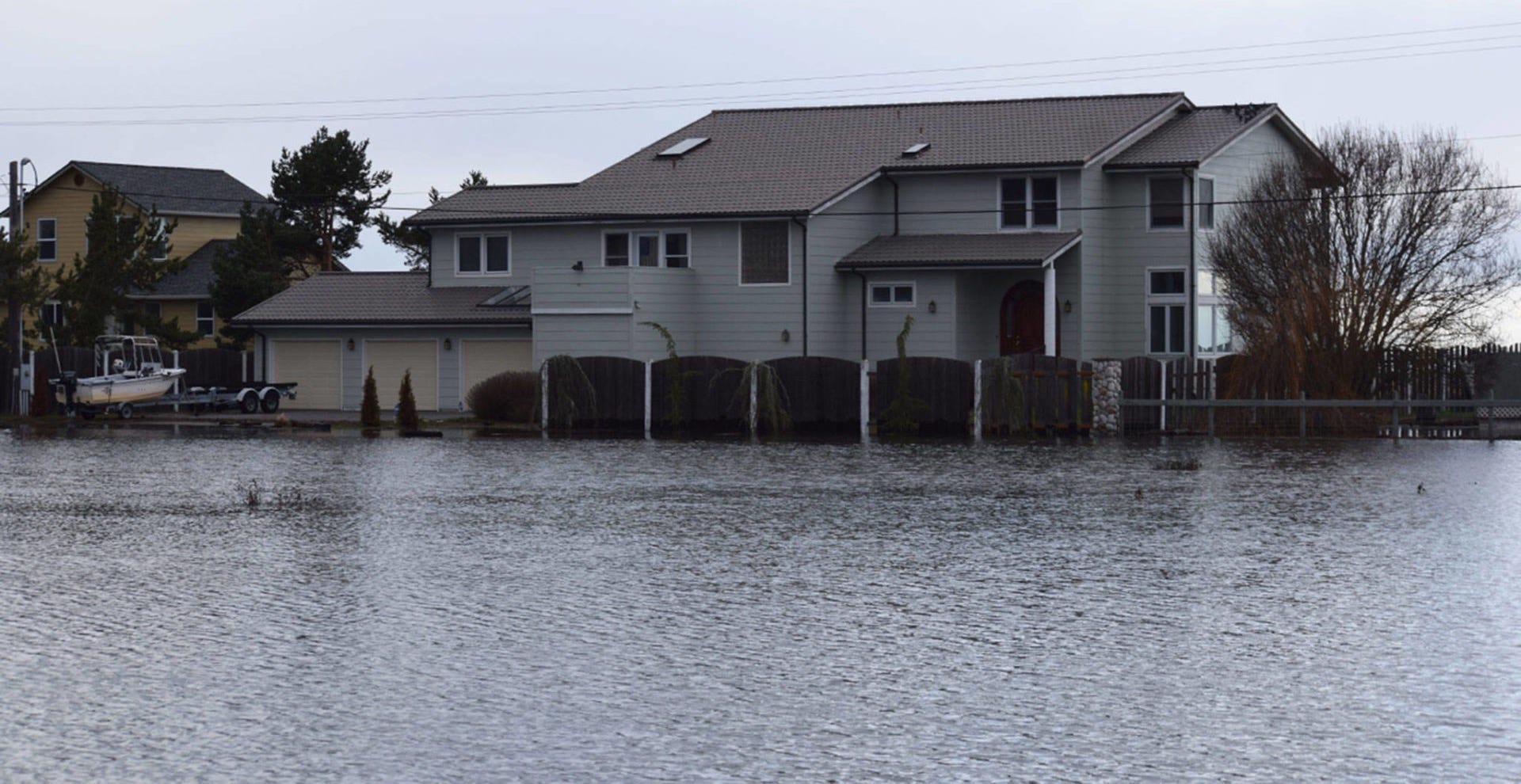
Residents documented worse flooding after that restoration. The MRC’s answer was not to restore the protection. It was to move the people.
Who is writing this
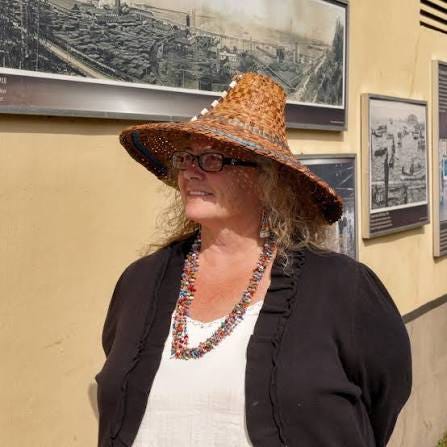
Suggs chairs the MRC. She is a Jamestown S’Klallam tribal member, a Port Angeles councilmember, and a public supporter of inserting U.N.-style Free, Prior and Informed Consent into the city’s 20-year plan.
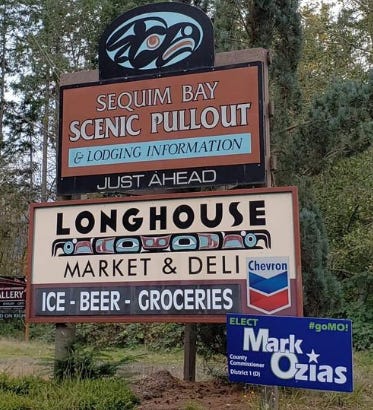
The Jamestown Tribe funded more than half of Ozias’s last campaign.
Ann Soule serves on the MRC and is a prominent Clallam County League of Women Voters activist.
The state League’s land acknowledgment states that Washington “is on the homelands of Native peoples who have lived here from time immemorial,” pledges to “amplify the voices of Indigenous people,” “partner with tribes,” and “respect the sovereignty of tribes and their rights to self-determination.”

The creeks they are not “shall-ing”
Tumwater and Peabody are salmon-bearing streams that have already undergone expensive restoration. They are now choked with garbage, needles, Mylar blankets, tents, human waste, and supplies from the County’s harm-reduction health center.


Encampments on city and county land sit in the same salmon streams the MRC wants fenced with “shall,” buffers, and paid biologists — for taxpayers, not for the tents. The letter has no comparable emergency for those streams. The enforcement energy runs toward shoreline owners, water rights, and future climate maps — not toward the open-air landfills on restored habitat a stone’s throw from the courthouse.
Tonight
Clallam Marine Resources Committee
Monday, September 21, 2026
5:30 p.m. – 7 p.m.
Hybrid: Board of County Commissioners Meeting Room, Clallam County Courthouse (after-hours entrance on 4th Street, left of the main doors). Click here for details.
Zoom Meeting ID: 837 6963 9254
Public comment is allowed.
Tell them “shall” is a cost.
Tell them a biologist on every file is not affordable housing.
Tell them trust land and a 122-acre irrigated golf course are the exemption that makes the rest of the letter a two-tier code.
Tell them 3 Crabs residents were told to retreat after a dike came out.
Tell them Tumwater and Peabody are still full of tents.
If you cannot be there, send it in writing to the county commissioners. All three can be reached by emailing the Clerk of the Board at loni.gores@clallamcountywa.gov. Include the Director of the Department of Community Development Bruce.Emery@clallamcountywa.gov.
The Plan sets the course for twenty years. The verbs decide who can still afford to stay.


