

Guest contributor Jake Seegers reminds us that last November, 59% of Clallam County voters said no to millions more in property taxes. Now commissioners are moving on two new standalone levies and a new sales tax worth about $3.2 million a year, with the veterans rate nearly tripled. No ballot this time. The levy hearing is Tuesday at 10:30 a.m.
The question voters already answered
Last November, Clallam County voters were asked a simple question:
Do you want to raise your property taxes to give county government millions of dollars more every year?
We answered.
No.
The county’s proposed levy lid lift would have increased the general property-tax levy rate from approximately $0.76 to as much as $0.95 per $1,000 of assessed value. At the time, I calculated that it would generate approximately $3.8 million in additional annual revenue. County officials said the increase was needed to address growing projected deficits.
Voters rejected it decisively.
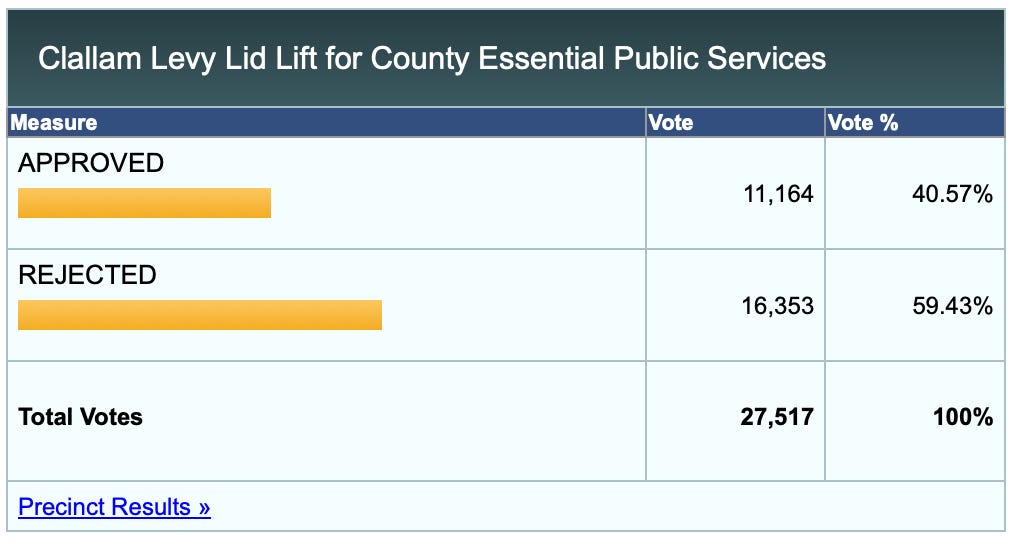
The final result was 59.43% opposed and 40.57% in favor. More than 16,000 Clallam County voters said no. (Washington Secretary of State)
The back door
One year later, the commissioners appear poised to accomplish much of the same thing through the back door.
Instead of asking voters for permission, they are considering a new 0.1% criminal-justice sales tax and separating the Veterans Relief and Developmental Disabilities levies from the county’s general levy.
Once fully implemented for an entire calendar year, these changes would collect roughly $3.2 million annually: about $2.35 million from the new criminal-justice sales tax and another $830,900 from the two standalone property-tax levies the commissioners take up Tuesday.
The county’s 2027 budget shows a smaller sales-tax number because the tax would take effect partway through the year. The draft budget projects approximately $1.519 million in 2027, assuming the tax takes effect in April and the county starts receiving collections in June. The county’s own finance forecast says a full year of the tax would add about $866,000 on top of the seven months in the recommended budget, which puts the full-year figure at roughly $2.35 million. (Olympic Herald)
And this time, voters don’t get to approve them first.
Moving these levies outside the general levy changes everything
Until now, Clallam County’s Veterans Relief and Developmental Disabilities levies have been funded as earmarks within the county’s general property-tax levy.
That distinction matters.
The county’s own documents acknowledge that these programs historically received their levy allocations from within the general-purpose property-tax levy. (Clallam County)
In other words, commissioners had to make choices.
Money allocated to these programs was money that wasn’t available somewhere else in the general fund.
That creates accountability.
But the Legislature changed the law in 2026 through ESHB 2442. Counties may now pull these levies outside the general levy and impose them as independent property taxes. The Department of Revenue makes another critical point: the first year a levy is separated, its amount is not limited to what was previously being collected within the general levy. (Washington Department of Revenue)
That is exactly what Clallam County is now proposing to do.
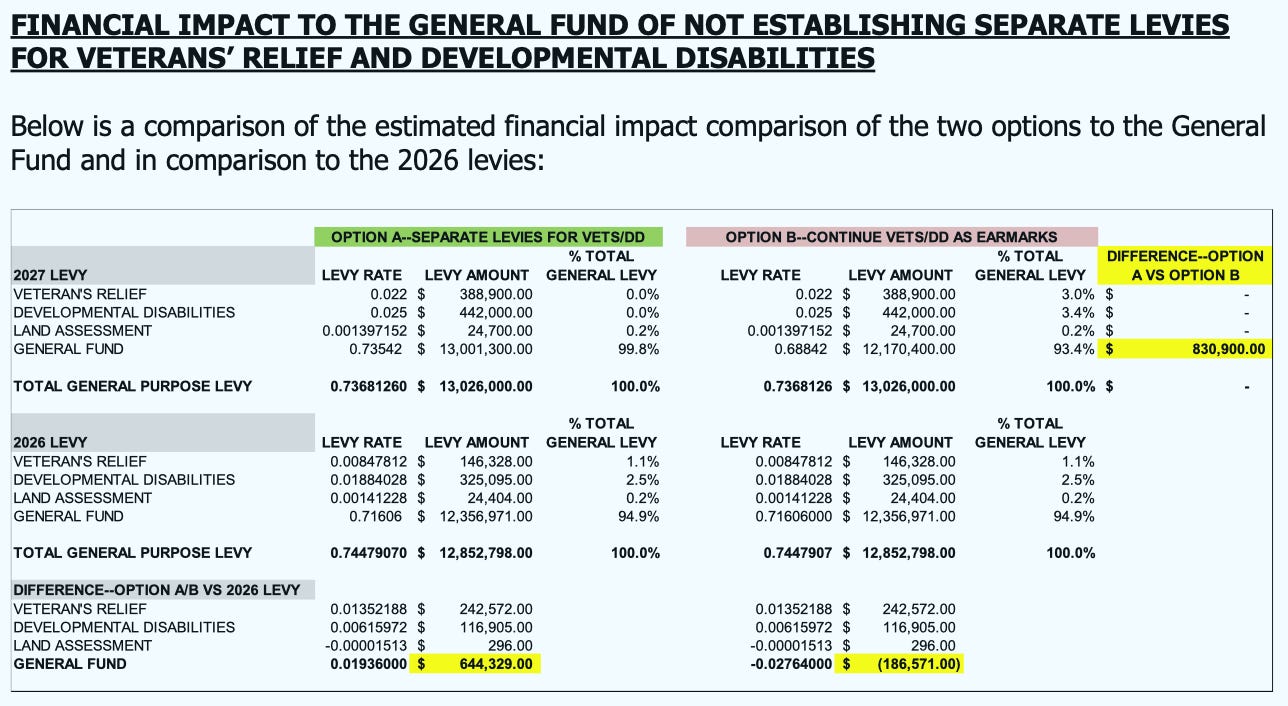
The proposed separate Veterans Relief levy would collect $388,900 in 2027, and the Developmental Disabilities levy would collect $442,000. Together, that’s $830,900 placed directly onto property-tax bills outside the county general levy.
For a $500,000 property, the county estimates the two levies would add $23.50 per year.
That may not sound like much.
Neither does $5 here, $10 there, or another tenth of a percent at the cash register.
But that is how government grows.
One “small” tax at a time.
Look at what they’re doing with the veterans levy
The Veterans Relief levy is particularly revealing.
In 2026, the county’s Veterans Relief rate was about $0.0085 per $1,000 of assessed value ($0.00847812), which raised $146,328.
State law sets a minimum rate of $0.01125 per $1,000. The maximum allowed rate is an extraordinary $0.27 per $1,000. (RCW 73.08.080)
The county is proposing $0.022 per $1,000 for 2027.
That is nearly triple this year’s rate (about 2.6 times) and nearly double the state minimum (about 1.96 times). In dollars, the veterans levy would jump from $146,328 to $388,900, an increase of $242,572.
The new state law does require the county to bring the veterans levy up to the statutory minimum. By the county’s own math, that would mean about $199,300 in 2027.
The commissioners are proposing nearly twice that.
Why? According to the memo, the $0.022 rate is what it takes to make the Veterans Relief Fund “completely self-supported” and to replace the $150,000 state grant supporting the county’s Veterans Service Officer, which the county says is “at high risk of being eliminated in 2027.”
The maximum allowed levy rate matters too.
Once the levy is separated, commissioners aren’t simply moving money from one accounting column to another. They are creating a standalone taxing mechanism with enormous statutory room above today’s rate. And the first year a levy is separated, it isn’t held to the 1% growth limit at all. (Washington Department of Revenue)
The Legislature handed counties that tool. The commissioners are choosing to use it—to cover a grant-funded position with a tax that voters don’t get to approve.
That story deserves some history.
The VSO grant was never guaranteed forever
The state’s Veterans Service Officer program wasn’t created during COVID, as I initially believed while researching this issue. It actually predates COVID.
The Legislature created the program in 2019 through 2SHB 1448 to provide funding for VSOs in underserved counties. Clallam was one of the original counties receiving funding and also served Jefferson County through the program.
But there is an important phrase in the history of that program:
“Subject to appropriation.”
In other words, state funding was never guaranteed forever.
We saw that uncertainty as early as 2023.
That year, proposed legislative budgets threatened to eliminate funding for Clallam and other counties. The Washington State Association of Counties warned that Clallam could lose its VSO funding and lobbied the Legislature to restore it. Ultimately, lawmakers provided additional appropriations to continue the program.
The county nevertheless built the position into its service structure.
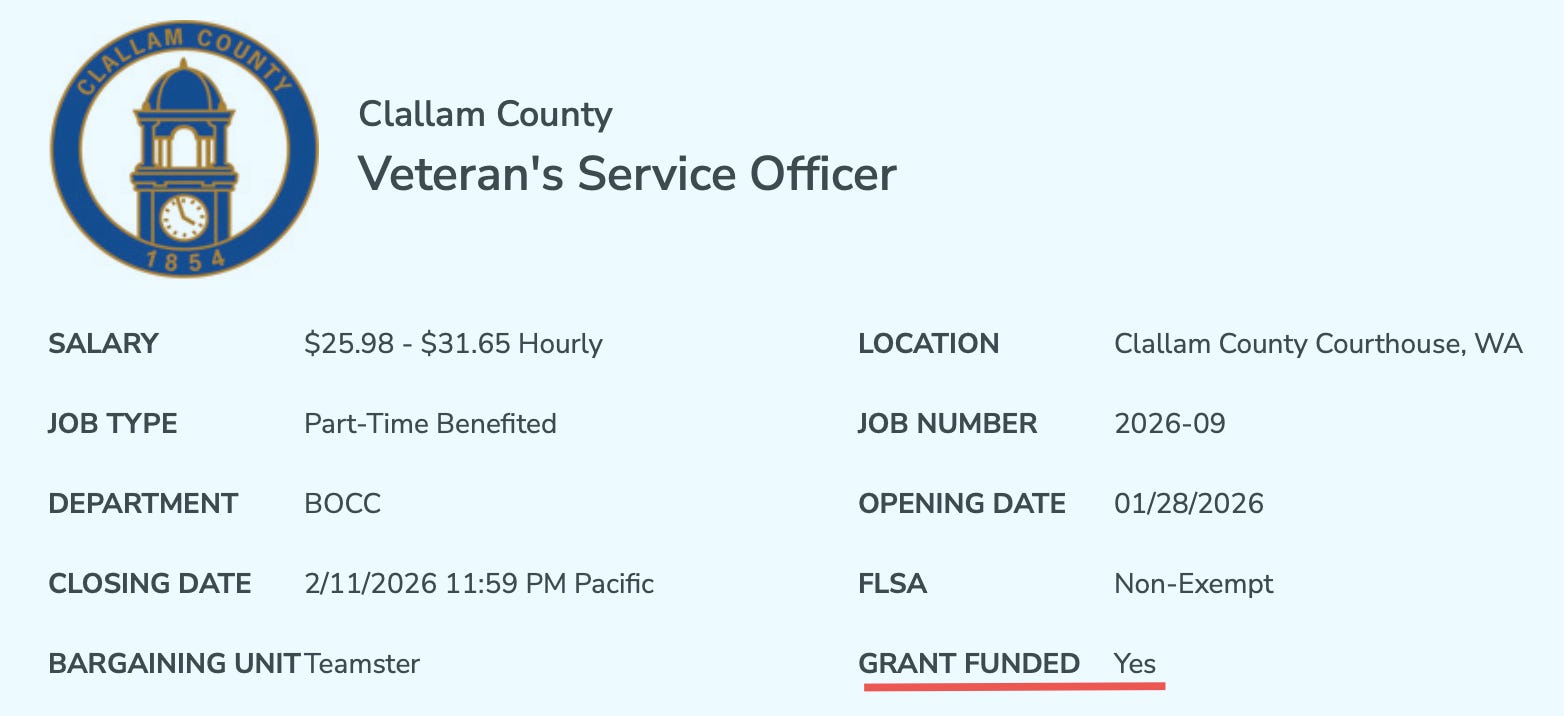
As recently as January 2026, Clallam County advertised its part-time, 20-hour-per-week Veterans Service Officer position and explicitly identified it as “GRANT FUNDED.”
The position keeps growing on outside money, too. Tuesday’s hearing agenda includes another $22,319 in Administrative Office of the Courts funding “to support 10 extra weekly Veterans’ Service Officer hours for the Veterans’ Therapeutic Court program.” (Nov. 24 agenda)
Now the state grant may disappear.
And the proposed solution isn’t to ask whether the county can restructure the program, partner more closely with veterans organizations, use accredited volunteers, share services regionally, or find another way to absorb the loss.
The proposed solution is another tax.
For generations, veterans organizations, family members, and community volunteers have helped veterans navigate benefits. That doesn’t mean a professional VSO has no value. It clearly does. Washington’s own data indicate VSOs have helped substantially increase veterans’ claims for earned federal benefits. (Washington Department of Veterans Affairs)
The question isn’t whether helping veterans is worthwhile.
The question is whether every grant-funded government position automatically becomes a permanent local taxpayer obligation when the grant disappears.
Because this isn’t the first time we’ve seen this move.
When grants disappear, taxpayers become the grant
In 2025, the federal Substance Abuse and Mental Health Services Administration (SAMHSA) stopped allowing federal grant dollars to pay for certain drug-use supplies.
Did Clallam County scale the program back?
No.
County officials replaced roughly $100,000 in lost federal funding with opioid-settlement money, continuing the purchase of harm-reduction supplies.
Then there is the Clallam Conservation District.
Commissioners Randy Johnson and Mark Ozias committed general-fund dollars to the district. When pressure on the general fund increased, commissioners approved a new $5-per-parcel assessment instead—despite a petition signed by 1,032 people opposing it.
That assessment is expected to extract roughly $2 million from property owners over ten years.
Now consider Recompete.
The North Olympic Peninsula received tens of millions of dollars in temporary federal funding intended to increase prime-age employment. But early results have raised serious questions about how much of that money is actually translating into durable private-sector employment. A September 2026 CC Watchdog analysis reported roughly 31 placements in the first year against a five-year goal of around 900, while substantial money flows through governments, nonprofits, and special interest groups.
And now Recompete programs and strategies are being woven into long-term county planning.
What happens when the federal money is exhausted?
What happens to the positions created around it?
What happens when the NGOs, government agencies, and programs built with temporary federal money don’t want to shrink?
We already know the answer government usually gives.
You pay.
“But keeping the levies together cannibalizes the general fund”
This is the argument we’re going to hear, and understanding how the math actually works is important.
Here is the county’s case, in its own words. ESHB 2442 ended the county’s ability to let these two earmarks drift below the state minimums. Clallam’s rates are about 33% below those minimums, so both must be reset in 2027. If the county kept funding them inside the general levy, simply moving to the minimums would cost the general fund $158,300. Because the general levy is projected to grow only $160,666 in 2027, the memo says the general fund would keep just $2,366 of that growth.
Two things in that math deserve attention.
First, the $160,666 figure assumes the commissioners skip their 1% increase.
Second, the memo’s headline comparison—$830,900, or 6.4% of the general levy, “diverted” from the general fund—assumes the veterans levy is set at $0.022, not at the state minimum. The state requires $158,300 more for these two programs. The rest of the jump is the commissioners’ decision to nearly double the veterans minimum.
And the minimum-rate reset is a one-time step. Once these earmarks are at the statutory minimums, the ongoing pressure on the general fund depends on something else: how fast property values rise.
There is a legitimate issue when property values are rising.
Washington’s 1% property-tax limit generally restricts how quickly the total dollar amount of a taxing district’s regular property-tax levy can increase from one year to the next. When the total assessed value of property grows faster than the amount the county is allowed to collect, the county’s levy rate falls—or compresses—to compensate.
But the statutory minimum funding requirements for Veterans Relief and Developmental Disabilities don’t necessarily compress along with the county’s general levy rate.
That’s where the pressure comes from.
Here’s a simple example.
Imagine the county collects $100 in property taxes and $5 of that must go to veterans and developmental-disability services. That leaves $95 for everything else.
Now imagine property values increase dramatically, but because of Washington’s 1% levy-growth limitation, the county can generally increase its existing levy by only about 1%. Instead of collecting $110 simply because property values increased 10%, it collects roughly $101, excluding things such as new construction.
The county’s overall levy rate falls to keep collections within that limit.
But if the statutory veterans and developmental-disabilities obligations don’t fall proportionately, those programs consume a larger share of that $101.
That is the cannibalization problem.
It is a legitimate concern when assessed property values are rising significantly faster than the county’s allowable levy growth.
But now flip the example around.
What happens if property values stay roughly flat?
There is little or no levy-rate compression caused by increasing property values. The county’s general levy isn’t being forced downward by a rapidly expanding tax base while the veterans and developmental-disabilities requirements remain comparatively fixed.
And if assessed values decline, the same rising-value compression problem doesn’t exist either. The levy rate can move upward as necessary, subject to the county’s statutory levy-rate limits, to collect the authorized levy amount.
That’s an important distinction.
Keeping these levies within the general levy creates increasing pressure on the general fund primarily when assessed property values are growing faster than the county’s permitted levy growth.
And that is exactly why timing matters.
If Clallam County were experiencing another period of rapidly appreciating property values, there would be a stronger mathematical argument for separating these levies.
But that isn’t what our housing market is showing right now.
Median residential and condominium sale prices have moved from approximately $500,000 in 2024, to $496,000 in 2025, to $489,950 year-to-date through October 2026.
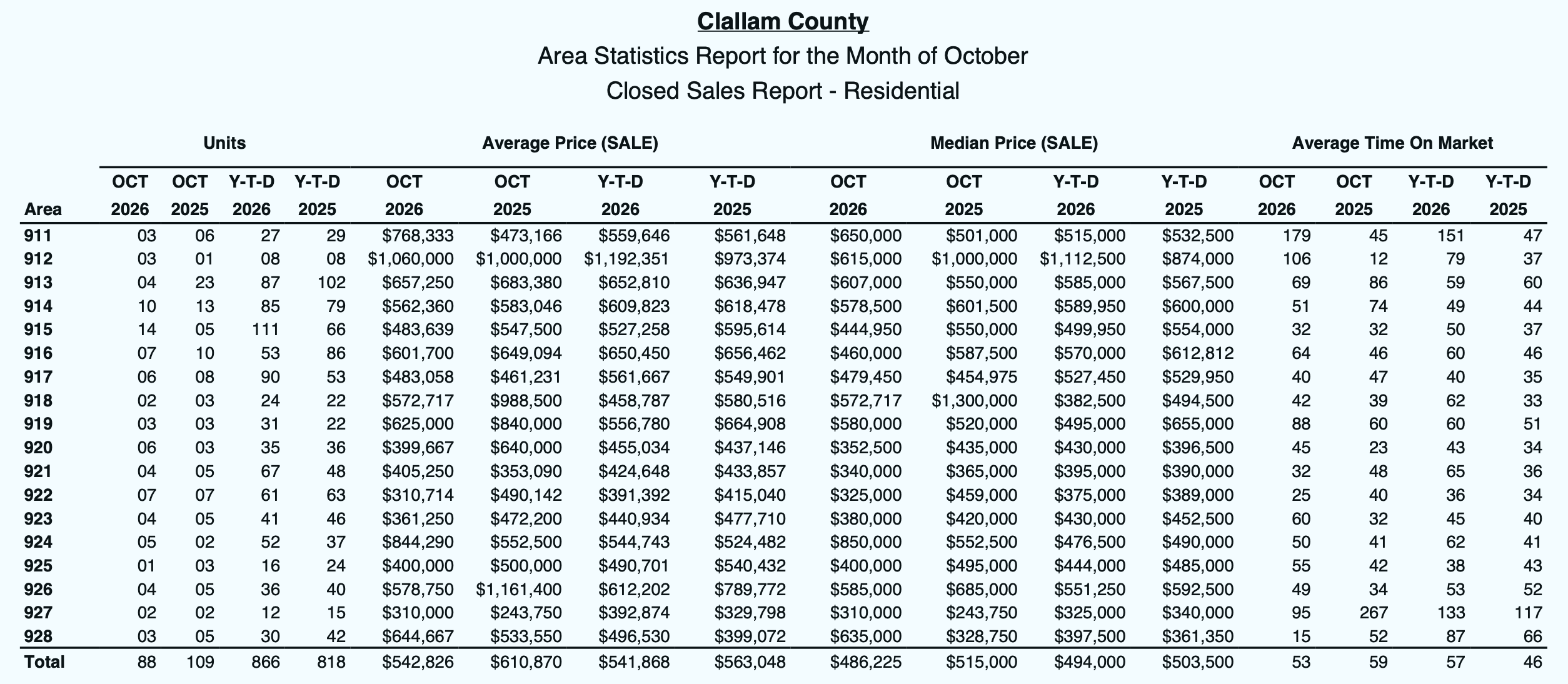
That doesn’t guarantee assessed values will decline—sale prices and assessed values are not the same thing, and assessments can lag market conditions.
But it does raise an obvious question:
Why permanently separate these levies now?
Keep them within the general levy.
Maintain the budgetary constraint that forces commissioners to prioritize spending.
Watch assessed values and the actual effect of levy compression.
If rapidly increasing property values eventually cause the statutory veterans and developmental-disabilities requirements to consume an unsustainable share of the general levy, commissioners can revisit separation then.
But there is no reason to remove that taxpayer protection today simply because it could become a problem tomorrow.
Once the levies are separated, the additional taxes are outside the general levy.
Keeping them together preserves something government budgets desperately need:
A reason to make choices.
WSAC wanted more flexibility. Of course it did.
The Washington State Association of Counties has been advocating for greater county revenue flexibility for years.
WSAC testified in support of ESHB 2442, the legislation that ultimately provided counties with these additional revenue tools. (House Bill Report, ESHB 2442)
That’s their job.
WSAC represents county governments.
It does not represent Clallam County taxpayers.
There is nothing inherently wrong with that. But taxpayers should understand the distinction.
County commissioners regularly participate in and advocate through organizations such as WSAC. When WSAC asks Olympia for more “tools” and “flexibility,” those tools often mean giving county governments more ways to collect or redirect taxpayer money.
The people who ultimately pay those taxes deserve a voice too.
We already gave them one
That’s what makes all of this so frustrating.
Clallam County commissioners asked voters for more money in 2025.
They warned us about looming deficits.
They made their case.
We listened.
And 59% of us said no.
Now, rather than treating that vote as a mandate for structural reform, prioritization and financial stewardship, county government is considering a new councilmanic criminal-justice sales tax and moving two existing earmarks outside the general levy.
Once all three changes are operating for a full calendar year, they would collect approximately $3.2 million annually in additional taxes—remarkably close to the approximately $3.8 million annual increase voters rejected in 2025.
“But we skipped the 1% increase”
To be fair, the county is offering something in return. To help offset the new levies, the commissioners are not budgeting the 1% increase to the general levy that state law otherwise allows.
That isn’t much of a concession.
The 2026 general levy was $12,852,798. One percent of that is roughly $128,500. The two new levies add $830,900. Even after the skipped increase, property owners still pay roughly $700,000 more.
Under the separate-levy plan, the county’s total from the general levy plus the two new levies rises from $12,852,798 in 2026 to $13,856,900 in 2027—about $1 million, or 7.8%. Keep the earmarks inside the general levy, and the total rises about $173,000, or 1.3%.
And skipping the 1% doesn’t necessarily give it up. Under state law, a taxing district that takes less than its allowed increase can generally “bank” that unused capacity and use it in a later year. (MRSC)
Which raises a fair question: do the commissioners believe they’re entitled to that 1% every year, so that passing on it once counts as a gift?
The Legislature may have given them the authority.
That doesn’t make it good policy.
Balancing a budget by finding new ways to collect more money isn’t fiscal responsibility.
Fiscal responsibility is deciding what government actually needs to do, measuring whether programs work, eliminating what doesn’t, planning for grants to end, prioritizing essential services, and living within the resources taxpayers have already provided.
Voters sent that message to the commissioners in 2025.
No meant no.
The question now is whether anyone in county government was listening.
What can you do?
The commissioners haven’t made the final decision yet.
If you believe voters meant what they said in 2025, make sure they hear from you again.
Write to the county commissioners and tell them what you think about the proposed criminal-justice sales tax and the separation of the Veterans Relief and Developmental Disabilities levies. Comments go to Loni Gores, Clerk of the Board, at Loni.Gores@clallamcountywa.gov.
More importantly, show up.
The commissioners will hold a public hearing on the separate Veterans Relief and Developmental Disabilities levies at 10:30 a.m. Tuesday, November 24, in Room 160 of the Clallam County Courthouse, 223 East 4th Street, Port Angeles. The same hearing block includes the 2027 general-purpose, road, and Conservation Futures levies. The board meeting starts at 10 a.m.
Can’t be there in person? Join by Zoom, or call 253-215-8782 (meeting ID 836 9266 4344, passcode 12345) and press *9 to raise your hand.

Attend the hearing and provide public comment. Ask questions. Make your position part of the public record.
The criminal-justice sales tax is not on Tuesday’s agenda, but the county’s 2027 budget already assumes it.
You don’t need to be an expert on county finance. You don’t need a spreadsheet or a ten-minute speech.
You are a taxpayer and a citizen of this county. That’s enough.
In 2025, the commissioners asked voters whether they wanted to pay millions more in taxes.
We answered.
Now it’s time to remind them what we said.