

For decades, the Sequim School District hasn’t just faced isolated scandals—it has developed a pattern. From federal convictions to million-dollar settlements, the real story isn’t just what happened, but how leadership repeatedly responded: quiet exits, taxpayer-funded payouts, and silence when questions are raised. Now, as new concerns emerge, the question isn’t whether problems exist—it’s whether anything has truly changed.
The Sequim School District presents itself as a model of community connection and student-centered values. Its mission speaks of safety, respect, and opportunity. On paper, the policies are strong, the language is reassuring, and the expectations are clear.
But the historical record tells a different story.
Yesterday, the Olympic Herald sent shockwaves through Eastern Clallam County with a report that, in striking detail, traces a decades-long pattern of administrative behavior—one that goes far beyond isolated mistakes. The reporting connects court filings, sworn testimony, internal investigations, and financial settlements into a single, consistent narrative—one that points to a deeply embedded culture of avoidance, protection, and retaliation.
This is not about one employee. It is not about one administration.
It is about a system.
A Record Defined by Avoidance, Not Accountability
Olympic Herald reporting documents more than $2.35 million in settlements, tied not to random incidents, but to repeated failures to act, failures to investigate, and failures to protect.
Each case stands on its own. Taken together, they form a pattern that is difficult to ignore.
Dennis Peterson (2001)
A federal conviction exposed one of the most disturbing failures in the district’s history. Peterson used his classroom, school equipment, and direct access to students to facilitate the exploitation of minors, with evidence tying the abuse directly to school property and school hours. The scale of the misconduct, and the length of time it occurred, raised unavoidable questions about oversight and supervision inside the district itself.Dave Cross (2004)
District records documented grooming behavior, inappropriate contact, and repeated prior warnings that failed to trigger meaningful intervention. Rather than pursue full accountability or continue investigating the scope of the misconduct, the district reached an agreement allowing Cross to resign quietly while continuing to receive salary and benefits. Even more concerning, the district agreed to cease further investigation into additional allegations, effectively closing the door on any deeper review.Chris Boushey (2004)
Extensive online communications between a teacher and a 13-year-old student revealed a pattern of boundary violations that investigators themselves described as grooming. The interactions spanned months, included encouragement of secrecy, and crossed clear professional lines. Despite the seriousness of the conduct, the resolution followed a familiar path: administrative leave, followed by resignation, with no public accountability process.Dave Trapp (2005)
Multiple documented incidents involving physical contact with students, supported by eyewitness accounts and prior reprimands, led to termination proceedings. However, rather than defend its own findings in a public forum, the district reversed course and settled. The outcome allowed Trapp to resign with compensation, avoiding a full airing of the facts and reinforcing a pattern of financial resolution over institutional accountability.Jerry Pedersen (2014)
A volunteer coach developed an inappropriate relationship with a minor athlete under his supervision, communicating extensively outside of appropriate channels. The misconduct was not uncovered through district monitoring or oversight, but through intervention by a parent who reported concerns directly to law enforcement. The case highlighted a critical blind spot in the district’s ability to detect and prevent abuse within its own programs.Public Records Violations (2024)
The district was forced into a $40,000 settlement after failing to comply with Washington’s Public Records Act. The case confirmed that requests for information were not being handled transparently, and that key records were improperly withheld. The settlement required procedural changes, but also underscored a longstanding tendency to control information rather than disclose it.Jennifer Maughan Settlement
More than $700,000 was paid to resolve claims tied to retaliation and workplace misconduct at the administrative level. Testimony associated with the case described a workplace environment shaped by favoritism, internal alliances, and punitive responses to those who raised concerns. The resolution followed the same pattern seen in prior cases—significant financial cost without public accountability.Hanna McAndie Case (2023)
The largest settlement—$1.5 million—stemmed from retaliation against an employee who reported the mistreatment of a vulnerable student. Court filings described an escalating campaign that included professional isolation, reputational attacks, and administrative pressure. Rather than defend the conduct in open court, the district again chose to settle, closing the case but leaving the underlying issues unresolved.
The Stoffer Factor: Leadership, Leaks, and Retaliation
Overlaying this pattern of institutional behavior is the role of leadership—particularly School Board Director Jim Stoffer, whose actions, as detailed in sworn testimony and investigative reporting by the Olympic Herald, raise serious questions about judgment, accountability, and the exercise of authority.
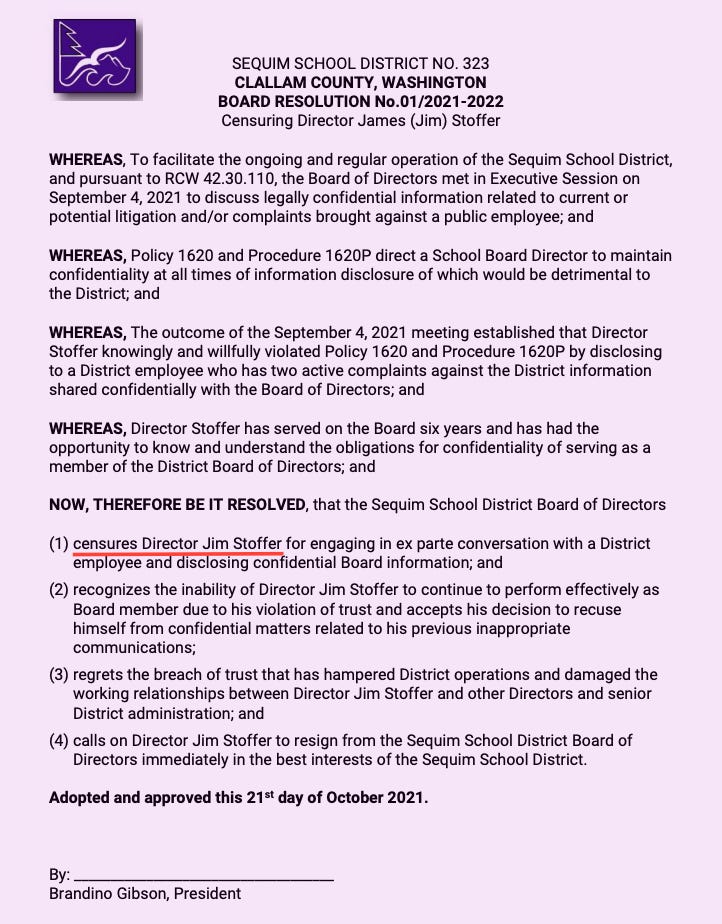
Stoffer was accused of sharing confidential executive session information, a fundamental breach of trust in any public body. Testimony and records indicate that sensitive personnel matters were discussed outside proper channels and circulated beyond those authorized to receive them. Rather than safeguarding information entrusted to him, Stoffer’s conduct contributed to an environment where internal matters were exposed, manipulated, and used to shape public perception.
That pattern extended beyond disclosure into active narrative control. Rather than keeping confidential personnel investigations secure, Stoffer used his position to funnel rumors directly to the public and to specific factions within the district. The hypocrisy of Stoffer’s actions is staggering—publicly invoking principles of order and discipline while privately distributing unverified and damaging claims outside official processes.
His involvement did not stop at information leaks. Testimony revealed that Stoffer was aware of warning signs during the hiring of Superintendent Robert Clark, including direct cautions from colleagues in other districts. When asked under oath whether he pursued those concerns, Stoffer admitted he willfully ignored the red flag.
When asked under oath if he pushed for details regarding why Clark was pushed out, Stoffer admitted he willfully ignored the red flag: “No, I didn’t want to go there.”
That decision would later carry consequences, contributing to the administrative turmoil, litigation, and costly settlements that followed. It stands as a clear example of a leadership choice not to act—despite having reason to.
Beyond internal decision-making, the Olympic Herald reporting outlines a pattern of aggressive and, at times, deeply personal retaliation against critics. Stoffer’s monitoring of social media was so aggressive and intrusive that it triggered internal grievances against him. Community members and district employees who spoke out did not simply face disagreement—they became targets.
Stoffer’s commitment to silencing his critics went to alarming extremes. When a community member began posting about district dysfunction, Stoffer didn’t just disagree—he actively attempted to undermine the man’s career by contacting his employer and triggering professional scrutiny. The escalation did not stop there. In a move that extended far beyond the bounds of public service, Stoffer also contacted the community member’s wife’s employer in a mirrored effort to damage her livelihood as well.
These actions reflect more than poor judgment. They point to a leadership approach that prioritizes control over accountability, and retaliation over transparency.
Failing Up
Despite this record, Stoffer has not stepped away from public education. In October 2023, he was appointed to the Board of Directors for Olympic Educational Service District 114, filling a vacancy after the resignation of a long-serving member.

That appointment placed him back into a position of regional educational leadership, representing multiple school districts and helping guide policy across the Olympic Peninsula. He continues to participate in board decisions, legislative updates, and governance functions within that system.
For many in the community, that reality underscores a deeper concern: this is not behavior that sidelines leadership—it is behavior that continues alongside it. And in a district already marked by patterns of silence and protection, it raises a difficult but unavoidable question about the kind of leadership culture that is not only tolerated, but allowed to persist.
A Network That Closes Ranks
The present-day structure surrounding the district raises additional concerns about alignment and influence.
Key figures connected to the school system—including advisors, board members, and politically active individuals—have overlapping roles in civic organizations and public advocacy efforts. Susan Fisch, who played a visible role in supporting a successful school bond effort, is also connected to the Mock Trial program. Patrice Johnston serves both as a School Board member and as a co-advisor to that same program.

These overlapping roles are not inherently improper. However, in a district with a documented history of protecting insiders and minimizing scrutiny, they raise legitimate questions about independence, oversight, and accountability.
When those within the same network are responsible for oversight, instruction, and public advocacy, the risk is not just conflict—it is consolidation of influence.
When Concerns Are Raised—and Ignored
Recent events have brought those concerns into sharper focus.
A student affiliated with the school’s Mock Trial program delivered public comments tied to an ongoing political dispute involving adults connected to that program. The situation raised reasonable questions about whether the student was acting independently or under the influence of authority figures involved in the same dispute.
Formal concerns were submitted to the Sequim School Board and Superintendent, requesting an investigation into potential boundary issues, advisor influence, and the appropriateness of student involvement in adult political conflicts.
No response was provided.
That silence is not an isolated occurrence. It mirrors a pattern documented across decades: when concerns arise—whether from employees, parents, or the broader community—the institutional response is often delay, deflection, or silence.

A Culture, Not a Coincidence
The consistent thread running through these cases is not the severity of any single incident.
It is the response.
Misconduct is addressed quietly.
Investigations are limited or halted.
Accountability is replaced with settlement.
Information is withheld or controlled.
Over time, these decisions do more than resolve individual situations—they shape institutional culture.
A culture where problems are managed, not confronted.
A culture where insiders are protected.
A culture where raising concerns carries risk, but ignoring them does not.
A Question of Trust
Last year, the Sequim School District asked voters for nearly a quarter-billion dollars of support—and the district received it.

That support was based on trust. Trust that leadership would act transparently. Trust that student welfare would come first. Trust that past failures would not be repeated.
But trust is not maintained through silence.
It is maintained through accountability.
Call to Action
The community deserves answers.
The Sequim School Board and Superintendent should:
Acknowledge and respond to concerns raised about student involvement in adult political disputes
Clarify the role of advisors and ensure clear boundaries between instruction and influence
Commit to transparent, independent review when concerns are raised
Demonstrate that the culture described in past reporting is not continuing today
This is not about revisiting history for its own sake.
It is about whether that history is still shaping decisions now.
Because the record is clear.
And the community is watching.
Today’s Tidbit
The following email was sent to the Washington State Office of Superintendent of Public Instruction.
April 23, 2026
To Whom It May Concern,
I am writing to formally request that the Office of Superintendent of Public Instruction review and investigate concerns involving the Sequim School District’s Mock Trial program and the district’s handling of those concerns.
Specifically, I have reason to be concerned about the potential for inappropriate boundaries between adult advisors associated with the Mock Trial program and students participating in that program. Based on publicly observed events and the involvement of advisors in related public matters, there is a reasonable question as to whether students may have been influenced, directed, or otherwise drawn into situations that extend beyond appropriate educational and mentorship roles.
Given the nature of these concerns, I submitted a formal letter to the Sequim School Board and Superintendent on April 9, 2026, requesting that the district conduct an internal investigation into possible boundary violations and clarify the role of program advisors. To date, I have received no response from the district acknowledging or addressing these concerns.
This lack of response is particularly troubling in light of the Sequim School District’s documented history of administrative failures involving misconduct, retaliation, and lack of transparency. As has been reported in recent investigative journalism, the district has, over a period of more than two decades, been involved in multiple incidents resulting in significant legal settlements, public records violations, and findings of inadequate oversight. While each case is distinct, the pattern raises legitimate concerns about whether internal processes alone are sufficient to ensure accountability in this matter.
I am not asserting a definitive conclusion regarding misconduct in the Mock Trial program. However, the circumstances, combined with the district’s failure to respond to a formal request for review, warrant independent oversight.
Accordingly, I respectfully request that OSPI:
Review the concerns raised regarding potential boundary violations between Mock Trial advisors and students
Determine whether the Sequim School District has followed appropriate policies and procedures in addressing or failing to address these concerns
Assess whether additional investigation, guidance, or corrective action is necessary to ensure student protection and appropriate staff conduct
Students should not be placed—directly or indirectly—in situations where educational authority intersects with personal, political, or external influence. When concerns of this nature are raised, they should be addressed promptly and transparently.
Thank you for your attention to this matter. I am available to provide additional information or documentation as needed.
Sincerely,
Jeff Tozzer
The commissioners did not reply to yesterday's email asking if they would be interested in working on potential gaps that allow out-of-state sex offenders to reside in Clallam County without registering.
Here is today's email sent to the commissioners:
Dear Commissioners,
You previously issued a letter of support for the Sequim School District bond and levy measures—measures that passed and will commit local taxpayers to a substantial long-term obligation. When interest is factored in—reportedly on the order of $100 million beyond the principal—the total cost approaches a quarter of a billion dollars over the life of the bond.
Given that level of public investment, would you consider issuing a similar letter of support on behalf of citizens who are raising concerns about transparency, accountability, and whether student interests are being fully prioritized?
Many in the community point to declining enrollment, disappointing academic outcomes, and a pattern of handling serious issues internally rather than through independent investigation. With taxpayers committed at this scale, there is a growing expectation for openness and trust in return.
Would you be willing to publicly support those calling for greater transparency and independent review where appropriate?
Oh for “fk’s” sake Jeff!!!
🤬😧
One question:
how. ?
how, did Jim Stoffer get elected to the “Clallam County Charter Review Commission” ???
Based on his “Character” & “Lack of integrity” & “Lack of Trust”??
Aren’t those a few requirements for local government? (ha ha, i laugh)
Or ANY Employer?
incredible article…. you had me at “hello” on this one…
Come on momma bears… wake up!!💥
Inappropriate behavior & mind bending indoctrination.
Get Jim Stoffer and his wife, Patrice as far a way from my kids as can be.
There is no *place for them in Education, or at the County level.
I will be at the next school board meeting.
btw…
can’t seem to get my “volunteer” paperwork accepted by the SSD volunteer dept.
Last year i volunteered..
however this year, there seem to be a hold up.
hmm… ?