


Most Clallam County homeowners have noticed the “Developmental Disability” line on their property-tax bill. It’s a special levy carved out under Washington law and sold to taxpayers as a humane way to fund programs for people with developmental disabilities.

Those goals are legitimate. The people who rely on these services deserve real help.
But here’s the problem: Once the money leaves the county and enters the hands of nongovernmental organizations (NGOs) and private consultants, the public loses all visibility.
The commissioners know this, but they approve the handouts anyway. And on Tuesday, they approved hundreds of thousands in contracts funded by that levy — almost entirely to outside organizations.
What the Levy Should Do
In theory, the levy funds programs that help people with developmental disabilities:
Employment support
Community inclusion activities
Family and caregiver resources
Early intervention services
These priorities are handled by the county’s Health & Human Services Department and reviewed by the Developmental Disabilities Advisory Committee.
In practice, however, this levy has morphed into a revolving door of taxpayer-funded grants to NGOs, consultants, and private contractors — with no accountability once the checks are cut.
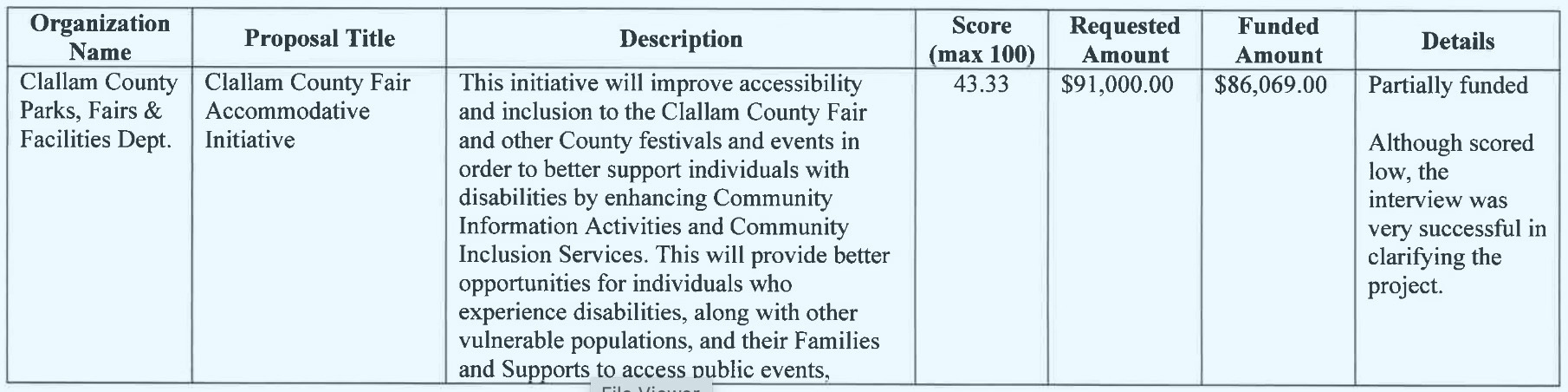
1. $86,069 to the Clallam County Fair for “Accessibility Improvements”
This proposal is framed as improving inclusion at the county fair and festivals. That’s fine — but why is the developmental disability levy being used to subsidize the county’s own Parks & Facilities Department?
Shouldn’t accessibility at public events already be a core government responsibility?
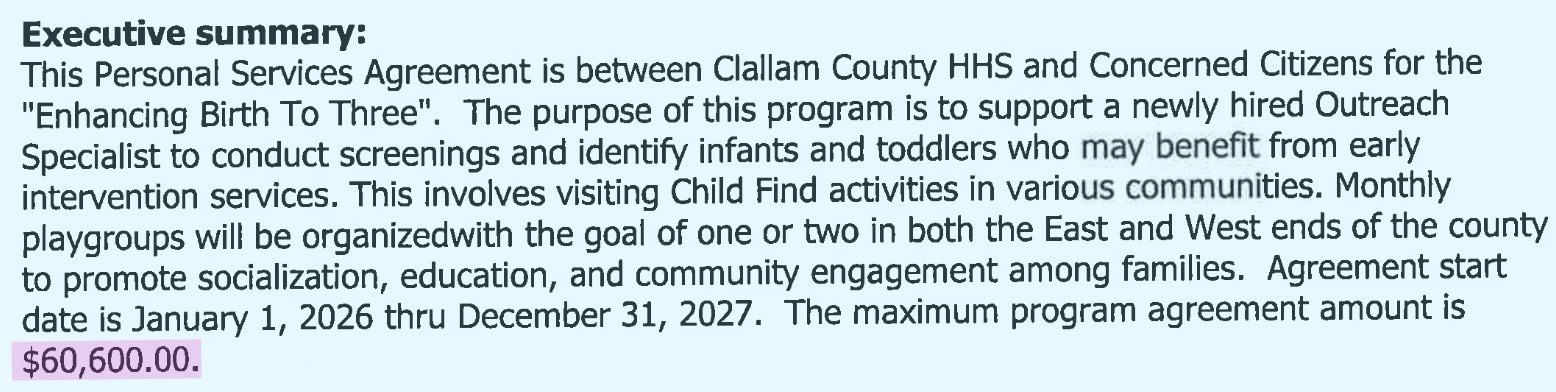
2. $60,600 to “Concerned Citizens” for infant/toddler screening and monthly playgroups
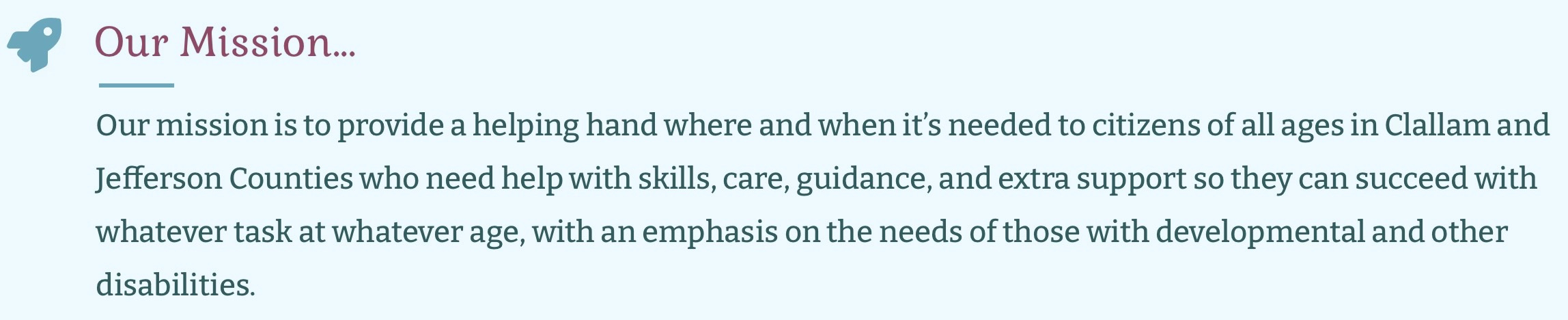
This NGO has a mission so broad it could cover almost anything: “helping hands… guidance… extra support… citizens of all ages.”
For over $60,000, taxpayers are buying:
One outreach specialist
Monthly playgroups
Incentives (gift cards, food, etc.) to reduce parent no-shows
Once the money leaves county control, taxpayers lose all rights to see how it’s spent — even though these groups survive almost entirely on tax dollars.
3. $101,616 to First Step Family Support Center

This “Supported Parenting Program” provides parenting coaching to families where one parent has a developmental disability.
Again, a worthy goal — but First Step is already receiving federal Recompete money for diaper distribution, a program intended to bring adults back into the workforce. How many streams of government funding does one organization need?
4. $72,673 to Monica Meyer Consulting, Inc. for four videos
This one deserves its own section.
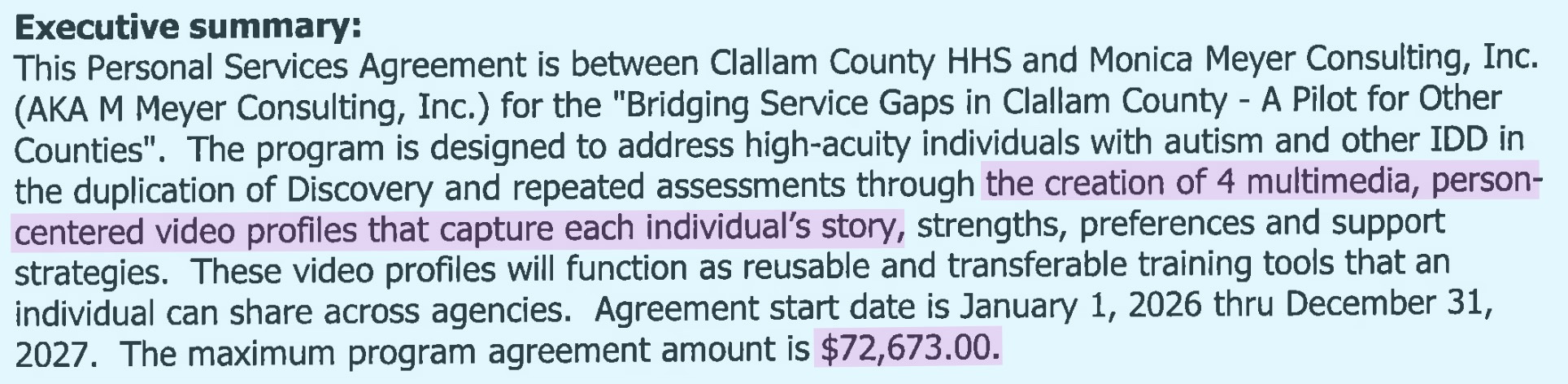
$72,273 for four 45–75 minute videos.
That’s over $18,000 per video.
The stated purpose? To reduce “exhausting and disparaging” repetition when families must retell their loved one’s story to new staff. The idea is that new staff will just watch the video instead.

The contract description is pure consultant jargon:
“Embodies collective impact… scalable model… strengthens pathways to community inclusion…”

What does that even mean? Why does it cost $18,000 per video? Once the money leaves the county, it’s gone — and the public has no right to ask.
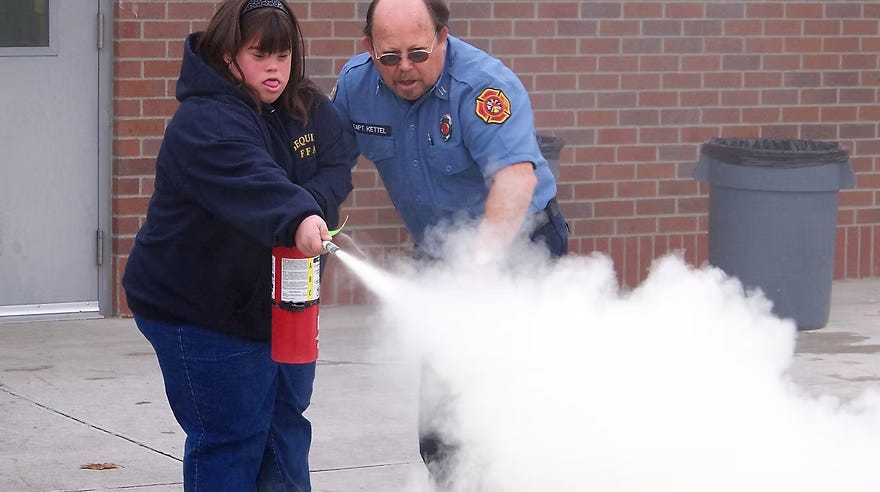
5. $80,642 to Pierce Jones & Associates for “Emergency Preparedness Training”

The program teaches basic emergency skills:
Build a go-bag
Use a flashlight
Make a checklist
Shelter in place
Practice scenarios
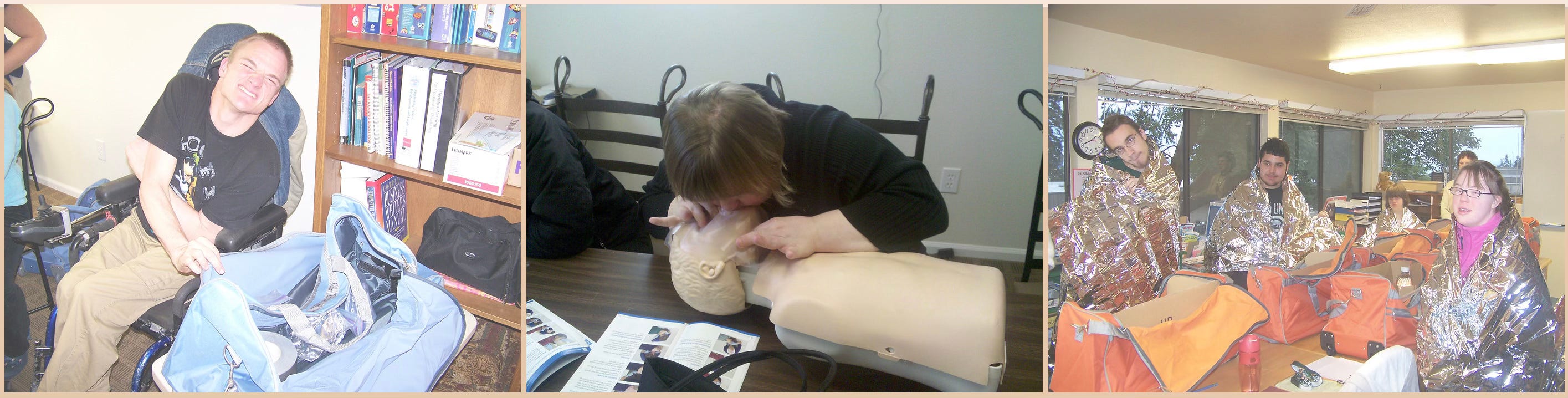
All important skills — but here’s the real question:
Why is the county paying more than $80,000 for classes that CERT volunteers, churches, or community groups could teach for free or for a few hundred dollars?
Are we really pretending that assembling a flashlight and a first-aid kit justifies an $80,000 contract?
The Pattern: Hand Out Money → No Oversight → Repeat
This levy is now a slush fund — one that:
Taxpayers are required to contribute to
Commissioners dole out to favored NGOs and consultants
Immediately disappears into private hands
Cannot be audited by the public
Has no measurable accountability
All while Commissioners Mike French and Randy Johnson sit on the Board of the William Shore Memorial Pool — now under state audit and fraud investigation — after years of rubber-stamping expenses without proper oversight.
If they didn’t catch fraud at the pool, why should taxpayers trust them to oversee hundreds of thousands in contracts to outside groups?
Who Actually Pays?
Here’s a key fact buried in the fine print: Most local property owners pay into the developmental disability levy. But properties held in tribal trust pay nothing.

That means:
The levy burden shifts to non-tribal homeowners and businesses
NGOs serving countywide populations receive funding from only some of the county’s taxpayers
Commissioners seemingly approve of the imbalance
Taxpayers subsidize organizations they can’t monitor, serving populations they can’t audit, at prices no one would pay if it were their own money.
Vanishing Trust
Programs for individuals with developmental disabilities should be funded — and funded well. These are some of the most vulnerable residents in our community.
But that doesn’t excuse reckless spending, zero-accountability structures, or the habit of treating tax dollars like Monopoly money.
A levy meant for direct services has become a blank checkbook for NGOs and consultants, with taxpayers footing the bill and no way to ask questions once the money leaves county hands.
If commissioners want to restore trust, they must:
Require full public transparency from any group receiving taxpayer levy funds
Provide measurable outcomes tied to each contract
Question inflated consultant costs
Stop rubber-stamping giveaways with no oversight
Reevaluate why non-tribal property owners carry 100% of the tax burden
Until then, taxpayers are paying for videos that cost more than used cars, emergency-prep classes that cost as much as a full-time salary, and “inclusion initiatives” that sound great on paper and vanish into the ether once funded.
A No-Holds-Barred Interview With the Clallam County Watchdog
Missing the CC Watchdog podcast on Fridays and Saturdays? Good news—Clallamity Jen drops her very first episode today, and it’s a full-length interview with yours truly, the Clallam County Watchdog.
Skeptics and doubters were invited to send C.J. their anonymous, uncensored questions—and they definitely showed up.
Is the Watchdog a master manipulator?
Power hungry?
Secretly grooming county commissioner candidates as part of an elaborate plan for world domination?
C.J. doesn’t tiptoe around any of it. She dives in headfirst with zero filters.
It’s nearly two hours of straight talk, myth-busting, and a few surprises—so do yourself a favor: split it between Friday and Saturday until Sundays With Seegers drops.
Huge thanks to Clallamity for a great interview, I really meme it.
Click here to listen on Clallamity Jen’s page.
Today's question to the commissioners:
Dear Commissioners,
How do you justify $18,000 of taxpayer money going to make a 45-minute video?
All 3 commissioners can be reached by emailing the Clerk of the Board at loni.gores@clallamcountywa.gov
I found it interesting the first time I heard of the making of these videos. Something wasn't right. My son is 40 years old with special needs. He has worked at many jobs over the years. Never once were we, his parents, allowed nor asked for input on what was best for him! Never had to tell his story once. So who is really saved from having to repeat this? Still not sure. Second comment, every year for many years, my son came home from Clallam Mosaic classes with a great big rolling duffle bag full of emergency preparedness items. I believe they had guest speakers for the day that brought them. But I asked to not be given them anymore because they were taking up so much space in his closet. One was enough anyway, thank you. No record of who had already received this? Now I'm beginning to understand, it's all about the money (as usual) and how to keep it coming to an organization even if not really needed for intended purpose anymore. Sad and such a waste.