

Local officials and legacy media keep assuring the public that transit is safer, crime is under control, and the system is working. But newly uncovered records tell a very different story — one of downplayed violence, omitted details, and a disturbing pattern of explosive devices found near our highways. If news outlets and local government are committed to transparency, why are residents learning about life-threatening incidents only by accident?
CC Watchdog needs to issue a correction to yesterday’s reporting. We previously stated that legacy media did not cover the September assault of a Clallam Transit operator in downtown Port Angeles. In fact, the Peninsula Daily News did mention the attack — nine days later, on September 18 — buried in an article about the search for a new General Manager.
The story appeared on the front page, but only beneath a photo of a spray-paint artist in Port Townsend and alongside unrelated features on a safety facility, a forest fire, and a missing persons case. The article titled “Clallam Transit to search for GM: Firm to help board recruit candidates for top position” did not describe the attack until the seventh paragraph, after turning to page A-3.
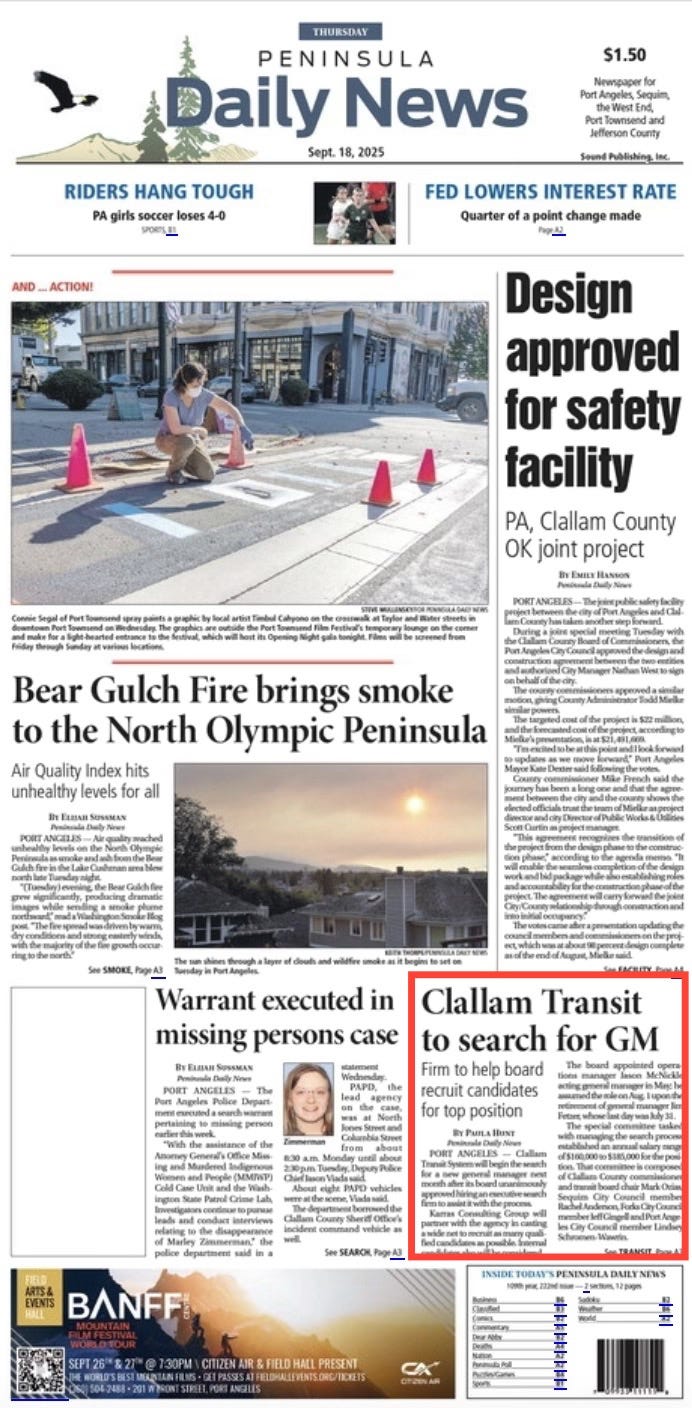
There, readers found a brief, heavily sanitized account:
A Sept. 9 assault on a driver at the intersection of Lincoln and First streets has the agency ramping up efforts to improve safety on buses.
Taron Lee, the agency’s acting operations manager, said passengers on the bus stepped up to intervene in the assault, and the suspect was quickly apprehended. The driver is now back at work.
“We want to be more proactive and figure out some further measures to eliminate the possibility of this happening again,” McNickle said.
Last year, the agency began de-escalation training to equip drivers with skills needed to manage crisis situations on their routes.
Maintenance manager Gary Abrams said he had been getting quotes on the cost of retrofitting the agency’s fleet with safety partitions that separate drivers and passengers.
Rick Burton, a transit operator who sits as a non-voting member on the board, said the city and county representatives who comprise the nine-member body should keep in mind what he said was the root of threats to safety.
“We can do whatever we have to do with barriers and to protect ourselves with de-escalation training,” Burton said. “The problem is, we have a homeless problem, and we have a health problem. That’s the issue.”
Absent were any meaningful details: no suspect description, no mention that the attacker was approximately 5’11” and 280 pounds, no acknowledgment that he allegedly struck the female operator’s head so hard it hit the driver’s window, no mention that he was brandishing a knife, and no recognition that two passengers likely prevented a homicide. The only fully candid comment in the article came from transit operator Rick Burton, who stated plainly that Clallam Transit is dealing with a growing homeless and behavioral-health crisis — a reality the public sees daily.
This would be troubling enough on its own. But it directly contradicts the rosy narrative county leaders have repeated throughout 2024.
Leadership Praises “Improved Security” as Violence Escalates
At a Board of Commissioners meeting earlier this year, Commissioner Mark Ozias celebrated record-breaking transit ridership — more than 800,000 boardings in 2024. “A real success for the agency,” he said. The zero-fare policy and pandemic recovery were credited for the 36 percent increase.
Commissioner Mike French added another reason: “increased security.” He praised new private-security partnerships and claimed the Gateway Transit Center in downtown Port Angeles had become safer. He acknowledged a “small number” of rider exclusions but assured the public the new general manager would improve comfort and “respectful atmosphere” on the buses.
Considering September’s violent attack of an operator, that optimism now appears wildly disconnected from reality.
More September Coverups
Now we’re learning that just days after the September bus assault — and without a word to the public — the Port Angeles Police Chief quietly emailed the mayor, entire city council, and senior staff with a list of alarming incidents from the same weekend. The email, dated September 22, included:
• Two arrests for possession with intent to sell drugs
• Two DUI/drug arrests
• A suspected arson attempt of a truck at the Safeway parking lot
• And, most disturbing, an improvised explosive device placed on the Highway 101 overpass — the third such incident in recent weeks
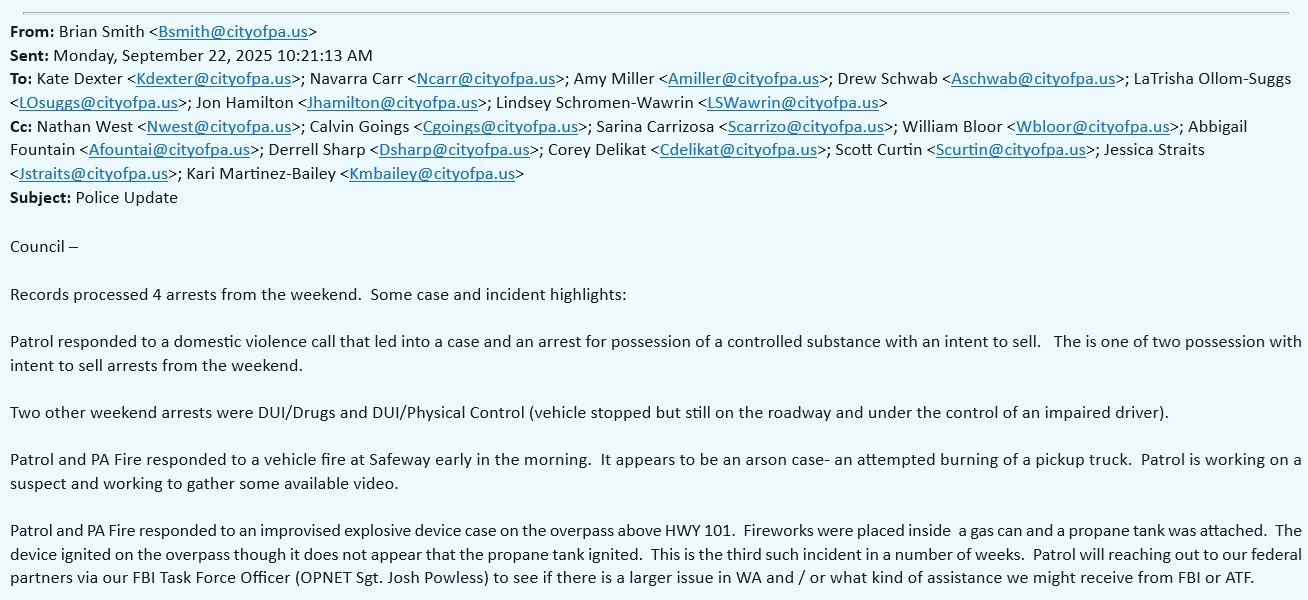
This was not a prank or stray fireworks. It was a gas can rigged with a propane tank and ignited on an overpass above the peninsula’s primary transportation artery. Police deemed it serious enough to notify the FBI and ATF.
Yet the public heard nothing.
Why Didn’t Residents Know About Multiple Bomb Incidents?
The Chief’s email went out at 10:22 a.m. on September 22 — well before the Peninsula Daily News’ daily print deadline. Yet the newspaper’s front page the next day contained no mention of the repeated explosive devices placed along Highway 101.
Instead, readers saw:
• A homeless encampment in Port Townsend being disbanded
• Sentencing for a man who strangled his girlfriend — tied to drug abuse
• A request for funding to study the opioid epidemic
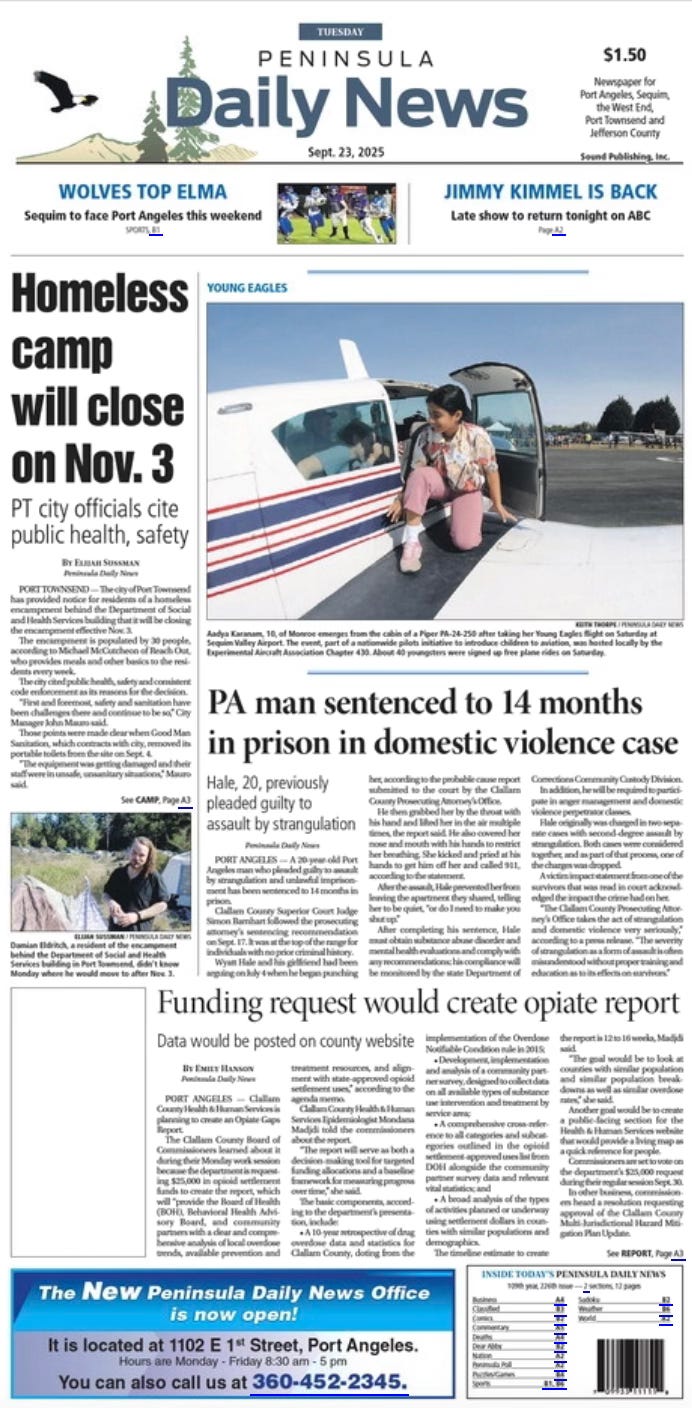
Three stories demonstrating the county’s deepening drug crisis. But not a single sentence on escalating bomb threats that risk closing the only route on and off the peninsula.
A concerned citizen stumbled across the email in unrelated public-records research and alerted CC Watchdog. Had she not done so, the public still would not know. What else is occurring beneath the surface of “everything is fine” messaging?
The Pattern Is Clear — and Dangerous
The contradiction is unmistakable:
• Leaders say security is improving while violent incidents rise.
• Media downplays threats while repeating official talking points.
• Government invests in programs that have not reduced drug-related crime.
• Harm-reduction policies expand, yet every metric shows deteriorating public safety.
Residents are told everything is under control. But the facts — and the unreported bomb incidents — say otherwise.
Clallam County deserves full transparency. Not selective disclosure. Not minimized threats. And certainly not silence when public safety is at stake.
What Needs to Change
Clallam County cannot continue operating under a communications model where serious public-safety threats are disclosed selectively, quietly, or not at all. If leaders want to rebuild public trust, three reforms are essential:
1. Full and immediate transparency about all violent incidents and credible threats.
Attacks on public employees, bomb placements, arson attempts, and drug-related felonies must be proactively reported — not buried in unrelated articles or confined to internal emails.
2. Public-facing safety data and monthly incident reporting.
Transit security statistics, crime summaries, and emergency-response trends should be published openly and consistently. Residents, riders, and business owners deserve honest, unfiltered information.
3. A shift from political messaging to operational accountability.
Record-breaking ridership and “improved security partnerships” mean nothing when operators are assaulted, passengers are endangered, and federal agencies are being contacted about explosive devices. Leadership must prioritize measurable safety outcomes, not press-ready talking points.
These are reasonable, actionable steps that every local government should already be taking.
Thanks for sharing this, Jeff...3 explosive devise incidents in a few weeks...crazy.
The 2024 “record-breaking ridership” of 800,000 got me totally distracted this morning. Do you think I’m that stupid to believe that approximately 2,200 riders daily rode the free bus? 800,000 \ 366 days. Someone’s fibbing to inflate ridership in order to apply for extra dollars to fund the “free bus” in Clallam County. “The wheels of the bus go round and round…..”