

Two years ago, I defended the League of Women Voters. Today, I’m asking them direct questions. After a partisan newspaper ad, unanswered emails, curated forums, and messaging that amplifies fear about looming threats, it’s time to examine whether the League of Women Voters of Clallam County is truly nonpartisan — or simply branded that way. This begins a weekly series of direct questions to the League. They are invited to respond through CC Watchdog, and I will publish their answers in full.
Two years ago, during the heated debate over whether Towne Road should reopen as promised or be converted into a park as the Jamestown Corporation was advocating, I participated in a Town Hall hosted by the People’s Forum.
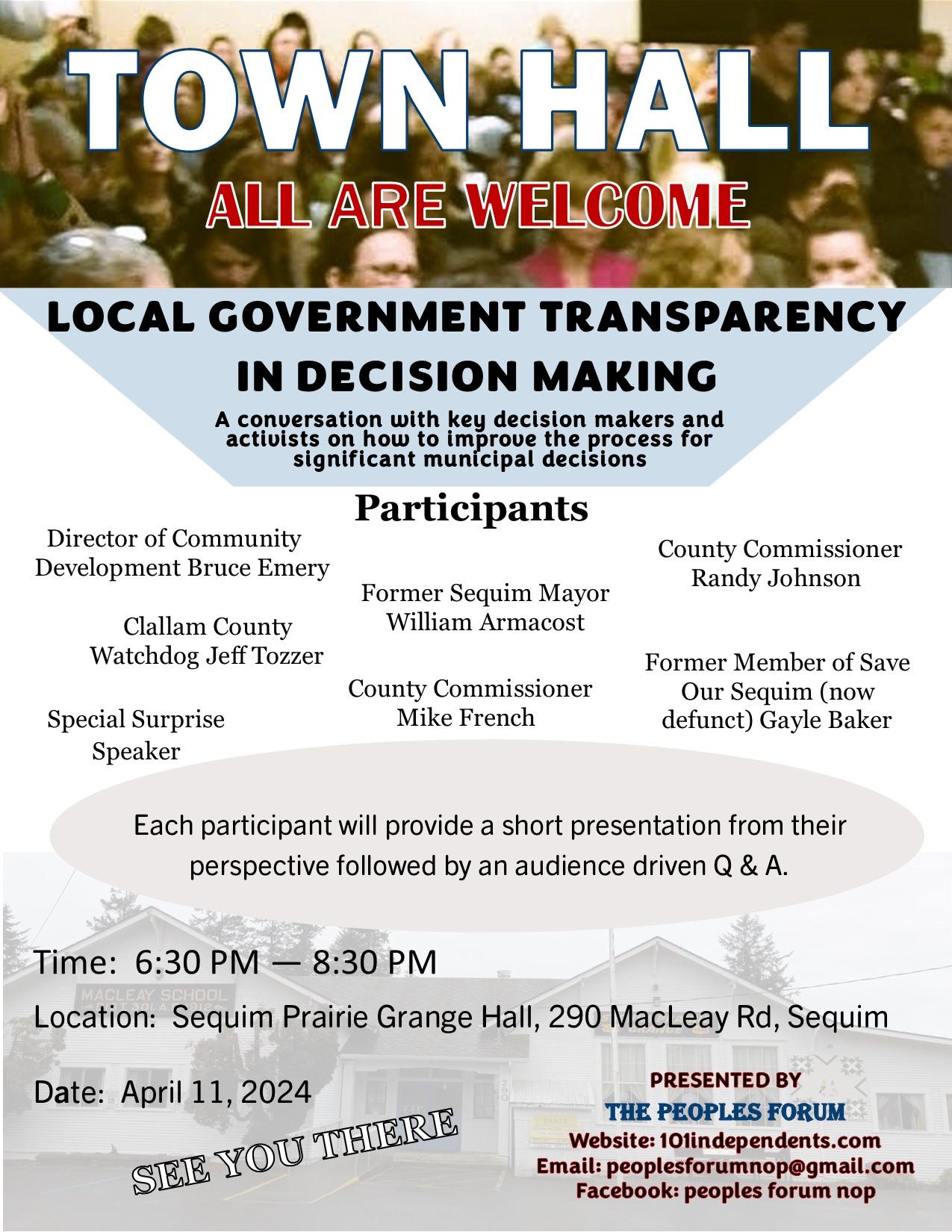
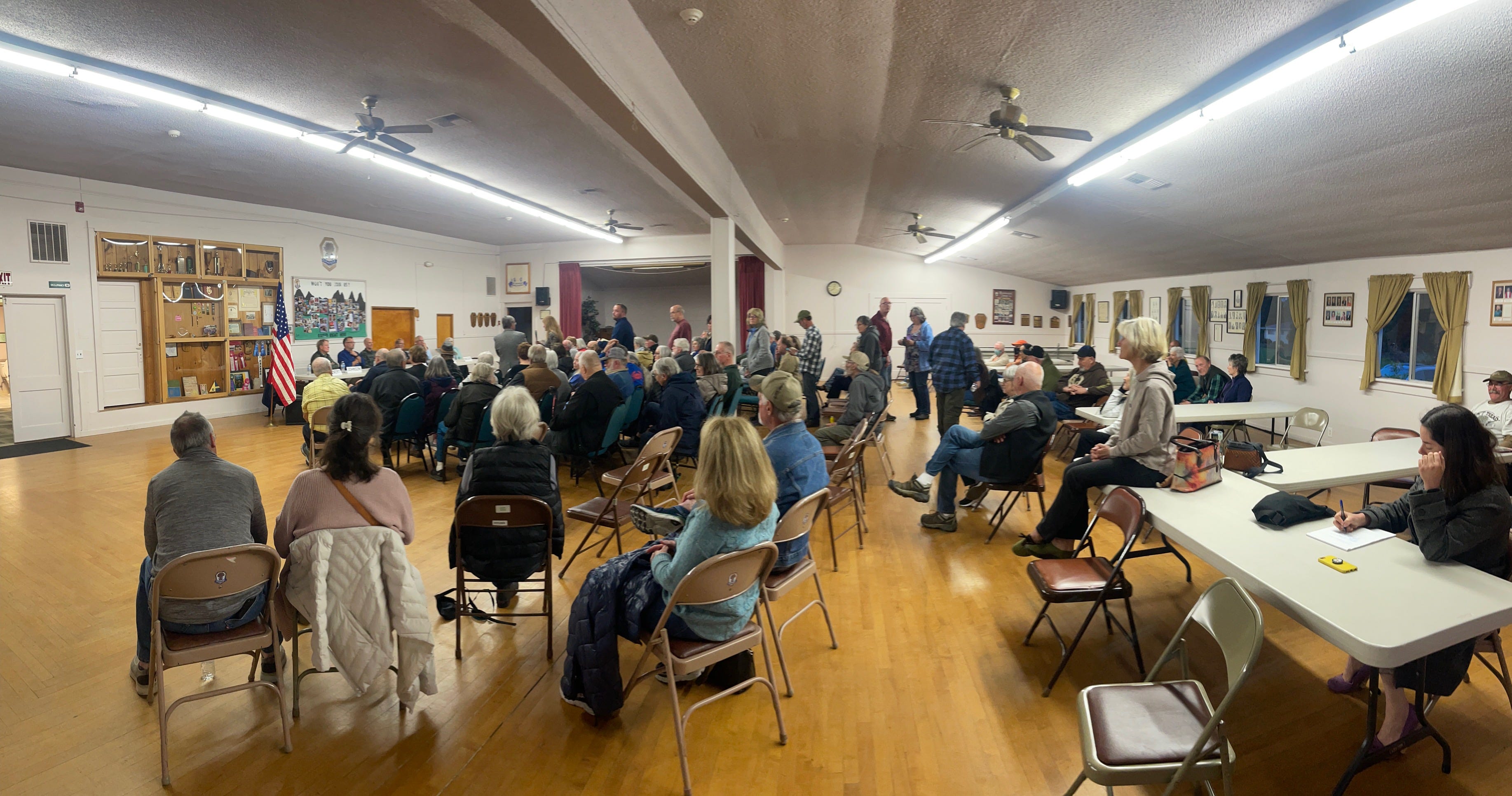
On the panel were DCD Director Bruce Emery and Commissioners Mike French and Randy Johnson. Commissioner Mark Ozias declined to participate in the debate held in his own district. About 80 residents attended.
What made that event work was simple: anyone could walk to the microphone and ask a question. It was moderated, yes — but it was open.
Compare that to forums hosted by the League of Women Voters of Clallam County, where questions must be submitted in advance and are curated by the League before being asked.
That contrast stayed with me.
At that Town Hall, longtime residents warned me that the League had long influenced local politics, swayed elections, and shaped the Sequim School Board, Sequim City Council, and past Charter Review Commissions. Some even described the organization as being aligned with a far-left, fringe, radical ideology.
I pushed back. I defended the League.
The League of Women Voters that I remembered from my youth — the one my mother admired — was about voter registration, civic literacy, and encouraging participation across party lines. It was respected. It was trusted.
Then last January I saw something that changed my view.
The League of Women Voters of Clallam County ran a paid advertisement in the Peninsula Daily News condemning the presidential administration.
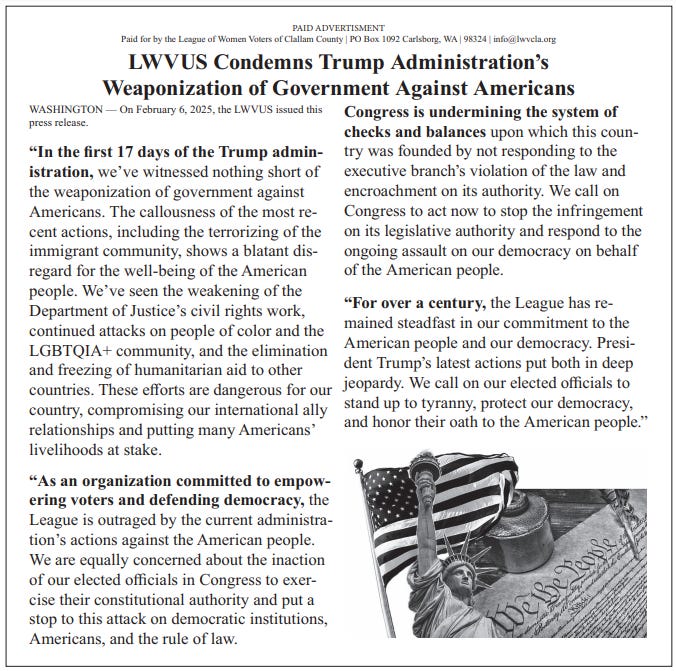
Not criticizing a specific policy. Not addressing a local issue. Condemning an entire presidential administration.
For an organization that calls itself nonpartisan, that was striking.
One line in particular stood out:
“We’ve seen… continued attacks on… the LGBTQIA+ community.”
As a gay man, that line caught my attention.
Doug and I married in 2015, two months after the Supreme Court legalized same-sex marriage nationwide. Our marriage simplified everything — health insurance, taxes, home ownership, estate planning.
During the 2016 presidential race, we were told — repeatedly — that our marriage would be annulled, that the Supreme Court would reverse course, that we would be targeted, rounded up, even exterminated depending on the outcome of the election. I’m not exaggerating. Friends warned us we might need to hide.
The election came and went. Four years passed.
Nothing happened to our marriage.
But something else did happen.
Doug and I are friends with a same-sex couple who have a “bug-out bag” packed with essentials. They’ve moved money into a Canadian account. They keep a boat at the marina fueled and ready. They’ve mapped the route. They can be in Canada in less than 24 hours — in case the federal government ever begins rounding up gay couples and putting them in camps.
We know another couple who refuses to get married at all. They believe a marriage license would place them on some kind of national registry — a list that could be used to identify and detain them if the political winds shift.
This is not satire. These are real conversations.
Our friends live in quiet, constant anxiety. They have contingency plans for exile. They rehearse escape routes for something that never happened.
Doug and I don’t live that way. And that’s the tragedy.
Because when activists repeatedly warn of annulments, registries, camps, and extermination, they may energize voters. They may raise money. They may consolidate power.
But they plant fear deep inside ordinary lives.
They convince people their rights are one election away from extinction.
Our friends are not afraid because of anything that has happened to them. They are afraid because of what they were told would happen.
And when organizations position themselves as the last barrier between minorities and annihilation, they are not just advocating policy. They are manufacturing emotional crisis.
Fear mobilizes. It builds loyalty. It wins elections. But it also steals peace from the very people it claims to protect.
And if the League of Women Voters — or any group claiming nonpartisan credibility — contributes to that climate of panic without balancing it with factual developments and constitutional realities, then it’s fair to ask whether they are informing voters…
…or frightening them.
So when the League’s ad claimed “continued attacks” on my community, I emailed the address listed — info@lwvcla.org — and asked a simple question:
“As a member of the LGBTQIA+ community, I am reaching out to request an example of attacks taken by the Trump administration that negatively impacted my community within the first 17 days of his presidency.”

I never received a response.
Meanwhile, last year the Supreme Court declined to hear a challenge that could have threatened same-sex marriage. The Court was asked to revisit the landmark Obergefell decision that guaranteed constitutional rights to same-sex marriage. The Supreme Court declined to do so. Marriage equality remained intact.
The same Court that many warned would dismantle our rights decided to leave them standing.
That decision wasn’t highlighted by the League. They didn’t run another ad in the local paper. They didn’t post the victory on Facebook. There was no acknowledgment that marriage equality remained secure. No reassurance to counter fear.
What I saw instead was an organization willing to run a public ad stoking alarm — but unwilling to answer a respectful, direct question from a member of the very community they claimed to defend.
Recently, I encountered a League leader at the courthouse. She wanted to discuss CC Watchdog, but declined to take my business card from my hand because she “didn’t want to end up in the Watchdog.” I assured her that private conversations remain private if requested, and that I rely on publicly available information to write my articles. She continued explaining why she would not be engaging with me. She also said the League never received my email.
So I sent the email again.

Ten days later — still no response.
There’s one more piece of this that I can’t ignore.
On the League’s website, under “Supporting Our LGBTQ+ Community Members,” there’s a Pride photo from Sequim.
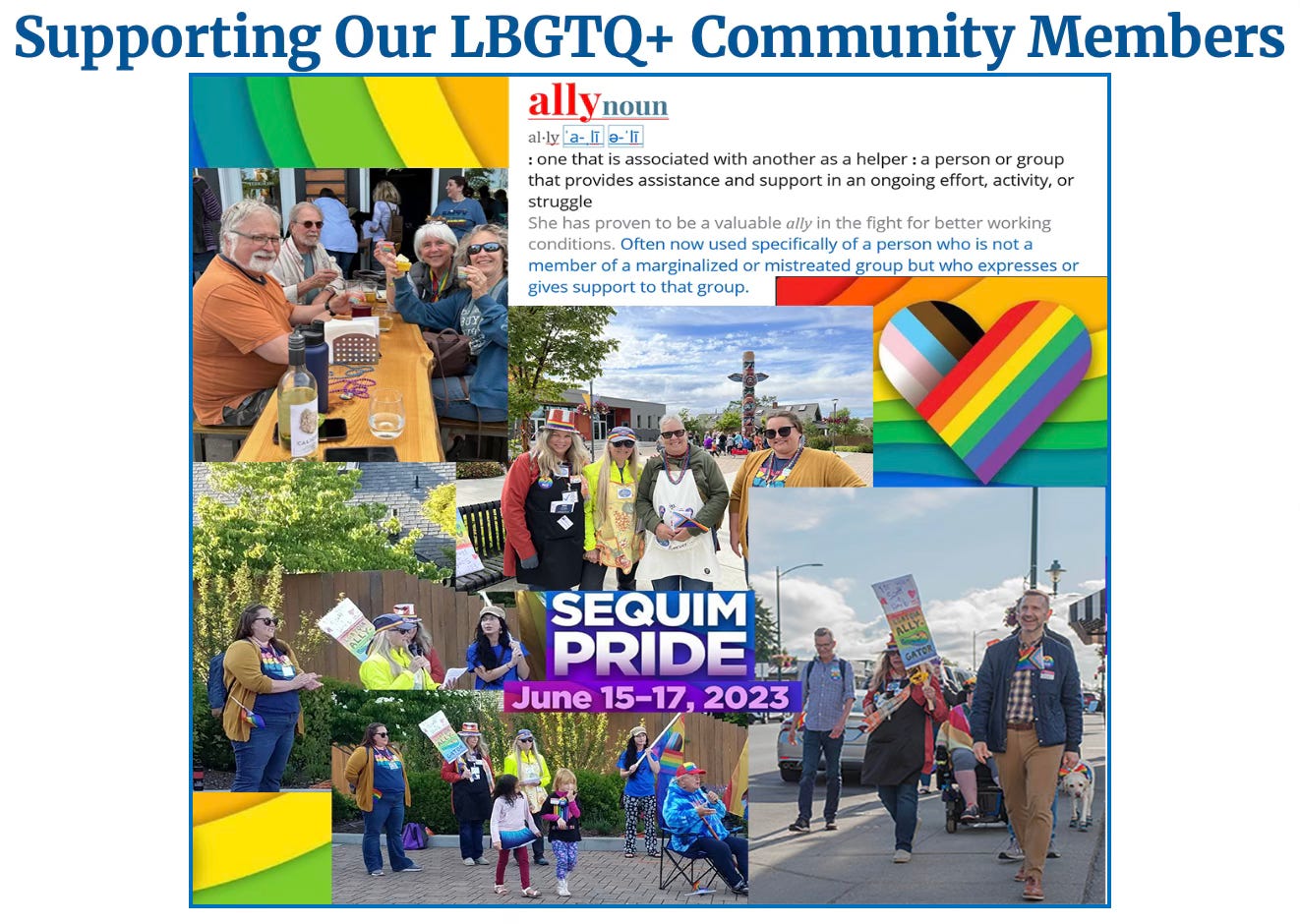
In it, former League of Women Voters Secretary Susan Fisch is front and center, raising a rainbow shot glass as an “ally.”
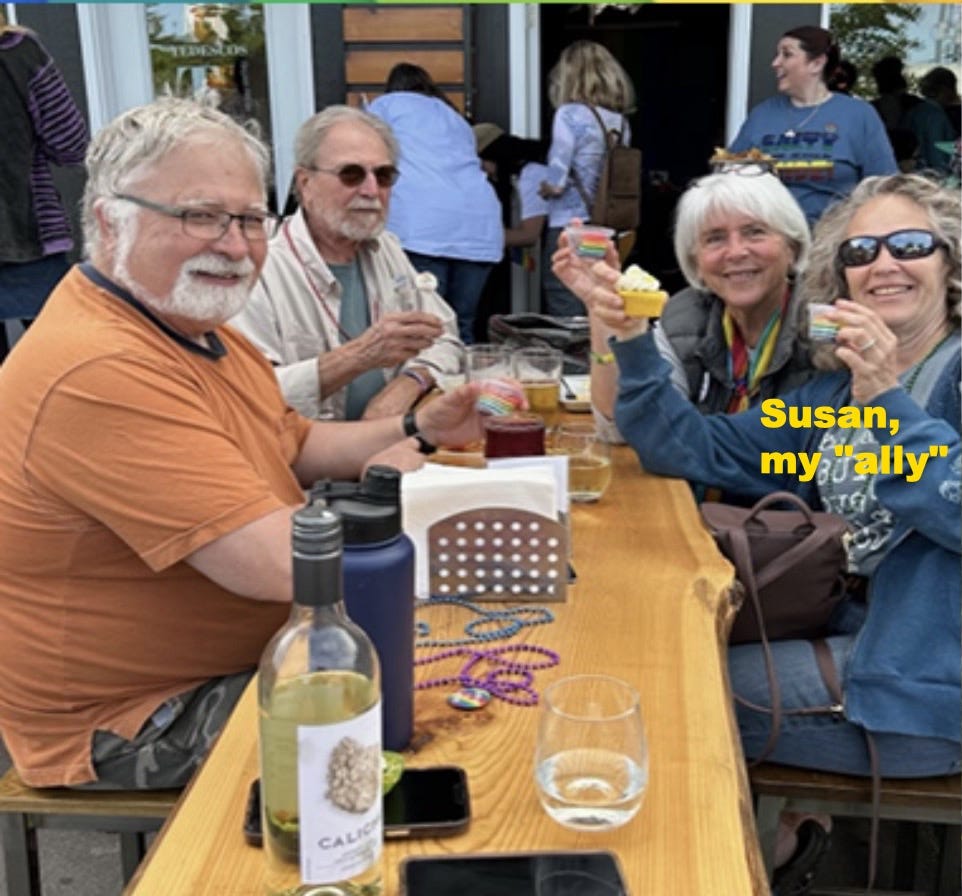
That image matters.
Because I served with Susan Fisch on the 2025 Charter Review Commission.
And during that time, I watched her block agenda items she opposed, restrict public comment, and narrow debate in ways that directly limited participation in a public, taxpayer-funded process. I experienced those restrictions personally. My constituents experienced them. Items were prevented from moving forward. Public input was curtailed. Speech was coonstrained through Susan’s procedural maneuvering.
These are not abstract concerns. They go to the heart of constitutional governance — open meetings, free expression, equal participation in the democratic process.
So when I see the charter review commissioner who ran as the Secretary of the League of Women Voters raising a glass as a champion of LGBTQ+ rights, I can’t help but ask:
Where was that same commitment to protecting rights when it came to protecting the rights of fellow commissioners and Clallam County residents to speak, propose, and participate freely?
In my lived experience, no federal administration has annulled my marriage. No president has stripped me of my constitutional rights as a gay man.
But at the local level, I’ve witnessed procedural power used to limit participation — and it was done by someone who publicly brands herself as a defender of equality.
That’s hypocrisy.
If the Secretary of an organization that claims to be nonpartisan and rights-focused participates in restricting open debate and public process, then it is fair to ask whether the League’s rhetoric about defending rights applies to everyone — or only to those who agree with them.
Rights are not situational. Free speech is not conditional. Public participation is not ideological.
And when someone who publicly claims to defend rights uses procedural authority to narrow them, that deserves scrutiny.
The League claims nonpartisanship.
The League runs partisan ads.
The League curates debate.
The League does not answer direct questions.
Nonpartisan means engaging issues individually, not condemning entire administrations. It means fostering open debate, not controlling the microphone. It means answering constituents, even when the question is uncomfortable.
This article begins a weekly series.
Each Friday, I will pose direct, respectful questions to the League of Women Voters of Clallam County. They are invited to respond through CC Watchdog. I will publish their responses in full, without editing.
Here are this week’s questions:
How does condemning an entire presidential administration align with your claim of being nonpartisan?
What specific policy actions did you reference when stating there were “continued attacks” on the LGBTQIA+ community?
Why are questions at League forums curated rather than asked directly by constituents?
Will the League commit to responding publicly to reasonable questions from the community?
How do you define “nonpartisan” in practice — not just in branding?
If you are a curious League supporter, or critic — send additional questions to info@lwvcla.org.
Transparency builds trust. Silence erodes it.
The League has the opportunity to clarify its mission and demonstrate that it truly serves all voters — not just those who agree with it.
The microphone is open.
Good Governance Daily Proverb:
In a constitutional republic, public power belongs to the people—not to organizations; transparency keeps that line clear, and when influence moves without visibility, the law may stand while public trust quietly erodes.
The commissioners did not respond to yesterday's question about how the Recompete Coordinator will bring people back into the workforce while also opposing capitalism.
Here is today's email to the League of Women Voters:
Dear League of Women Voters,
Please see the five questions at the bottom of the article. I’m happy to publish your responses in full, unedited.