

The League of Women Voters says it stands for equity, inclusion, and amplifying marginalized voices. But what happens when those voices were silenced—not by outsiders—but from within? A closer look at the Clallam Relief Act of 1925 raises uncomfortable questions the League seems unwilling to answer.
Last month marked the 101st anniversary of the Clallam Relief Act of 1925—a law often framed as a long-overdue effort to compensate the Clallam people. Congress appropriated $400,000, later reduced to $385,000, to be distributed among enrolled tribal members. On paper, it looked like justice.
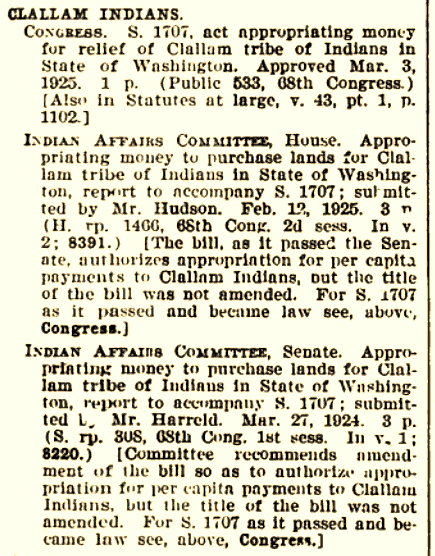
In practice, it tells a far more complicated—and far less discussed—story.
To receive payment, individuals were required to sign a sweeping legal release, relinquishing “all claims of any nature” against the United States under any treaty or agreement, including the Treaty of Point No Point. The intent was clear: this was meant to be a final settlement.
And yet, even at the time, not everyone was included.
Who Was Left Out—and Why It Matters
Historical records from 1926 reveal that eligibility was not simply about lineage—it became about who was allowed to count.
Despite federal guidance that tribal decisions should involve both men and women, a small group of male signatories pushed to exclude:
Clallam women who married outside the tribe
Their children
Others deemed to have “questionable” or “shadowy” claims
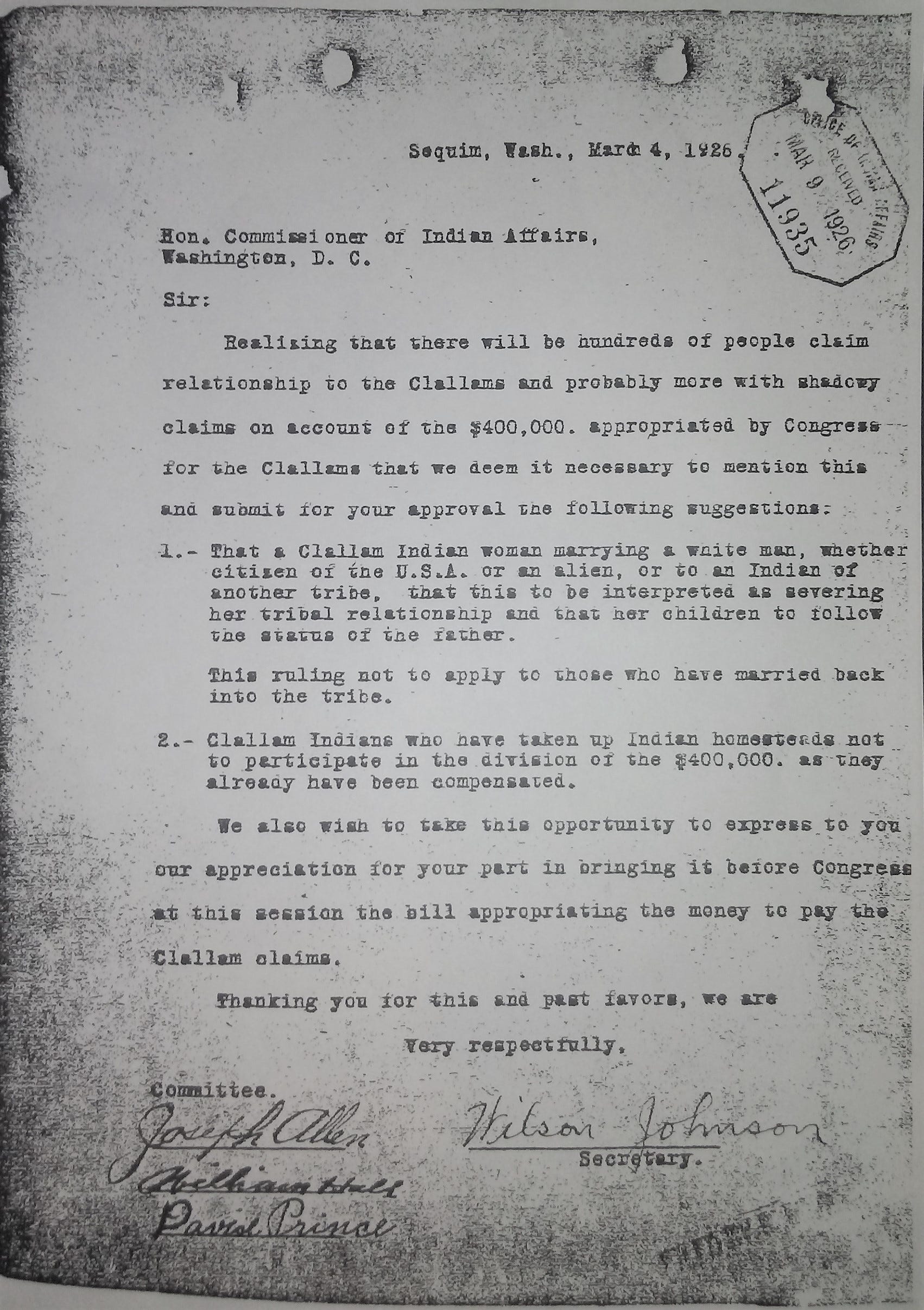
The reasoning? Fewer claimants meant larger payouts.
The result was not just administrative—it was systemic exclusion. Women and children who met earlier criteria were deliberately removed from the base roll. Their absence wasn’t incidental. It was strategic.
And the consequences didn’t end in 1925.
By 1933, complaints surfaced that hundreds of Clallam individuals had received nothing at all. Estimates suggested roughly 700 tribal members existed, but only about 533 participated in the distribution. The rest were left out—completely.
A Settlement That Didn’t Settle
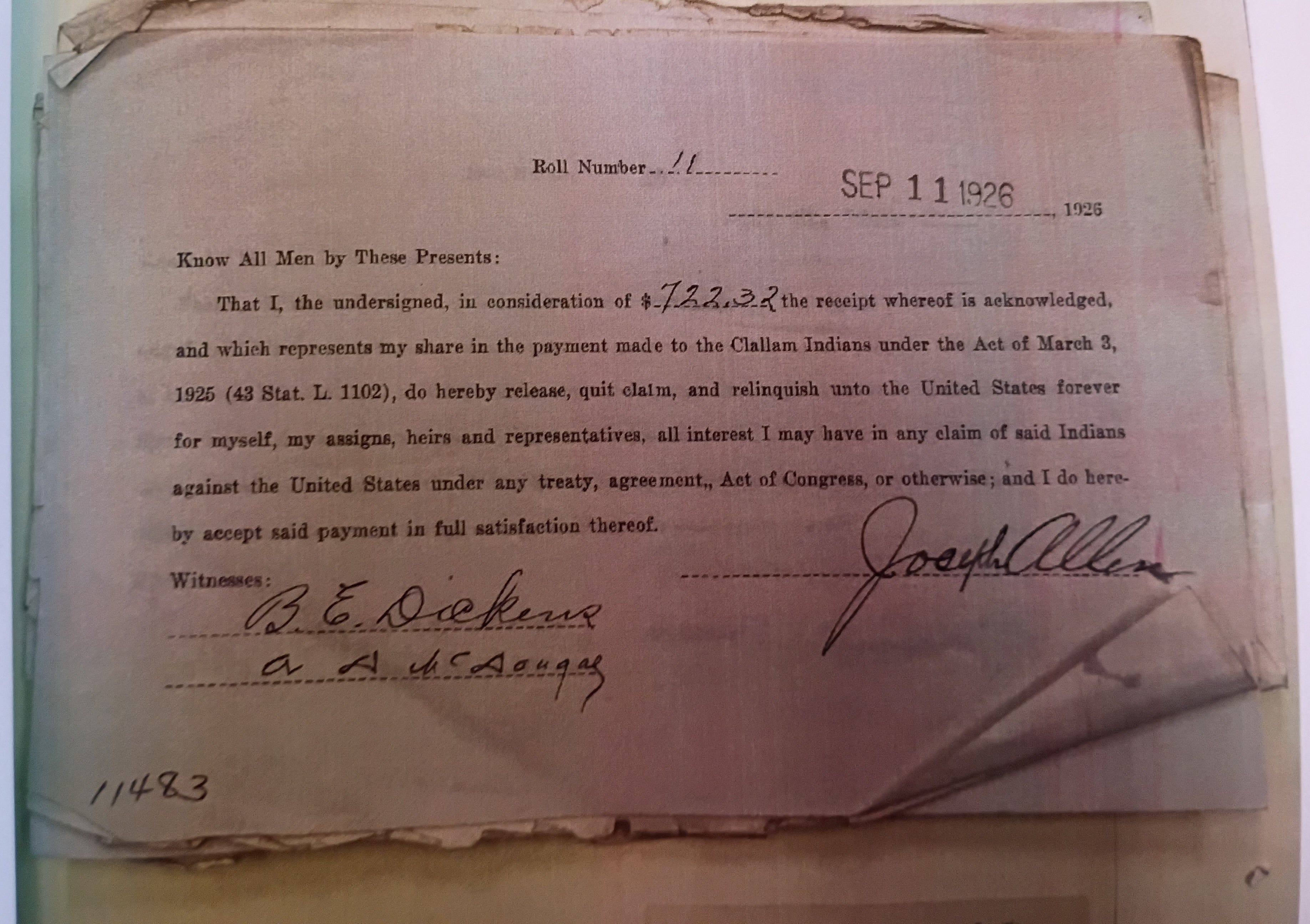
Each recipient signed language accepting payment as “full satisfaction” of all claims. That raises a reasonable question:
If this was truly final—why are we still revisiting these issues today?
But there’s another question, one that gets far less attention:
What about those who were excluded entirely?
What claims did they ever get to settle?
The League’s Selective Advocacy
The League of Women Voters frequently invokes phrases like:
“equity”
“inclusion”
“amplifying marginalized voices”
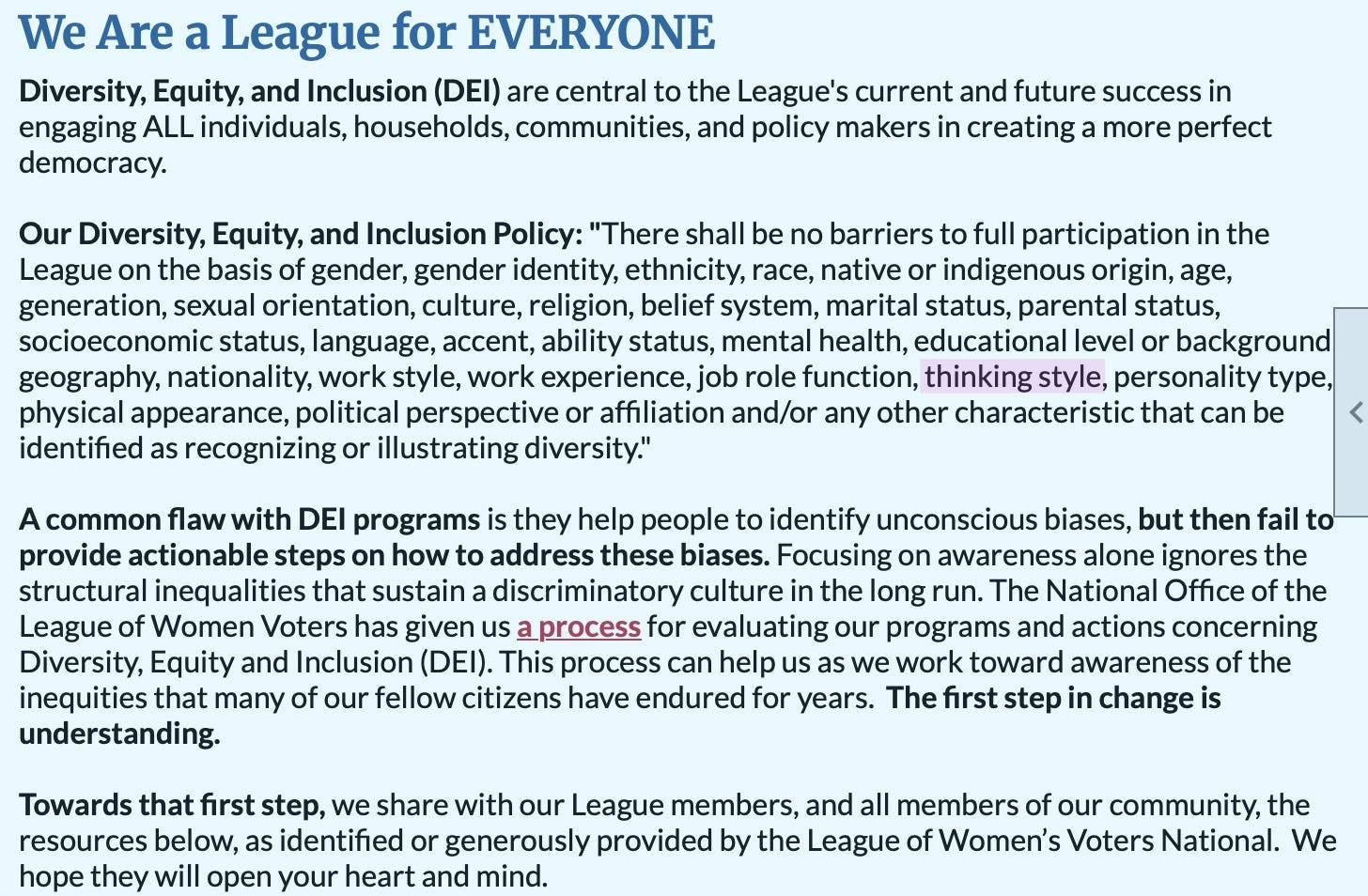
It acknowledges the region as the homeland of Indigenous people and speaks about historical injustices. But those statements tend to stop where the narrative becomes uncomfortable.

Because if the League is serious about amplifying voices, it raises difficult questions:
What about Clallam descendants whose lineage was excluded because of who their grandmothers married?
What about individuals of Clallam heritage who remain unrecognized today?
What about the Chimakum people—whose history in this region includes displacement, violence, and near-genocide at the hands of the Clallam?
The Chimakum are not federally recognized. They received no land, no compensation, and no institutional support. Their story doesn’t fit neatly into modern frameworks of advocacy—and so it is rarely discussed.
If equity is the standard, it has to apply consistently.
History Is Not a Slogan
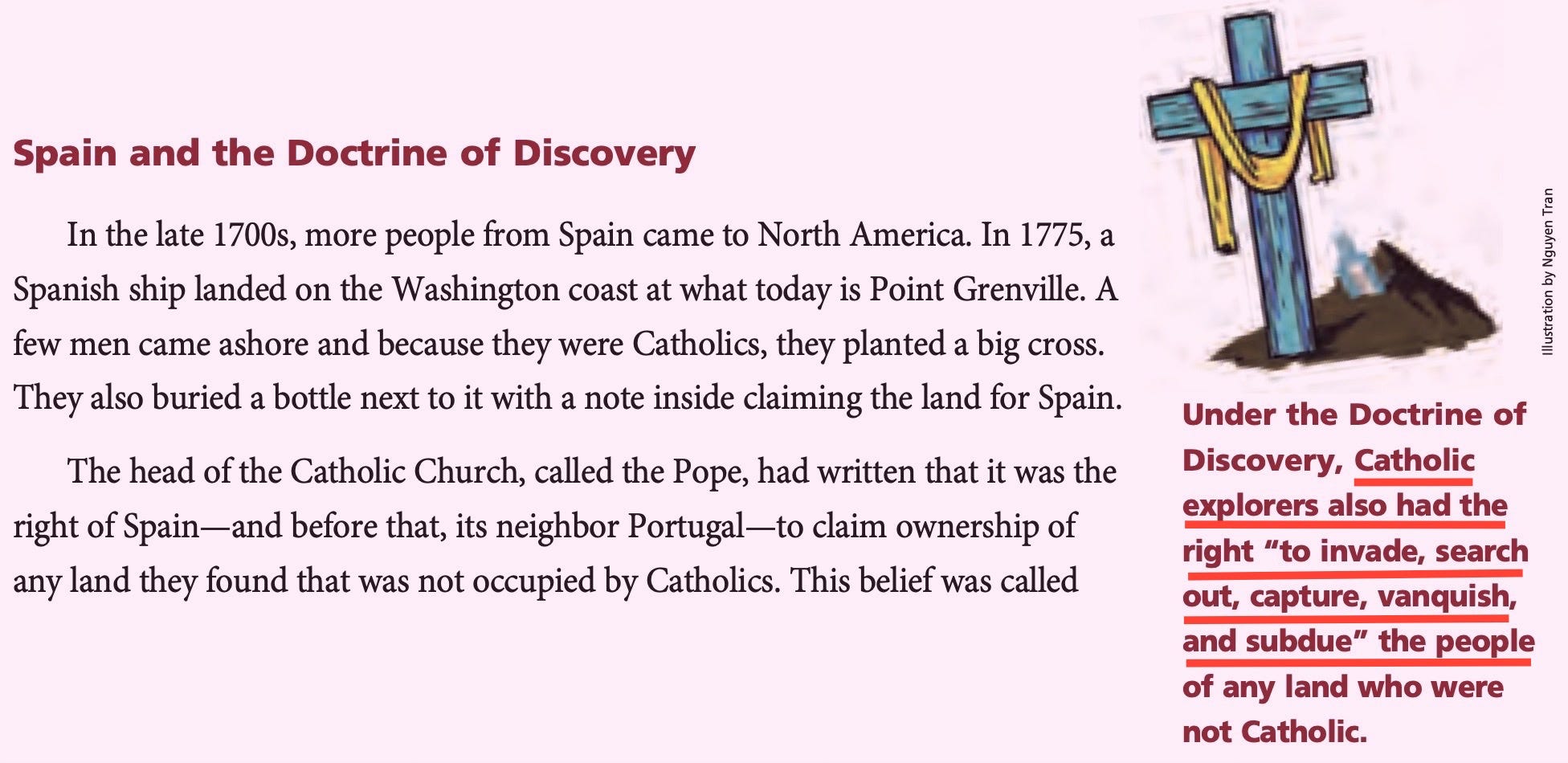
The modern tendency to reduce complex history into simplified narratives—“stolen land,” “colonizers,” “oppressed vs. oppressor”—breaks down under scrutiny.
History in this region, like elsewhere, is layered:
Conflict existed before European settlement
Power shifted between groups over time
Outcomes were not always just, even within communities
Acknowledging that complexity doesn’t diminish anyone’s experience—it strengthens the credibility of the conversation.
Ignoring it does the opposite.
A Question the League Should Answer
If the League of Women Voters is committed to fairness and representation, then the question isn’t whether it supports Indigenous voices.
The question is:
Which voices—and why those?
Because when advocacy appears selective, it starts to look less like principle and more like alignment.

Closing Perspective
The Clallam Relief Act of 1925 was supposed to resolve claims. Instead, it left behind a record of exclusion that still echoes today.
That history doesn’t disappear just because it complicates a modern narrative.
And for organizations that claim to stand for inclusion, that’s not a detail—it’s the test.
The League of Women Voters has found the time to take out ads in local newspapers warning residents that their rights are at risk. But when asked a simple, direct question—which rights?—there’s no response, no clarification, no engagement.

This is now the seventh article raising legitimate questions about the League’s positions and actions. Every article has been sent to info@lwvcla.org. Not one question has been answered.
Yet this is the same organization that hosts forums, moderates debates, and positions itself as a steward of civic dialogue. The message is hard to ignore: they ask the questions, but answer to no one.
Through the Clallam County Charter Review Commission—an entity frequently chaired or influenced by League leadership—they have helped shape the direction of county governance for decades. But during the most recent Charter Review, that influence took a more troubling turn.
The League’s secretary, Susan Fisch, along with other members, pushed for changes that would limit what could be reported from publicly available information. In effect, they were advocating for restrictions on speech—on information that is already, by definition, public.
That is not a gray area.
The First Amendment is a cornerstone of American democracy. It protects the free exchange of information, the right to report on public matters, and the ability of citizens to hold government accountable. Efforts to restrict the reporting of public information run directly counter to those protections.
So the question becomes unavoidable:
How is that defending democracy?
At the same time, the League’s internal rhetoric around “diversity of thought” rings hollow to many who have watched dissenting viewpoints dismissed or excluded.
If inclusion is the standard, it must apply beyond those who align ideologically.
There are, without question, marginalized voices in Clallam County that deserve to be heard. But increasingly, those voices include people who simply think differently than the League and the activist circles it promotes.
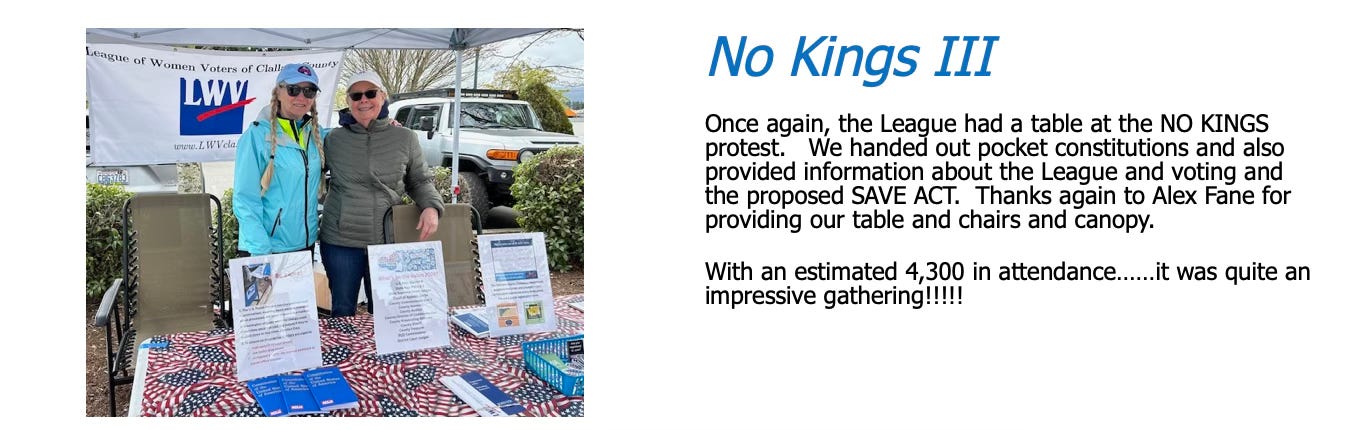
The League also plays a role in election observation—and in some cases, administration, such as involvement in Conservation District elections. For an organization that insists on its neutrality, that level of influence raises reasonable concerns about perception, impartiality, and public trust.
Taken together—with its role in civic processes, its willingness to entertain restrictions on speech, and its lack of responsiveness—the result is not greater confidence in local institutions, but growing skepticism.
Accountability isn’t optional for organizations that claim to defend democracy.
And when questions go unanswered, people will start asking them somewhere else.
Today’s Tidbit: Drought for Some, Not for All
The Washington State Department of Ecology has issued a statewide drought declaration, with the Olympic Peninsula flagged as especially vulnerable due to unusually low snowpack.
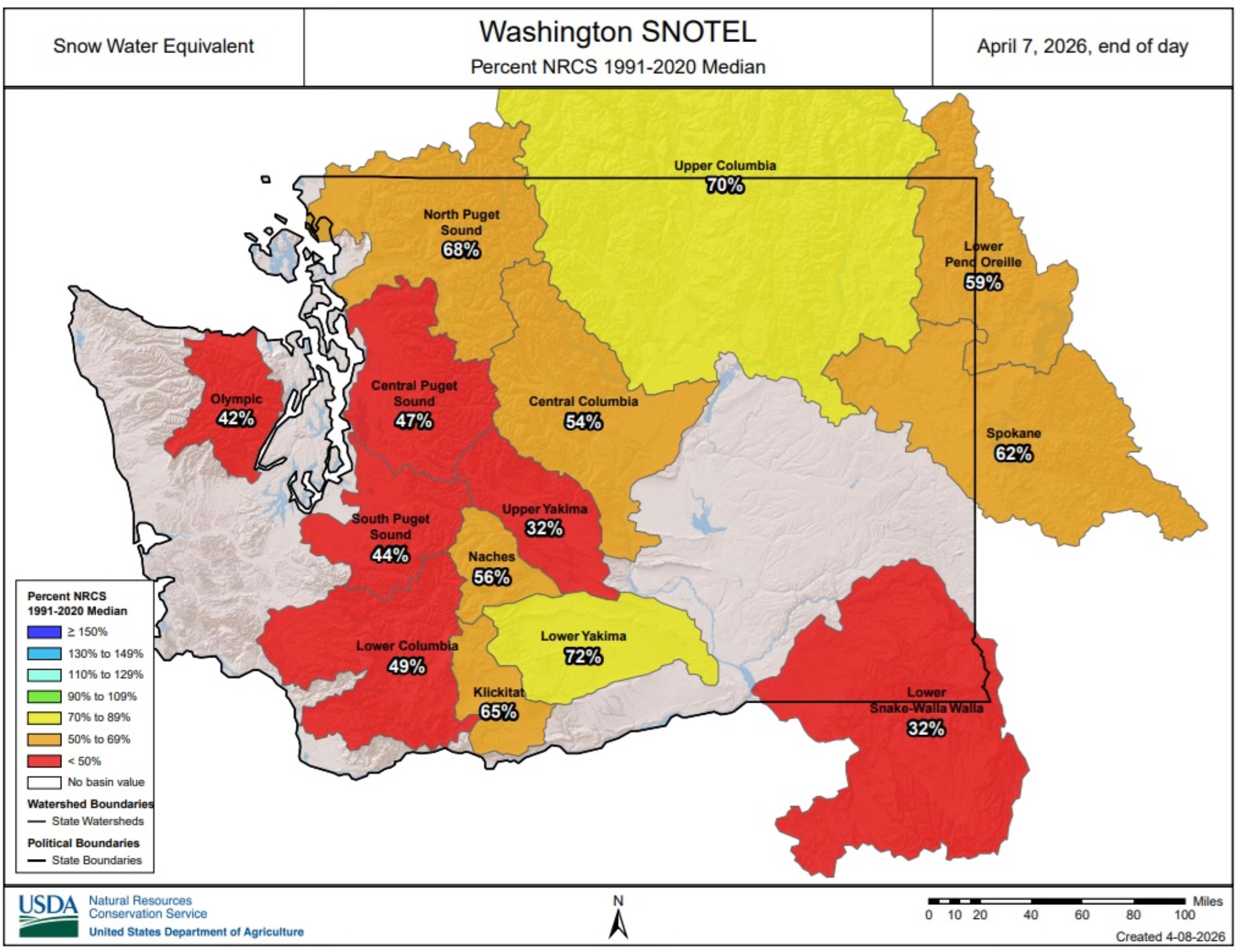
“Going into April with half of our usual snowpack is alarming,” said Department of Ecology Director Casey Sixkiller. “Without enough snow… we must prepare for widespread shortages.”
The message from the state is straightforward: start conserving now.
For the moment, that conservation is voluntary. Residents are being asked to reduce lawn watering, fix leaks, and limit non-essential use. Local governments may implement restrictions later, but today the responsibility rests largely on individuals to act early.
The Inconsistency
On the Olympic Peninsula, where summer water supply depends heavily on mountain snowpack, the concern is legitimate.
But the application isn’t uniform.
While residents are urged to cut back, large-scale water users—such as irrigated golf courses—are expected to continue operating. That includes the Jamestown S’Klallam Tribe’s 122-acre course, which hosts the “Sonny Sixkiller Celebrity Golf Classic” in late July, typically one of the driest periods of the year.

Sonny Sixkiller, the tournament’s namesake and spokesman for Jamestown Corporation, is also the father of Ecology Director Casey Sixkiller.
The result is an uncomfortable contrast: the state’s top water official is calling for conservation while a high-profile, water-intensive event tied to his father proceeds during peak drought season.
Complicating matters further, state-imposed water restrictions do not apply in the same way to sovereign tribal trust lands, creating a structural gap in how conservation policies are experienced across the region.
The Question
No one is disputing the drought.
But when conservation is voluntary for some, enforceable for others, and functionally inapplicable to entire categories of land use, it raises a fair question:
Who, exactly, is being asked to sacrifice?
The commissioners did not reply to yesterday's question about the harm reduction supplies discovered during Joshua Wilson's arrest, and whether providing drug paraphernalia is having the intended consequences. Also, the Sequim School District did not reply to last week's email requesting an investigation into the possibility of an inappropriate relationship between a student and League of Women Voters activists.
Here is today's email sent to info@lwvcla.org:
Dear League of Women Voters of Clallam County,
I’m writing with a few straightforward questions that I believe deserve clear answers.
Over the course of multiple articles and direct outreach, several questions have been sent to your organization without response. Why has the League chosen not to engage or provide clarification?
Additionally, why did the League decline to advertise or promote the recent Public Safety Town Hall—an event open to the entire community—despite being asked, while continuing to promote events such as ESPRIT, which is a private convention for transgender individuals? (https://lwvcla.clubexpress.com)
Finally, when concerns are raised about the conduct of individuals in leadership positions—such as Susan Fisch and Patrice Johnston, whose actions are perceived by some as hostile to free speech—does the League’s silence indicate agreement or endorsement of those actions?
These are basic questions about transparency, consistency, and accountability. I would appreciate a direct response.
The difference between last night's Calico Cat forum, which by the way was standing room only and went long due to public interest, and LWV forums, was that the questions weren't curated.
In one setting we had the ultimate in free speech and public debate with no agenda other than to hear perspectives. In this current environment of overcharged national politics controlling local politics little old Clallam County came together and just talked. WTF? It felt surreal, especially because while the verve was clearly in one direction there were those publicly recognizable as being associated with the LWV's also asking hard questions of the panel.
On the other hand, the LWV's curates the questions they'll allow a candidate to be asked. What's not so obvious is their use of the tactic of telling anyone with a question to submit it which in reality is a method to curate the questions so as to control the narrative.
Until the LWV's decides to return to their original mission I won't ever spend another minute listening to them tell me how to think.
Thank you Mark Curtis, the organizer of last nights event, of injecting a breath of fresh air back into Clallam County last night.