

DNR’s Tiger Stripes timber sale near Salt Creek sold for $1.17 million, money set aside for Crescent schools, Hospital District 2, Fire District 2, county roads, and the library. On Dec. 2, the coalition trying to undo it and block the next sale holds its Sequim rally at the Dungeness River Nature Center, in a venue the Jamestown Tribe owns. They call a 100-year-old second-growth stand a “legacy forest.” Before it’s locked up, someone should ask who pays.
The flyer
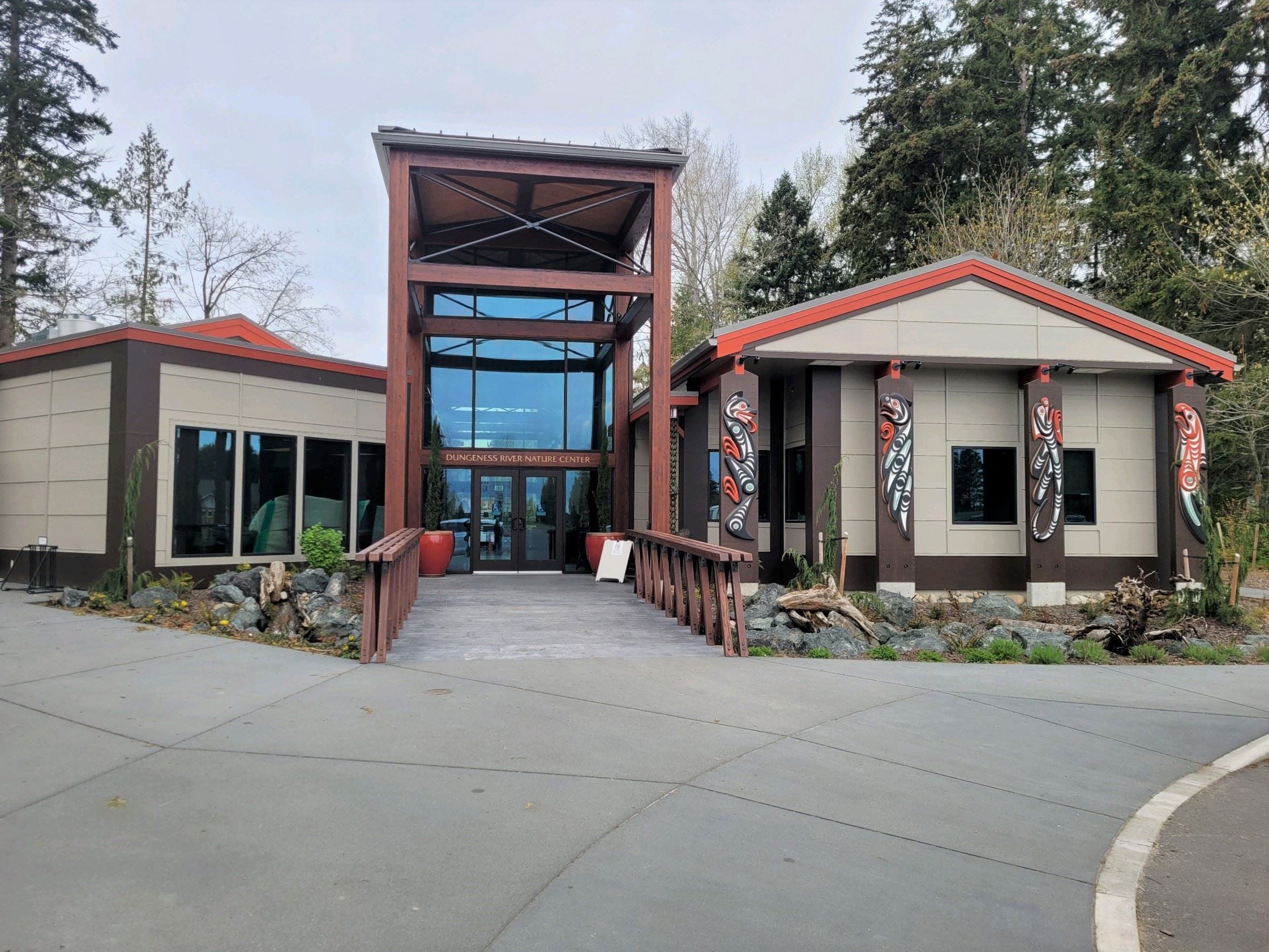
The poster reads like a nature talk: “Save Our Rare Coastal Forest! Salt Creek/Striped Peak. An evening to learn about the nature, ecology and cultural value of this forest.” Wednesday, Dec. 2, 6:30 to 8 p.m., at the Dungeness River Nature Center, 1943 W. Hendrickson Road, Sequim.

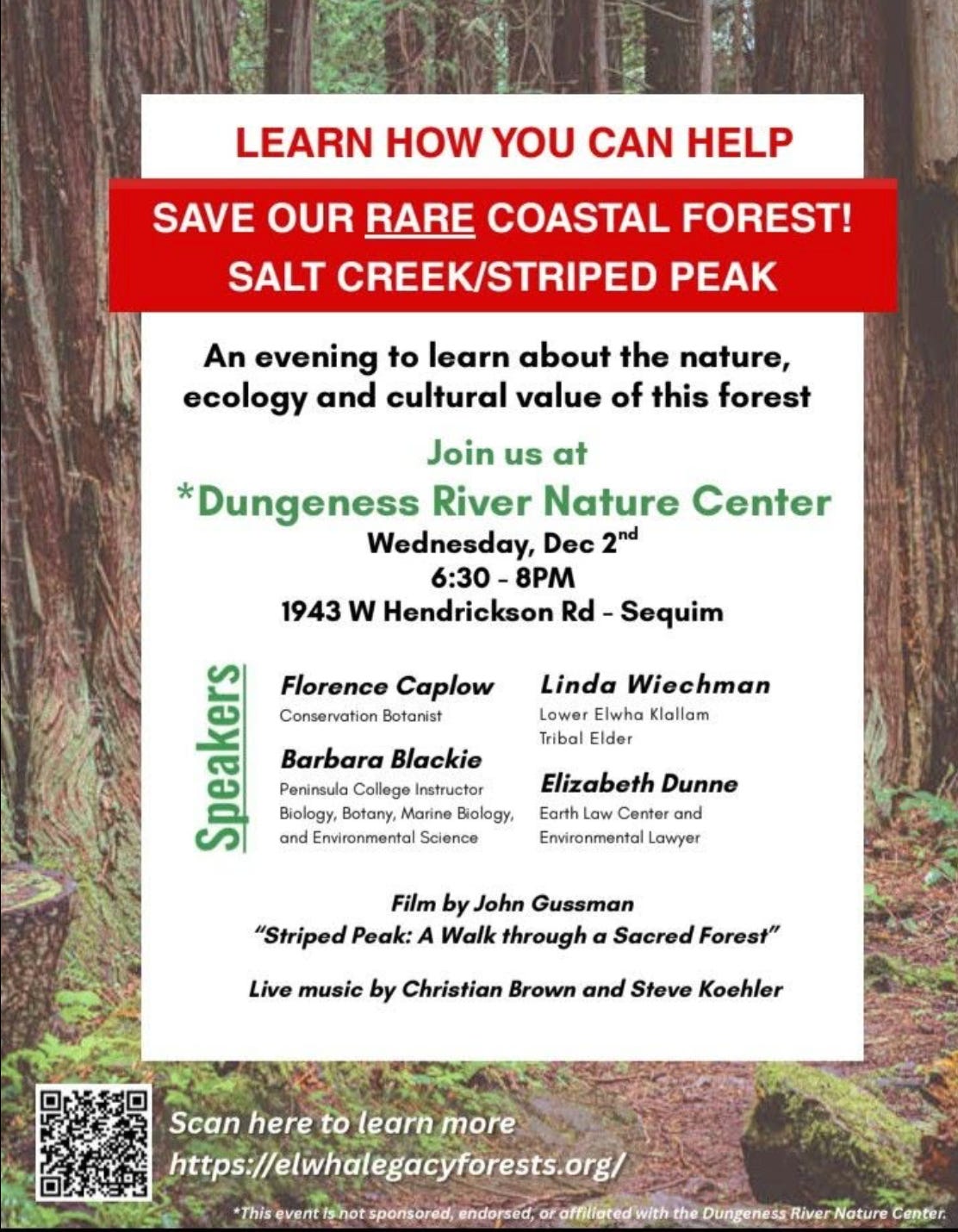
The speakers are conservation botanist Florence Caplow; Peninsula College biology instructor Barbara Blackie; Lower Elwha Klallam Tribal Elder Linda Wiechman; and Elizabeth Dunne of the Earth Law Center. There’s also a short film by John Gussman, “Striped Peak: A Walk through a Sacred Forest,” and live music performed by Indivisible activist Steve Koehler.
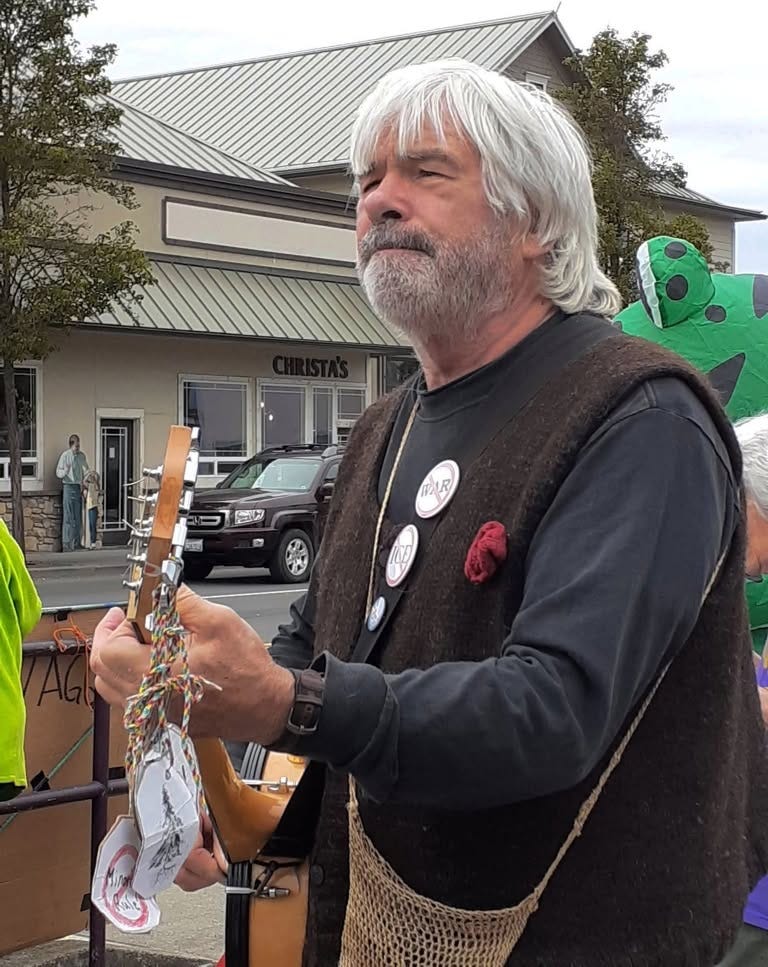
The group behind it isn’t a foundation. It’s the Elwha Legacy Forests coalition, which posts on Facebook as “Olympic Peninsula Legacy Forests Community.”
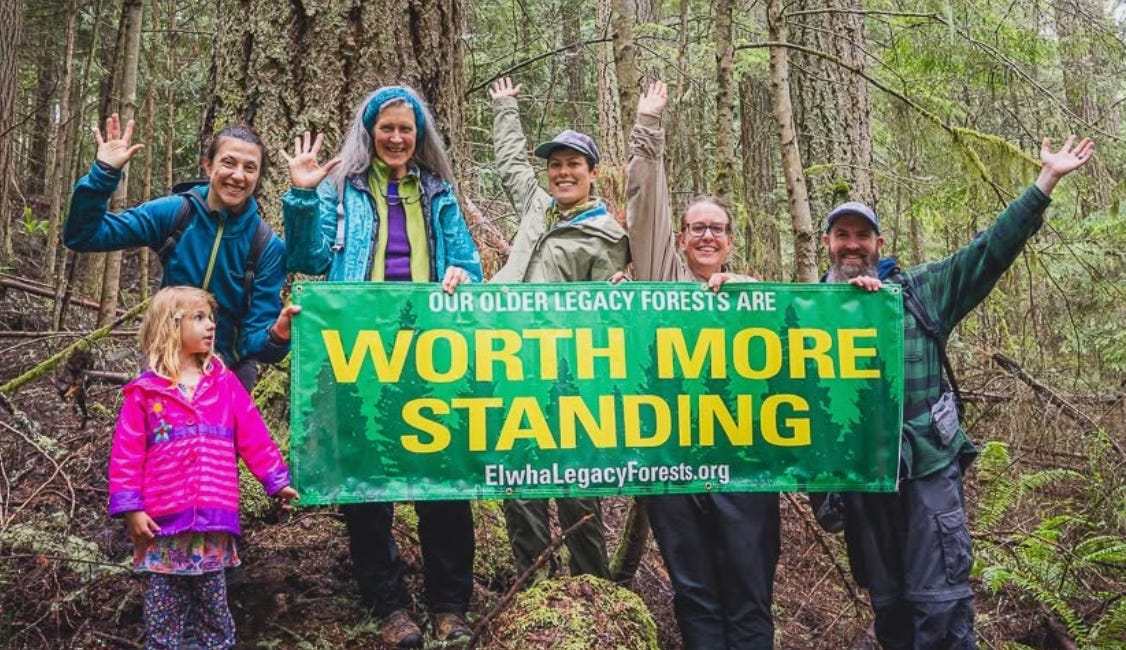
By its own description, it’s “a local and volunteer grassroots coalition” formed in 2022 to stop DNR timber sales. The Earth Law Center says Dunne co-founded it in early 2023. Its website lists the sales it has fought: Power Plant, TCB23, Doc Holliday, Alley Cat, Parched, Tree Well, Bread and Butter, and now Tiger Stripes and Bird’s Eye View on Striped Peak.
The event isn’t a lecture. It’s one stop in a campaign. The coalition’s Salt Creek page asks readers to call the Commissioner of Public Lands and the Board of Natural Resources and “ask them to permanently cancel these timber sales,” including the one that has already been sold.
What’s actually being cut
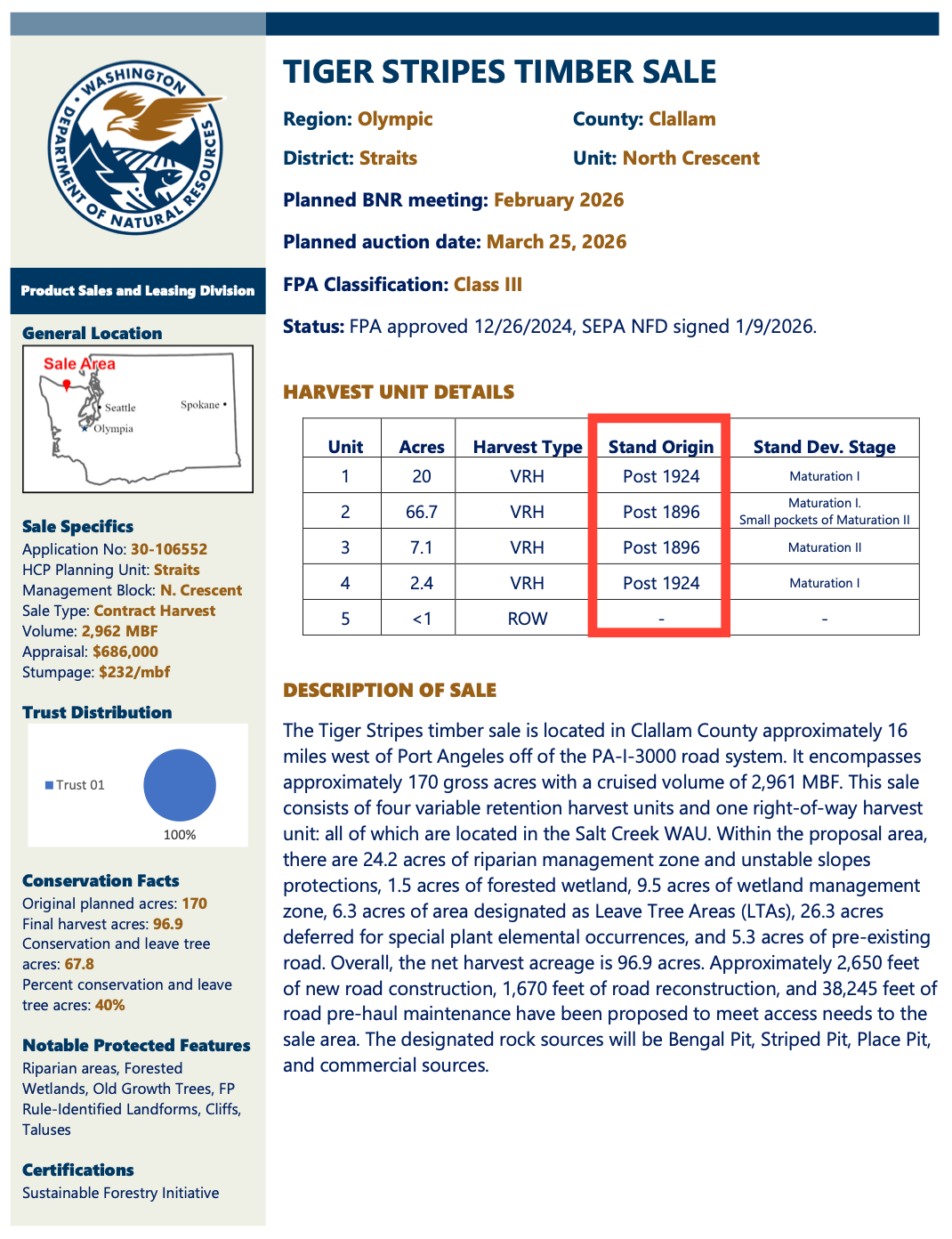
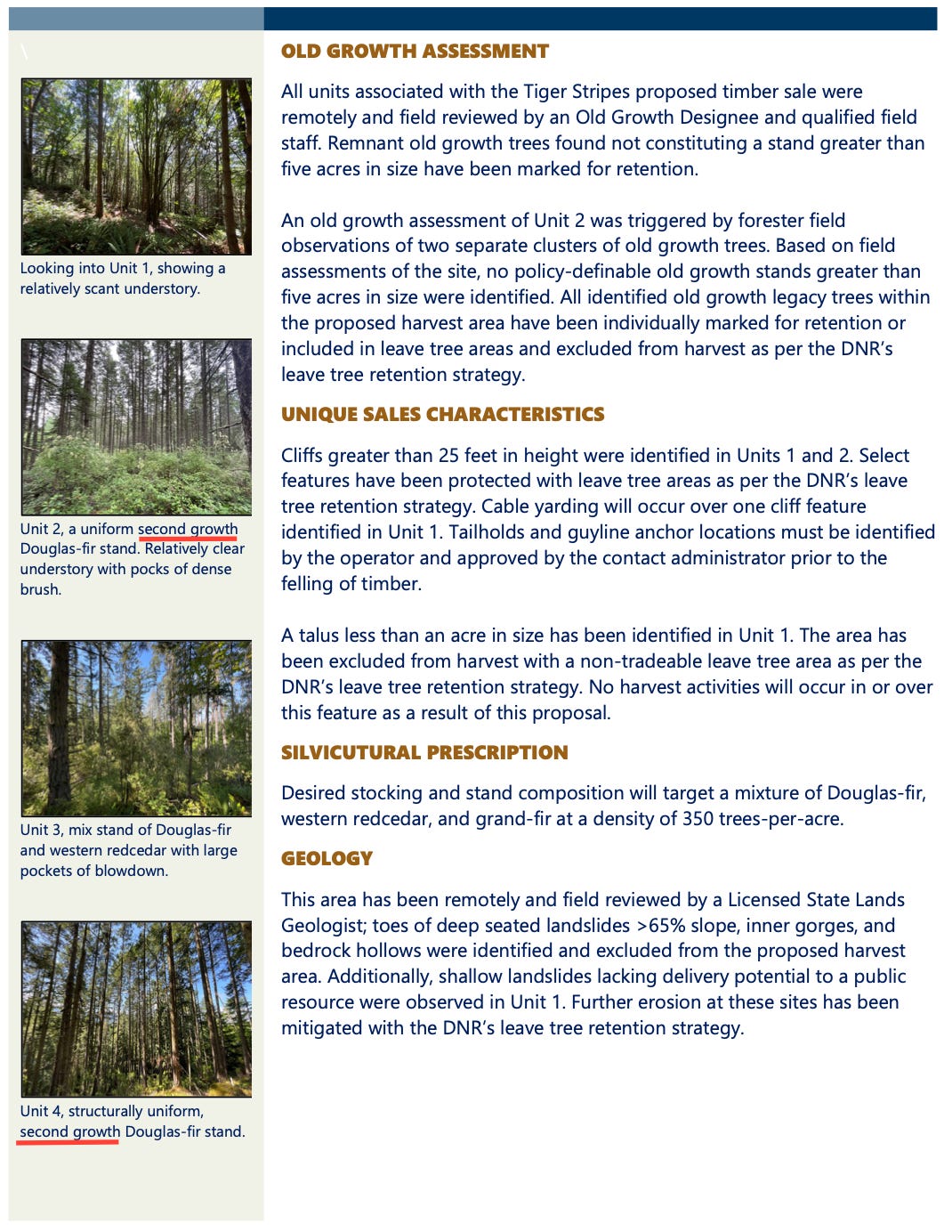
DNR’s own February 2026 fact sheet for the Board of Natural Resources describes Tiger Stripes this way:
Stand origin: “Post 1896” and “Post 1924.” That’s roughly 100 to 130 years old.
What foresters found: Unit 2 is “a uniform second growth Douglas-fir stand.” Unit 4 is a “structurally uniform, second growth Douglas-fir stand.”
Old growth: An Old Growth Designee reviewed every unit and found “no policy-definable old growth stands greater than five acres.” Individual old trees were “marked for retention.”
What’s left standing: Of 170 gross acres, 96.9 will be harvested. The other 67.8 acres, or 40%, are set aside for streams, wetlands, unstable slopes, cliffs, leave trees, and 26.3 acres deferred for rare plants.
That isn’t old growth. It’s a forest that regrew after it was cut or burned more than a century ago, on land the state manages to make money for public services. Nothing in DNR’s sale documents shows whether people planted it or it reseeded naturally. The coalition calls it “naturally regenerated.” Either way, it’s second growth on a working forest.
It was also always on the schedule. DNR approved the forest practices application for Tiger Stripes in December 2024. The coalition’s own flyer says Bird’s Eye View was “originally not scheduled until 2028.” That’s another way of saying it was scheduled. The coalition’s proposal also says DNR “logged areas surrounding Tiger Stripes less than 10 years ago.”
Who gets the money
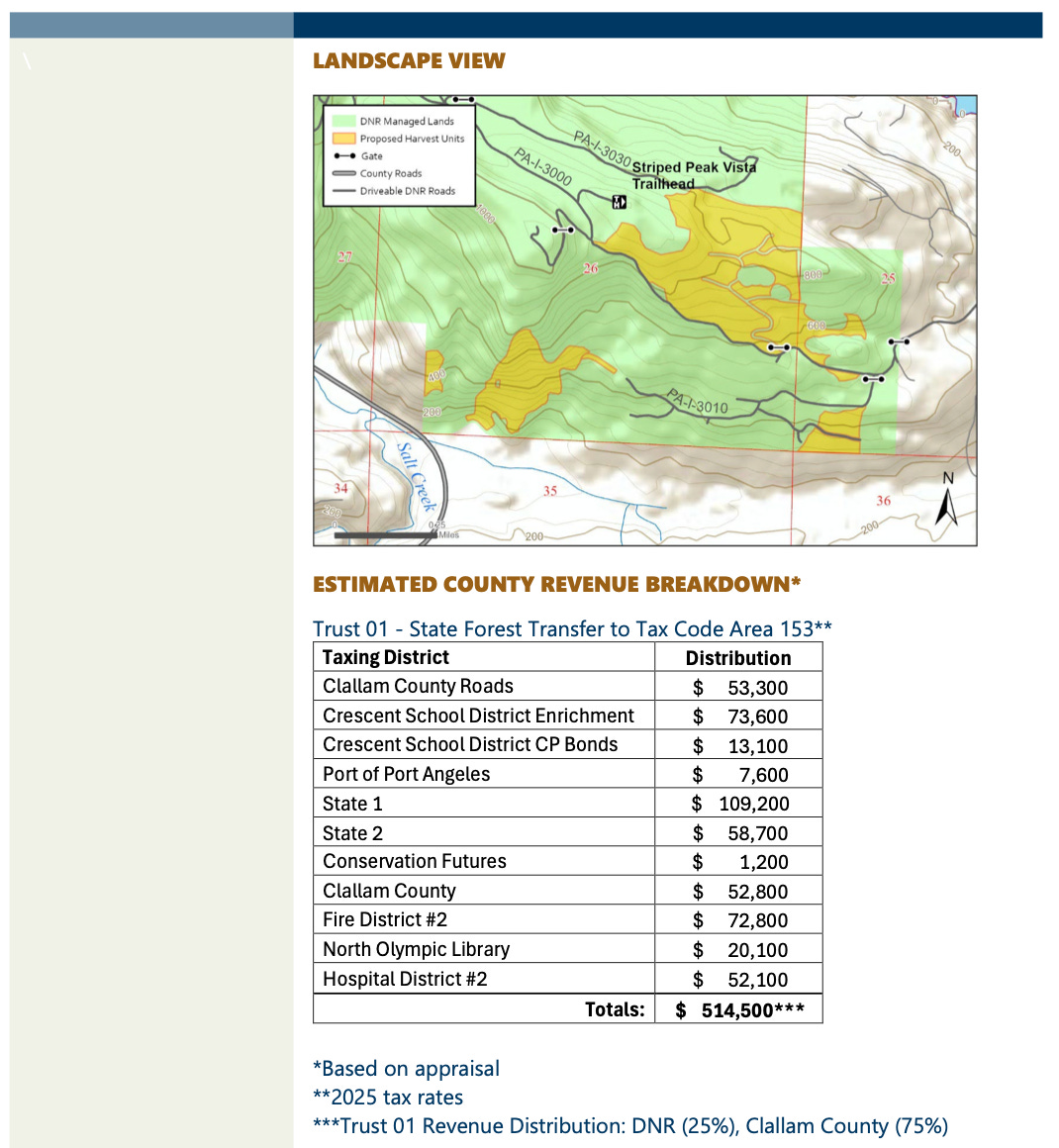
Tiger Stripes sits on 100% State Forest Transfer trust land. Under that trust, DNR keeps about a quarter of the revenue and 75% goes to Clallam County taxing districts, divided by levy rate.
At the appraised value of $686,000, DNR’s fact sheet estimated $514,500 for the taxing districts where the land sits:
Crescent School District: $73,600 for enrichment and $13,100 for capital bonds
Fire District #2: $72,800
Clallam County Roads: $53,300
Clallam County general: $52,800
Hospital District #2: $52,100
North Olympic Library: $20,100
Port of Port Angeles: $7,600
State school levies: $167,900
Conservation Futures: $1,200
But the sale didn’t go for $686,000. On March 25, 2026, Murphy Company bid $1,168,544.46, 70% over the minimum, against two other bidders. If roughly the same 75% split applies, those districts stand to get about $876,000. That’s the money the coalition is asking the state to give back.
Bird’s Eye View is next. The coalition puts its value on paper itself: its proposal asks the Legislature for $3.2 million in Climate Commitment Act money to buy out about 166 acres. Under that plan, the beneficiaries are “fully compensated,” as long as Olympia keeps appropriating.
Here’s the problem with that. When a sale disappears, the school district, the hospital, and the fire department don’t stop needing the money. They ask voters for a bigger levy, or they make cuts. And a $3.2 million buyout isn’t free money either. It’s state money that could have gone to something else.
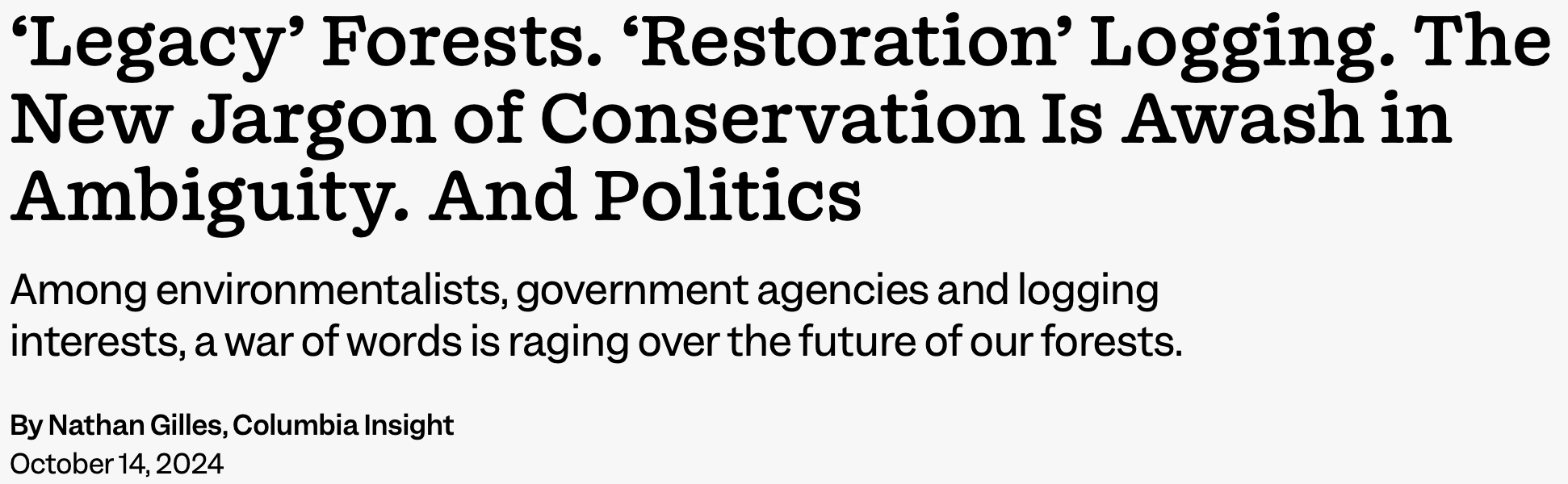
How “legacy forest” was invented
For decades, the line was clear. Old growth is protected. DNR’s policy uses stands of five acres or more that originated before 1850. Everything younger is a working forest.
Then the term changed.
The coinage. After touring state trust forests starting in 2019, activist Stephen Kropp, founder of the Legacy Forest Defense Coalition, wanted a catchier name for “naturally regenerated second growth, mature forests.” He settled on “legacy forests.” The same report says DNR “doesn’t recognize the term ‘legacy forests’ as either a scientific or legal term.”
2022. DNR’s deputy uplands supervisor, Angus Brodie, told NWPB: “The term legacy forest isn’t really a defined term.”
2025. Commissioner of Public Lands Dave Upthegrove used DNR’s own term, “structurally complex forests” (stands at the Maturation II stage). He set aside 77,000 acres and left 29,000 available for harvest. The Legacy Forest Defense Coalition called it “a continuation of the status quo.” The industry group American Forest Resource Council put the timber value of the 77,000 acres at about $2.3 billion.
Today. Elwha Legacy Forests defines a legacy forest as one that is “naturally re-grown 2nd growth and not monoculture plantation forests.” By that definition, nearly any second growth that wasn’t planted in rows qualifies.
By DNR’s count, most of Tiger Stripes is Maturation I. Only Unit 3 (7.1 acres) and “small pockets” of Unit 2 reach Maturation II. Most of it doesn’t meet the old-growth test or even the state’s newer “structurally complex” test. So the language has moved again. The coalition’s Striped Peak proposal talks about “rare coastal rainforests” and “stands 300-400 years old,” and the Dec. 2 film calls it “a Sacred Forest.” DNR’s field review of the Tiger Stripes units found stands that began after 1896 and 1924.
Old growth was replaced by legacy, and legacy by “rare coastal.” Each time a forest fails one definition, a new one is drafted.
The venue
The poster has a footnote: “This event is not sponsored, endorsed, or affiliated with the Dungeness River Nature Center.” That’s fair to note. The center rents its meeting space to community groups and nonprofits, and that is most likely what’s happening here.

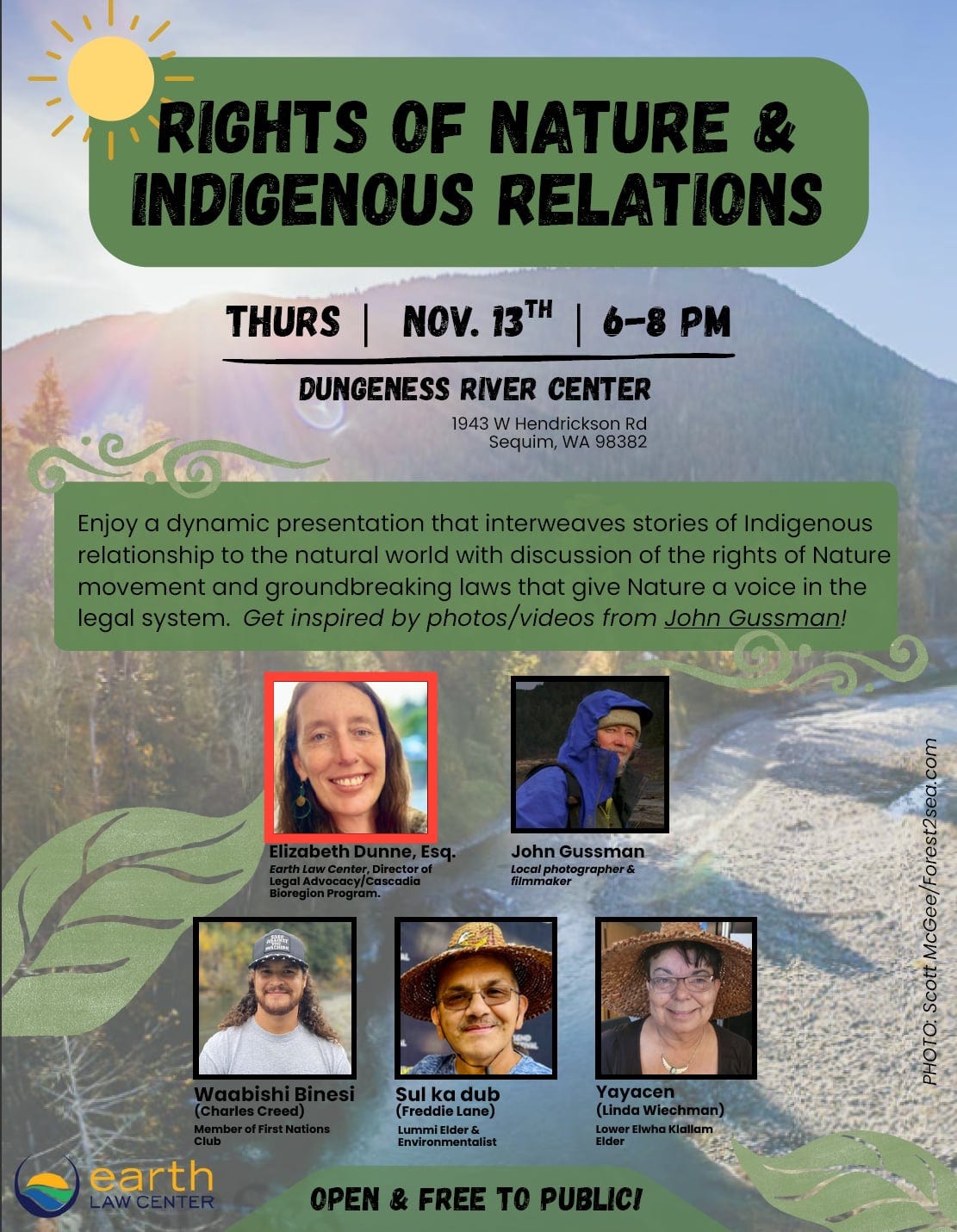
But optics count. The Nature Center sits in the 75-acre Railroad Bridge Park, which the River Center itself describes as “owned by the Tribe.” The Jamestown S’Klallam Tribe has been a partner since 1994, maintains the park and buildings, and lists the center among its own programs. It isn’t the first time. CC Watchdog reported in November 2025 that Dunne was scheduled to present “Rights of Nature & Indigenous Relations” at the same venue.
The tax picture explains why this matters. Land taken into federal trust is exempt from state and local taxation. Every acre the Jamestown Tribe moves into trust comes off the rolls that fund schools, hospitals, and fire districts—the same services that lose revenue when timber harvests decline. In October, the county commissioners wrote to the Bureau of Indian Affairs that “nearly 70 percent of Clallam County is in public ownership and is exempt from paying property taxes,” in a letter approved Oct. 27.
Tribal corporations operating on trust land generally do not pay state or local sales taxes. Tribal gas stations keep 75 percent of the state gas tax under a 75/25 compact with Washington; that money is supposed to help maintain roads. Meanwhile, property taxes on trust land are skipped entirely, shifting the cost of those same roads, schools, and emergency services onto everyone else.
So here is the question for the Jamestown Tribe: does it support a campaign that would further reduce funding sources and raise taxes on its neighbors—costs its own trust land and corporations will not share? If it doesn’t, will it say so? Allowing its venue to be used by an entity pushing policies that shrink the tax base while taxes rise creates poor optics for one of the larger sources of local revenue loss.
Meet the lawyer
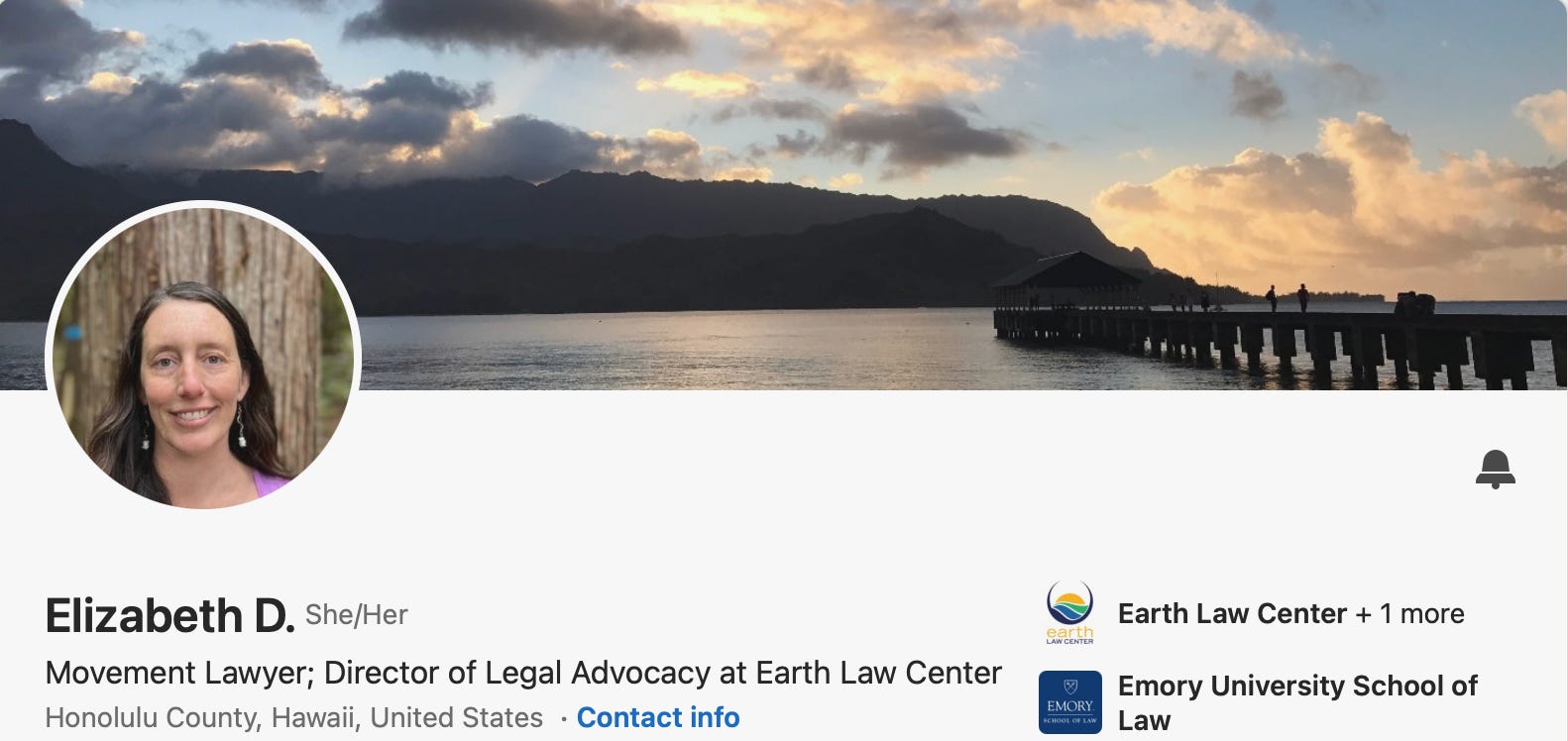
Elizabeth Dunne is the Earth Law Center’s director of legal advocacy. Her LinkedIn profile lists Honolulu County, Hawaii, and the Center’s mailing address is in Durango, Colorado. CC Watchdog has covered her before. Here is what the record shows.
The Elwha lawsuits. The Earth Law Center says it stopped the 150-acre “Power Plant” sale through “community organizing, political pressure, and filing a court action,” with the Center for Whale Research and the Keystone Species Alliance as plaintiffs.
Pennsylvania. On Jan. 5, 2018, U.S. Magistrate Judge Susan Paradise Baxter ordered Dunne and Thomas Linzey of the Community Environmental Legal Defense Fund to pay $52,000 for their “continued pursuit of frivolous claims and defenses” in the Grant Township wastewater-well case. The judge wrote that their theories had been “repeatedly” discredited over 15 years of litigation. (She referred Linzey, not Dunne, to the state disciplinary board.) The defense fund called the ruling punishment for defending a community’s rights.
Rights for wild rice. The Earth Law Center’s mission is “rights of nature,” meaning legal standing for rivers, forests and plants. It says it fights for a future “where nature will be able to defend its rights in court, just like people can.” It also cheered the 2021 lawsuit in which wild rice (Manoomin) was the lead plaintiff against Minnesota’s DNR. That case was brought with help from the Center for Democratic and Environmental Rights, where Linzey is senior legal counsel, and a tribal appeals court dismissed it for lack of jurisdiction.
She is also the contact person on the Striped Peak proposal. Her Earth Law Center manages the “Elwha Forest Fund.”
The Elwha piece, and the end game
Wiechman is presenting as a Lower Elwha Klallam Tribal Elder, and the Elwha connection runs through this campaign. The Elwha report Dunne’s group co-wrote in August 2026 says “over half of Lower Elwha Klallam Tribal citizens” signed a petition against more logging in the watershed. It also notes the Tribe opposed DNR’s Alley Cat sale in November 2024.
On Oct. 20, 2026, the Lower Elwha Klallam Tribe Project Lands Restoration Act became law. It took about 1,082.63 acres of federal land along the Elwha into trust for the Tribe and made it part of the reservation. To be accurate, that land came from the National Park Service and the Interior Department. It was already federal and already off the county tax rolls.
The bigger question is where this ends. Striped Peak is DNR trust land, not federal land. The coalition’s proposal stresses its “cultural” value and an old Klallam village site at Crescent Bay. It asks for a state conservation designation that would take the land “out of their existing management structure which treats them as timber for harvest.” So:
If Striped Peak becomes a conservation area, who manages it, and who replaces the timber money for Crescent schools and Hospital District 2?
Is a “sacred forest” framing the first step toward asking for a transfer?
Tribal trust and reservation land already pays no county property tax. As more land moves off the rolls, or out of production, who pays for the hospital, the fire engine, and the school?
These questions deserve answers in public, before the next sale is pulled.
What you can do
Go on Dec. 2. The event is Wednesday, Dec. 2, 6:30 to 8 p.m., at the Dungeness River Nature Center, 1943 W. Hendrickson Road, Sequim. Ask the speakers how much money Crescent School District, Hospital District 2, and Fire District 2 would lose, and who would replace it.
Comment to the Board of Natural Resources. The board meets Tuesday, Dec. 1. Public comment registration closes at 4 p.m. Wednesday, Nov. 25. Email bnr@dnr.wa.gov.
Contact the Commissioner of Public Lands. Dave Upthegrove can be reached at cpl@dnr.wa.gov or (360) 902-1000. Ask him to honor the Tiger Stripes contract and keep Bird’s Eye View on schedule.
Contact the county commissioners. Ask whether the county has calculated what the junior taxing districts lose if these sales are canceled. All three commissioners can be reached by emailing the Clerk of the Board at Loni.Gores@clallamcountywa.gov.
Read the documents yourself: DNR’s Tiger Stripes fact sheet and the coalition’s Striped Peak proposal.
A working forest pays every time it is harvested. A promise from Olympia pays only until the next budget.