

Welcome to Social Media Saturday, where CC Watchdog does the doom-scrolling on local social media so you don’t have to. This week’s edition highlights a post that crossed a bright line—from condemning hate to promoting it—and exposes how selectively enforced outrage has become in Clallam County.
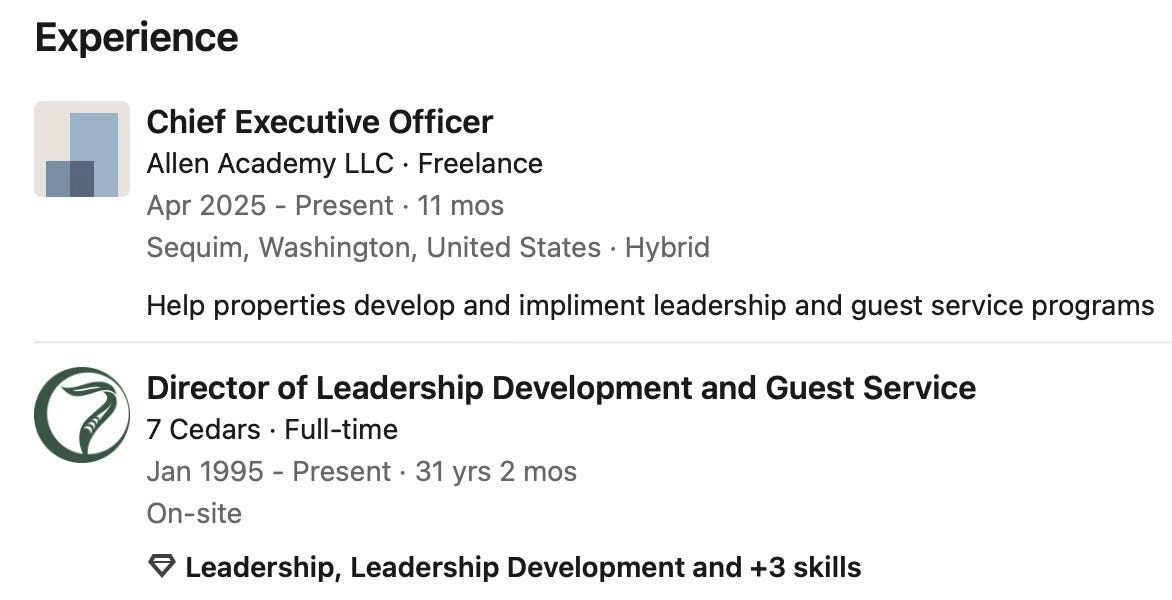
Paula Allen is the niece of Jamestown Corporation CEO Ron Allen. She is also a personal coach and motivational speaker who leads the Allen Academy, an organization that promotes “effective leadership” and claims to provide “the resources and support necessary for individuals to thrive, fostering an intrinsic leadership system that is resilient and adaptable to any challenge.”

This week, Allen identified what she described as a problem:
White people.
There is an added irony. Paula Allen’s uncle, Jamestown Corporation CEO Ron Allen, is 75% white and of British descent, and it is widely understood that many members of Paula Allen’s generation within the tribe are likewise overwhelmingly of European ancestry—commonly 88% white. In other words, the racial category being condemned is not some distant or abstract “other,” but one that overlaps substantially with the very family, community, and workforce she comes from.
In a public Facebook post, Allen wrote, “Embarrassing that we live among them… white people are a problem… and to think they think they are superior—superior to the bottom of my shoe… someone feels very small around kids of color, I would too… if you find out who the parents are, let me know.”
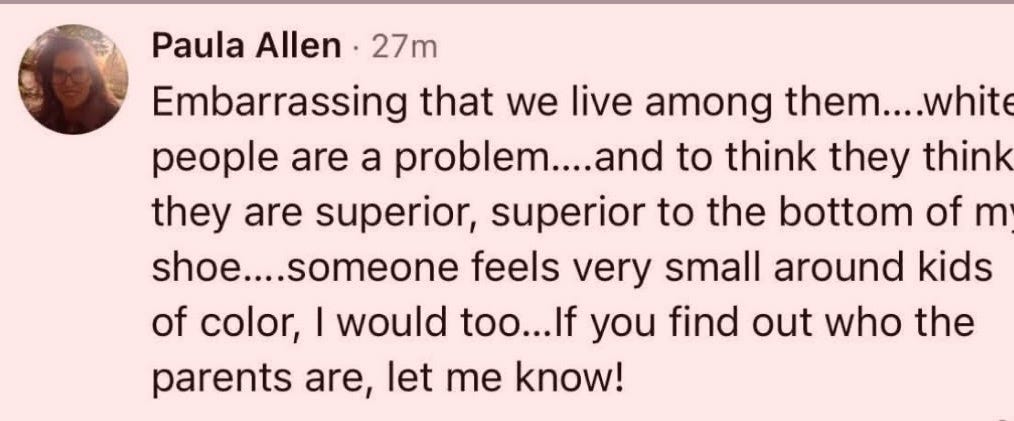
The post appears to have been written in response to a photograph showing a swastika and a racial slur spray-painted on a wall—an act that is despicable, hateful, and deserving of universal condemnation.

But condemning racism does not excuse engaging in it.
Strip away the justifications, and the language stands on its own. It is explicitly racist. Period.
Ask a simple question: what would the reaction be if someone posted that “Hispanics are a problem,” or that “Indians are superior to the bottom of my shoe”? The answer is obvious. There would be outrage. Protests. Candlelight vigils. Statements from organizations. Endless references for years to come as proof of entrenched bigotry.
And rightly so—because that would be racism.
Yet when the target is “white people,” the rules suddenly change. The outrage evaporates. The silence becomes deafening.
Allen spent roughly three decades working for Clallam County’s second-largest employer, the Jamestown Corporation, in roles including Retail Manager and Guest Service Manager at the 7 Cedars Casino. It is not unreasonable to ask: how should white employees have felt knowing a senior figure publicly describes people like them as “a problem,” not even worthy of the bottom of her shoe, solely because of skin color?
Racism does not become acceptable because it is framed as righteous anger. It does not become harmless simply because it targets a politically unfashionable group. And it does not advance justice when it mirrors the very thinking it claims to oppose.
If Clallam County is serious about rejecting racism, it cannot do so selectively. Standards either apply to everyone—or they are meaningless.
Yes, racism is alive and well in Clallam County. And sometimes, it looks exactly like this.

Social Media Weekly Roundup















The commissioners did not respond to yesterday's email about sending concerns to Olympia regarding how the Climate Commitment Act is affecting rural residents in Clallam County. Here is today's question sent via email:
Dear Commissioners,
Do you believe that annually issuing a proclamation that separates constituents into “colonizers” and “Indigenous people” helps reduce or exacerbate racial tensions in Clallam County? Do you think these proclamations advance unity and mutual respect in our community, or might they contribute to division instead?
All three commissioners can be reached by emailing the Clerk of the Board at loni.gores@clallamcountywa.gov.
Good Governance Daily Proverb:
When disagreement collapses into personal attack and collective blame, it reflects a failure of governance norms — not ideology. Institutions fail when grievance replaces standards and people become targets instead of problems being solved.