

On September 11th, 2001, I was a 22-year-old American Airlines flight attendant based in Washington, D.C., dreaming of a life above the clouds. Three years ago, another September 11th sent me walking a river trail in Clallam County and quietly changed the rest of my life. This is the story of how both days stripped away easy assumptions and left something stronger in their place: a belief that this country, and this county, are still worth the work.
Above the Clouds
I graduated from the American Airlines flight attendant academy in July 2001 and was assigned to the Washington, D.C., crew base covering Reagan National, Dulles, and Baltimore. I was twenty-two and certain I had landed the best possible. American had just acquired TWA and was the largest airline in the world. My office rose above the weather every day. No matter how gray things were on earth, I always saw the sun at 35,000 feet.

I was reminded of rising above the clouds on September 9th when I flew from Reagan into JFK. New York sat under a thick blanket of fog. The only landmarks that broke the cloud layer were the twin towers of the World Trade Center. That was the last time I saw them.

The Day the Phones Wouldn’t Work
I was off duty on September 11th. Five of my classmates shared a house with me in Alexandria, Virginia. Two American jets were involved in the attacks; one of them, Flight 77, which hit the Pentagon, belonged to our crew base. I remember the phone lines were jammed that day as I tried to track down roommates and friends based in D.C. and Boston. Eventually every roommate and close friend was accounted for.
Flight 77 was the morning transcon flight to Los Angeles. It was a high-seniority trip none of us with two months on the job could hold. We flew reserve—filling in when others called out or were on vacation. Many of us had worked that flight before 9/11 and would work it again. None of us worked it that morning.
The regular crew on Flight 77 knew their business passengers the way a family knows one another: who took coffee with cream, which newspaper they preferred, who wanted to be woken for the meal and who wanted to sleep. American’s D.C. base was small, and the sudden absence of six colleagues left a hole you could feel.
I also thought of one Boston-based crew member. Our paths had crossed a few months earlier. His last name was so close to my mother’s maiden name that we joked we were probably related. He was not a close friend—just a colleague I hoped to fly with again. He was on American Flight 11. That crew, based in Boston, was on the first plane to strike the towers. He did not come home that day.
We barely had time to feel any of it. Within days, the airline announced a 20 percent workforce reduction. Twenty-five thousand flight attendants would become twenty thousand by month’s end. Those of us at the bottom of the seniority list turned in our badges on September 30th.
A Walk Along the River
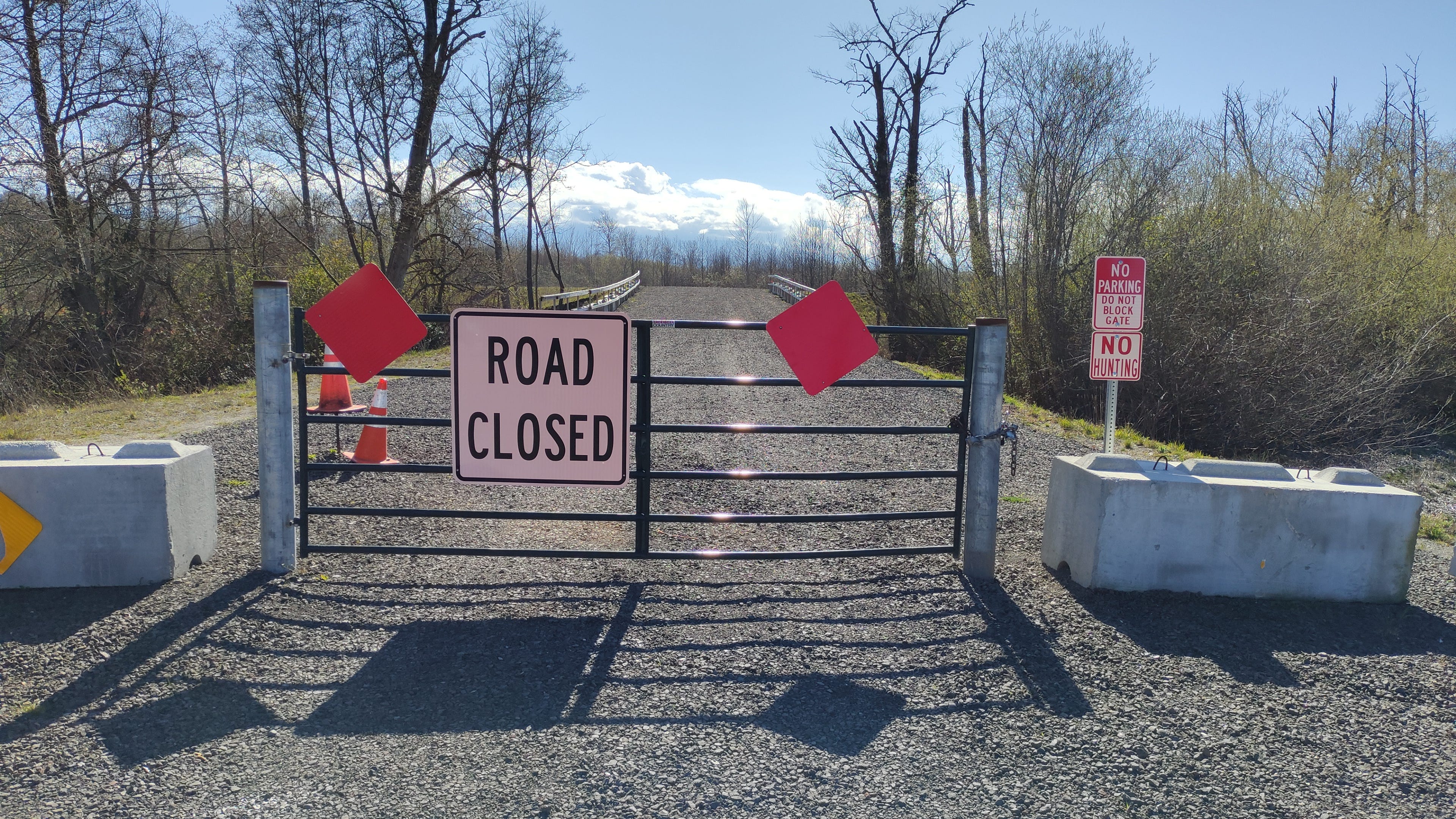
My second September 11th arrived three years ago. My cousin was visiting. It was a beautiful late-summer day, and Doug and I decided to walk with her along the Dungeness River. This time we would walk the soon-to-open roadbed of Towne Road.
On the way, we passed a notice stapled to a stake that was fluttering in the breeze. I walked past it. Doug photographed it.
At home, he read the picture aloud. The county was considering several designs for Towne Road—or possibly never reopening it at all. There were officials to contact: the Board of Commissioners and DCD Director Bruce Emery. I wrote to both. I asked a simple question: why wouldn’t the road open?
Commissioner Ozias replied promptly and courteously. Contaminated soil had been found; the unexpected cleanup cost had left the project without money to finish.
Emery sent a link to a recorded meeting. I had not known county meetings were filmed. In the video, staff told the commissioners that a grant had already covered the entire cost of removing the contaminated soil. The county engineer added that Towne Road could be completed without using a single dollar of county funds. Commissioner Ozias pushed back, saying he had received hundreds of signatures asking that the road stay closed, and the commissioners pulled the plug on finishing Towne Road.
I asked Director Emery about the petitions. He said he didn’t know the details and suggested a public-records request—my first. The records showed not “hundreds,” but just 98 signatures opposing reopening Towne Road. There were 122 supporting it.
That discrepancy was the first small crack. I began posting the correspondence with Commissioner Ozias on Nextdoor.com. The posts did not stay quiet for long. Moderators objected. One of them, Jim Stoffer, took particular issue with my sharing correspondence from his friend, Commissioner Ozias. The conversation grew sharper, then it ended. I received a lifetime ban from Nextdoor, and I decided to create my own website about Towne Road.
When I asked Doug whether the site should be TowneRoad.com or ReopenTowneRoad.com, he suggested something broader. I thought the idea was unnecessary.
I am glad I listened.
What Came After the Road
The work widened. Public records showed Commissioner Ozias using his office to oppose a family business that wanted to reopen a dormant gravel pit across from his driveway—while the county hauled gravel from Jefferson County and struggled to create local jobs.
Other stories followed.
Olympic Medical Center, our largest employer, dropped to only five days of cash on hand before most residents heard a word about it.
Quiet emails showed talks with a major campaign donor about “taking over” the Dungeness Recreation Area, the beloved county park above the spit.
Public money moved toward projects that raised fair questions about priorities and fairness, including $118,000 sent through a church to Mike French’s NGO to create three safe-parking spaces.
And when Sequim artist Richard Madeo was fatally assaulted, the legacy media had nothing to say while a neighbor’s life and work slipped by in silence.
Some of those stories sound sensational because the facts themselves are striking.
In 2022, a section of the old Dungeness levee was opened before the county’s new setback levee was finished. Public records show the county then declared an emergency so work could be rushed ahead of flood season. The Tribe warned of a mass casualty event. The first draft of that emergency resolution placed responsibility for the early breach on project partner Jamestown, which had removed the dike. After Jamestown offered $500,000 tied to new wording that would clear the Tribe of blame, the adopted resolution shifted responsibility to the Army Corps of Engineers, and the County covered it up.
All of this is documented in public records. Reporting these nearly unbelievable stories is not a smear. It is an invitation to look at the same documents anyone else can request.
I have been called many names along the way: a MAGA extremist, a Trumper, a racist, a bigot, a member of the KKK, a transphobe, a Republican. Doug and I have been accused of bringing Latino prostitutes into our open marriage. I was even written into a local play as a dog who eats human feces.
Labels and rumors travel faster than reading public records.
I do not expect every reader to track three years of detail. I ask only that newcomers judge the work by the documents—not by how loudly, or how inventively, some people react to them.
Two Worlds
Flight crews still talk about life before 9/11 and after. Before: shoes stayed on, visitors walked to the gate, a 90-minute flight from Seattle to San Francisco still came with a real meal. After 9/11: plastic utensils, longer lines, and a new watchfulness.
Clallam County has its own before-and-after story. Before Towne Road, many of us assumed that when a road was designed, engineered, funded, and promised, it would be a road. We assumed public comments mattered and that public servants were, at the very least, serving the public. After Towne Road came a harder, more necessary question: what else have we taken on faith?
Vigilance can become a habit. A watchdog can bark at shadows. Three years in, it is possible to live in a place where even well-intentioned leaders are met with suspicion. That is a real loss. It is also a reminder of what we let grow thin: the everyday trust that makes a place feel like home has been broken.
America let its guard down in the years before 2001. Clallam County let its guard down in the years before a simple road project refused to stay simple. In both cases, the answer is not bitterness. It is the decision to stay engaged.
A Place Worth the Work
The first September 11th ended my career and pointed me toward another. After a few detours, I found myself trading planes for trains.

September 11th taught me that freedom is not a finished gift. The work that began 250 years ago has to be taken up again by every generation.
The second September 11th taught the same lesson closer to home. This county—its rivers, its roads, its hospitals, its small businesses, its people who still believe public records belong to the public—is worth the effort. Watchfulness does not have to be angry. It can be an act of hope: the belief that sunlight still matters, that neighbors still deserve straight answers, and that a place this beautiful is worth protecting for the people who will walk its trails long after we are gone.
That is the story I bring to newcomers. Two September days, twenty-two years apart. Both asked the same question, and both received the same answer:
Keep going.
@JeffTozzer, connecting your time above the clouds in 2001 to a quiet walk on a Clallam River trail perfectly captures why we do this: trust is precious, and this county is worth defending.
To the skeptics reading this: keep your skepticism, but aim it in both directions. I’ve directly challenged our local agencies to step into the public square, fill in the blanks, or correct the record if they feel context is missing from these articles. Their response is always silence.
When the government hides, they forfeit the narrative. There’s a reason Washington’s transparency rules are called 'Sunshine Laws'—sunshine is the best disinfectant. Until our local agencies choose to step into the light and answer to the public, we have to rely on the facts we can verify. By consistently bringing the receipts and primary documents, CC Watchdog provides that sunlight.
Washington law is clear: the people do not yield their sovereignty to the agencies that serve them. Local government is an instrument built for us, and this platform reminds us we still have the power to steer it.
Politics impacts policy, policy impacts people. Vote in public servants, not politicians, to impact politics. Rinse and repeat.
Thanks for holding the line.
I didn’t have a 9/11 awakening, but rather a ‘Jimothy’ moment when I first stumbled onto CCWD. I’m cheap and don’t like to pay for news, so I go on line looking for news. I started following Jeff’s articles at the beginning of his Towne Rd series. As I followed the articles it was like seeing the first picture of Jimothy running across the road, it didn’t look right.
Towne Road? Where was it? Why did it matter? But reading on it clearly pointed to something out of whack that deserved a second glance. The second glance was my awakening that some people running Clallam County can be covert. Their motives needed scrutiny, so CCWD gave me, and still is giving scrutiny. Thank you Jeff for the tremendous amount of work you have done for Clallam County and explaining why 'Jimothy' is out of whack!