

Clallam County’s draft Comprehensive Plan adopts, word for word, a Jamestown Tribe statement that it “will continue to reacquire land” across its Land Consolidation Area, a sentence the Tribe first wrote about “our Land Consolidation Plan.” An April email from the Tribe asked the county to rewrite its policies on trust land and casino growth, and the Planning Commission agreed “by concurrence.” Two weeks ago, the commissioners told the federal government that trust transfers are eroding the county’s tax base and zoning, yet the plan they’re about to adopt never says so.
Ron Richard’s letter to the commissioners on the Comprehensive Plan update made a pointed claim: parts of the plan read as if the Tribe wrote them.
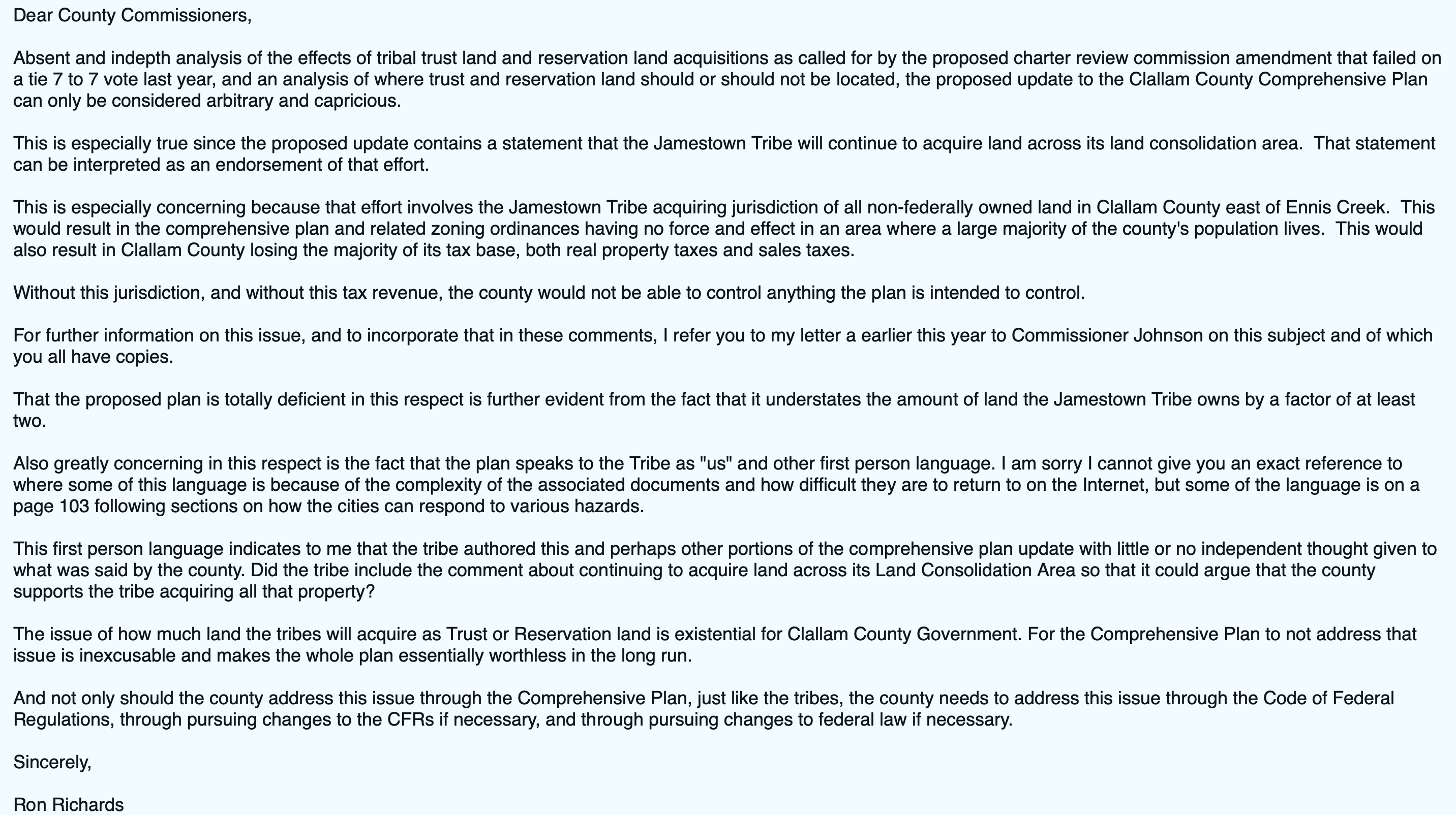
Few have taken the time to review the 567-page draft ordinance, the two volumes of the county’s Hazard Mitigation Plan (Volume 1, 1,950 pages; Volume 2, 176 pages), and the county’s own Public Engagement Report. Is Richard’s claim true?
How the Tribe’s words got into your plan
Start with the new climate chapter, Section 31.02.820. Policy 8.6 says:
“The 2025 Clallam County Hazard Mitigation Plan (HMP), is hereby adopted by this reference (Exhibit M). This policy is also considered part of the Land Use Element of this Comprehensive Plan.” (draft ordinance, p. 179)

The Hazard Mitigation Plan is a FEMA plan covering several governments. Each one (the cities, the tribes, the PUD, the Port) writes its own “annex,” a chapter about itself. That’s normal. The plan explains how it worked: participating governments got “data requests and instructional worksheets” between April and August 2024 and “coordinated with the MJHMP [Multi Jurisdictional Hazard Mitigation Plan] Project Management Team and Consultant Team to develop content for their respective jurisdictional annexes.” (Vol. 1, §2.1.6, p. 2-61)
The Jamestown annex says the same:
“representatives from Jamestown S’Klallam Tribe coordinated directly with the MJHMP Project Management Team and Consultant Team to update this jurisdictional annex.” (Vol. 2, §1.2, p. 89)
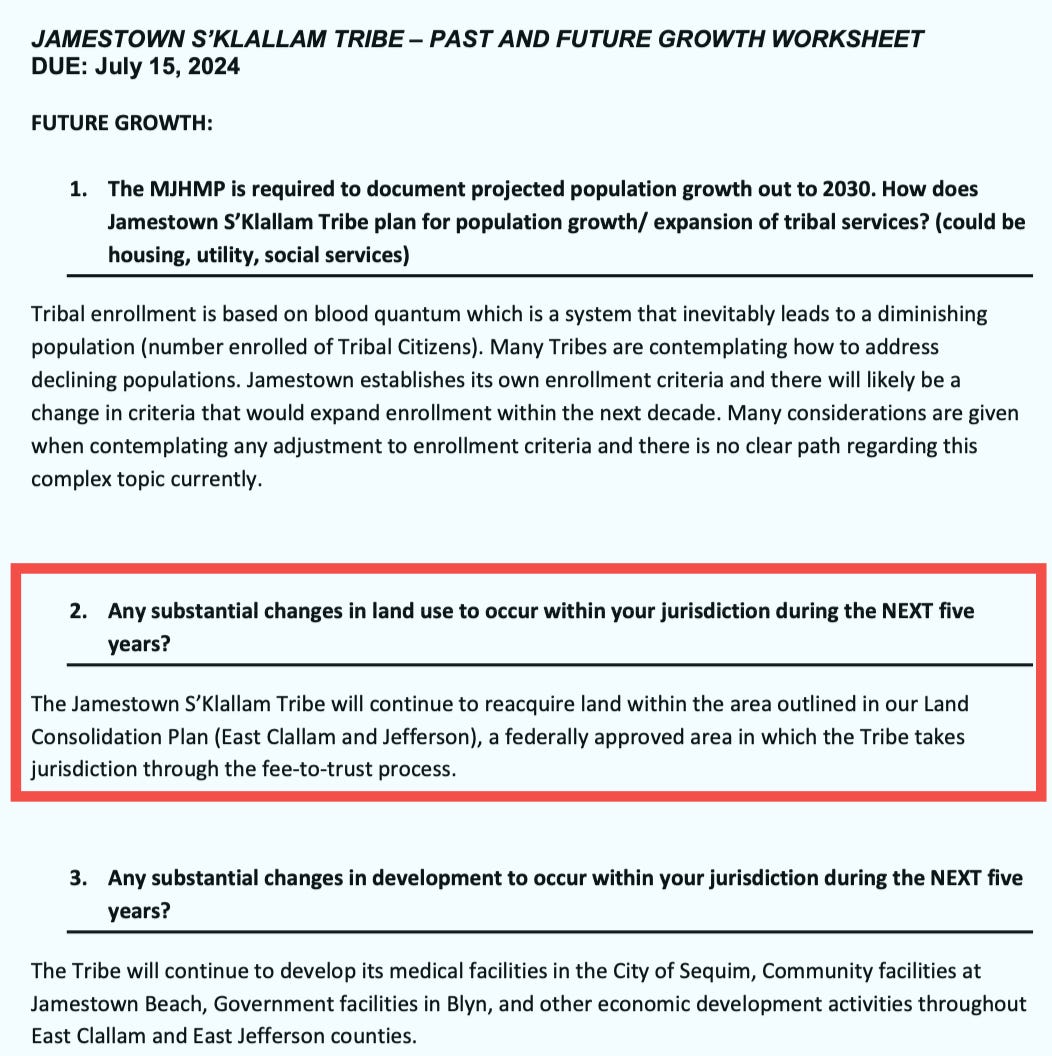
Here’s what the Tribe wrote on its July 2024 “Past and Future Growth Worksheet”:
“The Jamestown S’Klallam Tribe will continue to reacquire land within the area outlined in our Land Consolidation Plan (East Clallam and Jefferson), a federally approved area in which the Tribe takes jurisdiction through the fee-to-trust process.” (Vol. 1, Appendix F, PDF p. 1,882)
And here’s the annex the county is now adopting by reference:
“The Jamestown S’Klallam Tribe will continue to reacquire land within the area outlined in the Tribe’s Land Consolidation Plan, including areas in Clallam and Jefferson counties, a federally approved area in which the Tribe takes jurisdiction through the fee-to-trust process.” (Vol. 2, §3.4, p. 102)
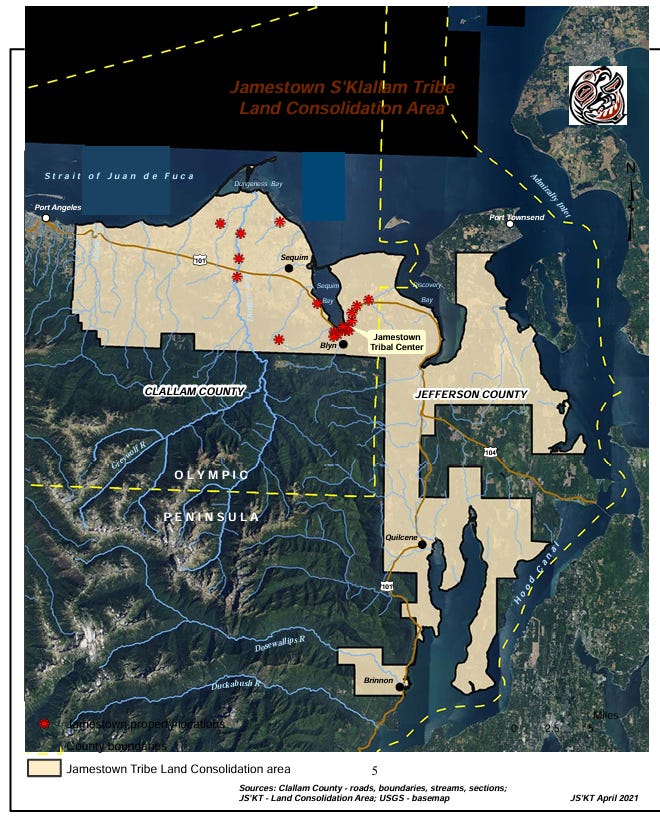
Only a few words changed: “our” became “the Tribe’s.” The annex adds that the Tribe’s goal “is to transfer lands from fee status to trust/reservation land” (p. 100), and that its Service Area “is defined as the entirety of Clallam County” (p. 92).
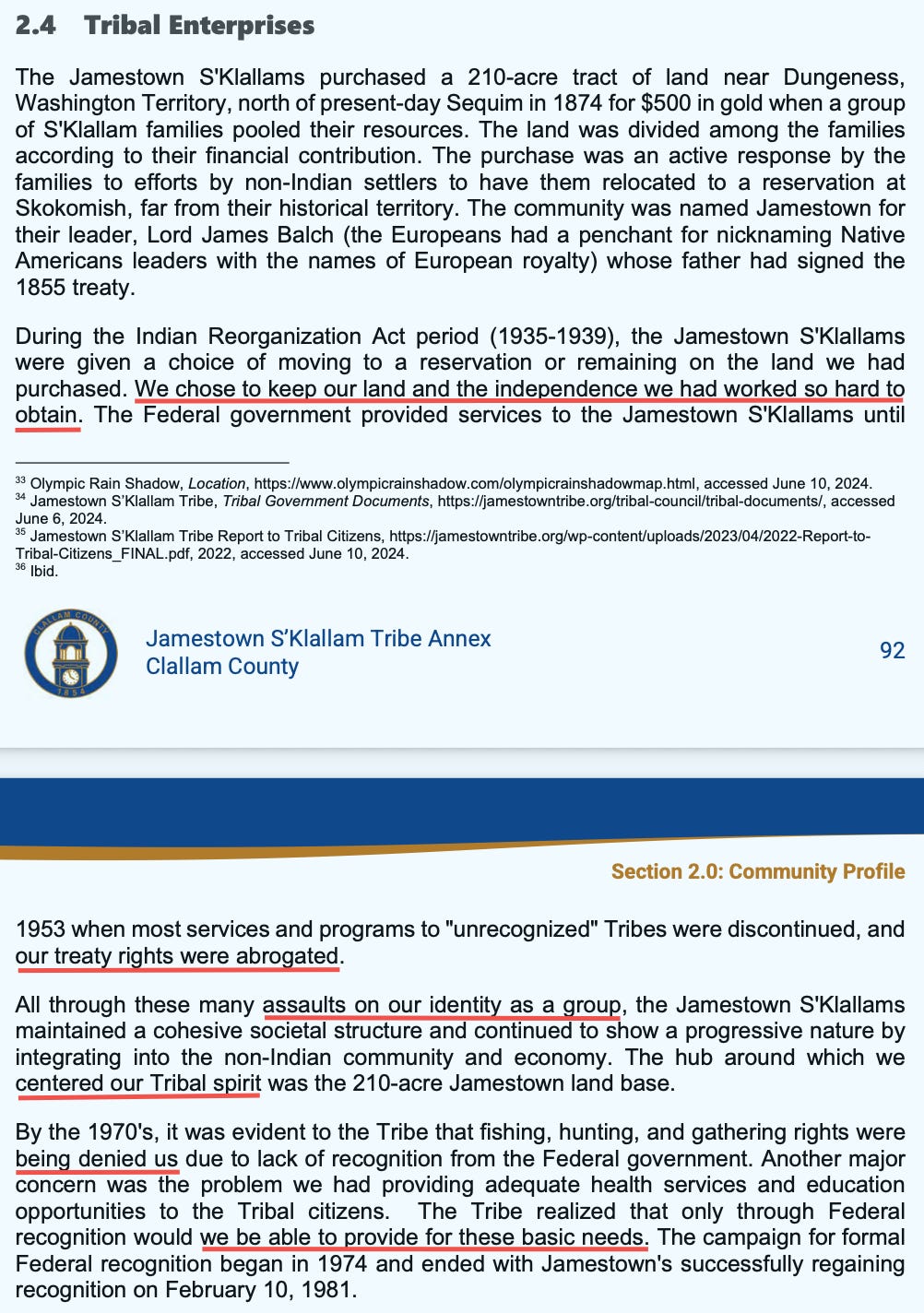
Some of the first person survived the editing (pp. 92–94): “We chose to keep our land… our treaty rights were abrogated… all through these many assaults on our identity… rights were being denied us…”
To be fair, a tribe writing its own annex is how these FEMA plans work. The problem is that the county made the whole thing part of its Comprehensive Plan’s Land Use Element without a word of qualification. The plan doesn’t say “this is the Tribe’s statement, not county policy.” It just adopts it.
The emails that rewrote county policy
The tribal influence doesn’t stop at the hazard plan. The county’s Public Engagement Report logs every comment and what happened to it. Public Comment #58 is an “Email from Wendy Clark, Transportation Program Manager, Jamestown S’Klallam Tribe, dated April 1, 2026.” (Appendix P, pp. 83–85)
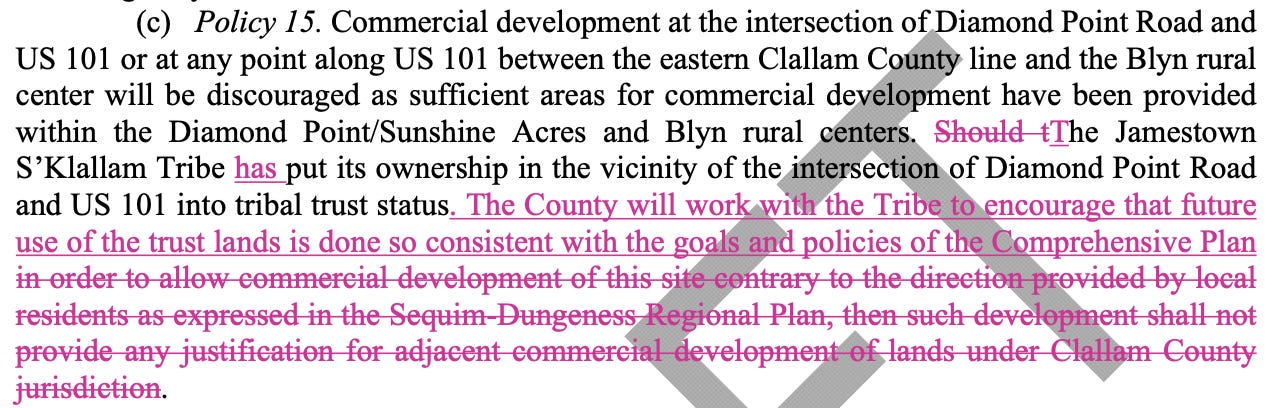
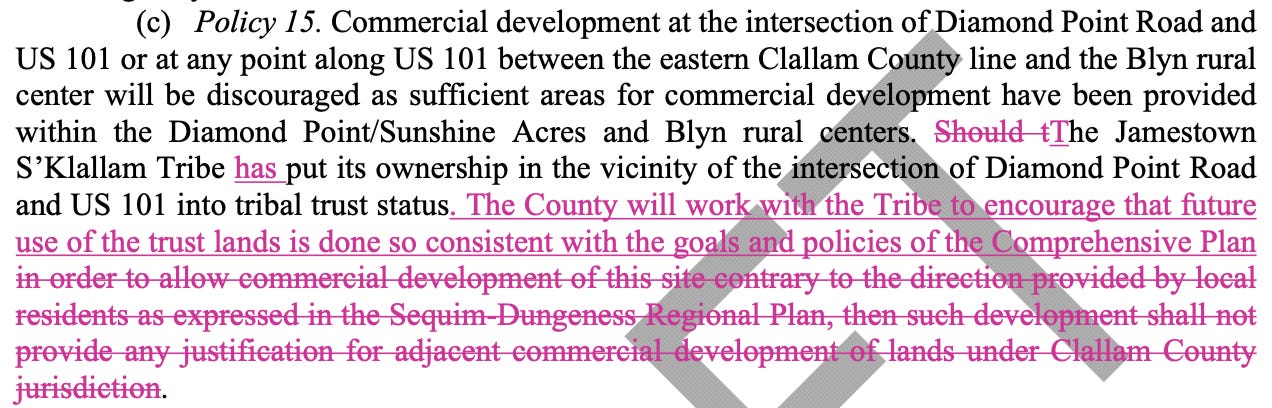
Item (g) noted that the Tribe had put land near Diamond Point Road and Highway 101 into trust and suggested updating Policy 15. The result was “Adopted as presented by concurrence.” The draft now deletes this existing protection: “…in order to allow commercial development of this site contrary to the direction provided by local residents as expressed in the Sequim-Dungeness Regional Plan, then such development shall not provide any justification for adjacent commercial development of lands under Clallam County jurisdiction.” In its place: “The County will work with the Tribe to encourage that future use of the trust lands is done so consistent with the goals and policies of the Comprehensive Plan.” (Sec. 31.03.415, p. 245)
Item (h) said the last sentence of Blyn Policy 4 was “non-binding” and suggested removing it. Staff suggested more, and it was “Adopted as presented by concurrence.” The draft deletes all of Policy 4: “Future development by the Jamestown S’Klallam Tribe in the Blyn LAMIRD will require increased public services, particularly police and fire. Future development plans should be carefully coordinated with those service providers…” (Sec. 31.03.435, p. 246)
A December 9, 2025 Tribe email asked to swap the Highway 101 “overpass” language for “multimodal safety improvements” (Appendix P, comment #17). The draft now strikes the sentence: “An overpass on Highway 101 should be considered if traffic congestion caused by development of the casino impacts the regional mobility of the highway.” (p. 246)
The same draft also strikes a policy nearby: “Along Highway 101, potential encroachment or sprawl from the Blyn rural center, including development accessory to the Jamestown S’Klallam casino, shall be avoided.” (Sec. 31.03.425, p. 246) It also strikes “Since local government has no regulatory authority of Tribal land use…” from the Blyn section (p. 247). It did not identify who asked for those two deletions.


What you got
The county did do outreach, and it deserves credit for it. Its own report lists:
an online policy survey from December 20, 2024 to March 15, 2025 (464 responses);
five community workshops in July 2025 (Clallam Bay, Joyce, Sequim, Forks and Port Angeles);
printed binders of the draft at four library branches starting March 17, 2025;
a Planning Commission hearing that opened November 5, 2025 and was continued ten times through April 15, 2026.
The hazard plan ran its own survey from March 6 to May 10, 2024 (619 responses), held a public workshop on August 7, 2024, and posted the draft for public review from December 4 to 31, 2024. It received six public comments. (Vol. 1, §2.1.7)
The record also shows where the process fell short. The automatic email notices to people who had signed up for updates “[were] not functioning as intended.” The county found out on March 4, 2026, four months into the Planning Commission hearing, and had to extend the hearing to make up for it. (Appendix P, p. 2)
Look at the difference. You could answer survey questions, attend a workshop, or write a letter about a 567-page document plus 2,100 pages of hazard plan, and hope staff summarized your point fairly in a table. Members of the hazard plan’s Steering Committee (governments, agencies, and some businesses) got the draft for a two-week internal review from November 18 to December 2, 2024, before the public saw it. (Vol. 1, §2.1.6) The Tribe, a sovereign nation, went further: it wrote its own chapter, and its emails were adopted “by concurrence.”
No ordinary Clallam County Citizen got to write a chapter about themselves into the Land Use Element.
The commissioners already know the cost
Here’s what makes the plan’s silence hard to excuse.
On October 27, 2026, the Board approved on its consent agenda a letter to the Bureau of Indian Affairs about a Jamestown trust application for 9.6 acres on Fish Hatchery Road. It’s signed by Chair Mike French, Randy Johnson, and Mark Ozias. The letter says (Oct. 27 agenda packet, pp. 50–54):
“This approach to land transfers diminishes the ability of the County to equally and equitably tax and regulate property consistently within Clallam County.”
“When you combine federal, state, local government, school, and tribal reservation lands, nearly 70 percent of Clallam County is in public ownership and is exempt from paying property taxes.”
“Local communities are left with a patchwork of parcels subject to either different or no regulations. The result is that communities no longer control land use…”
The Board asked the BIA to deny the application, or to require a payment in lieu of taxes and land uses consistent with neighboring parcels.
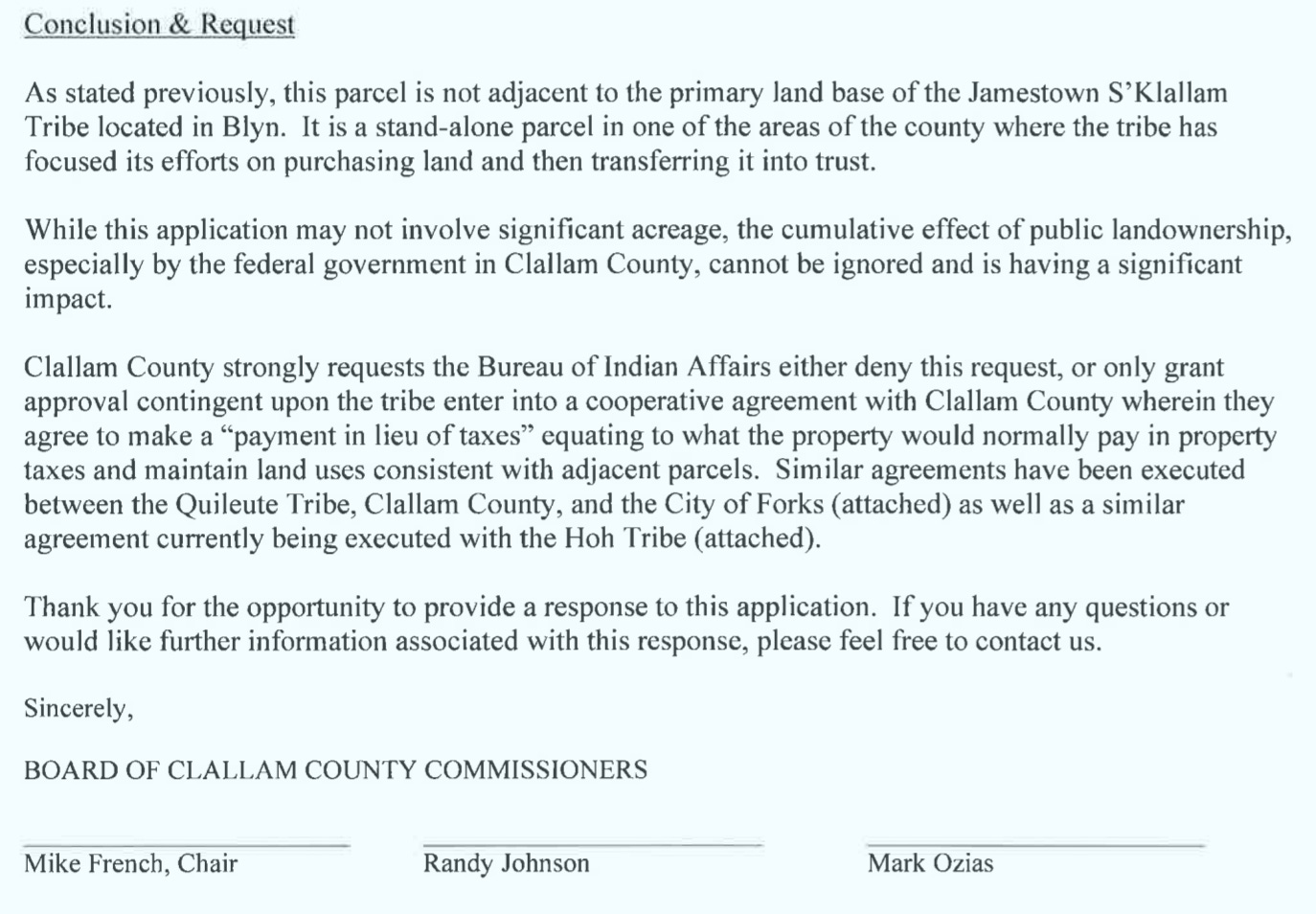
That’s exactly the analysis the Comprehensive Plan leaves out. The plan says only that it “does not guide physical improvements on tribal trust lands” (Sec. 31.01.100). It reprints the Tribe’s plans to keep acquiring land, and it deletes the policies that protected neighbors. It never addresses jurisdiction, tax base, or where trust land should and shouldn’t go.
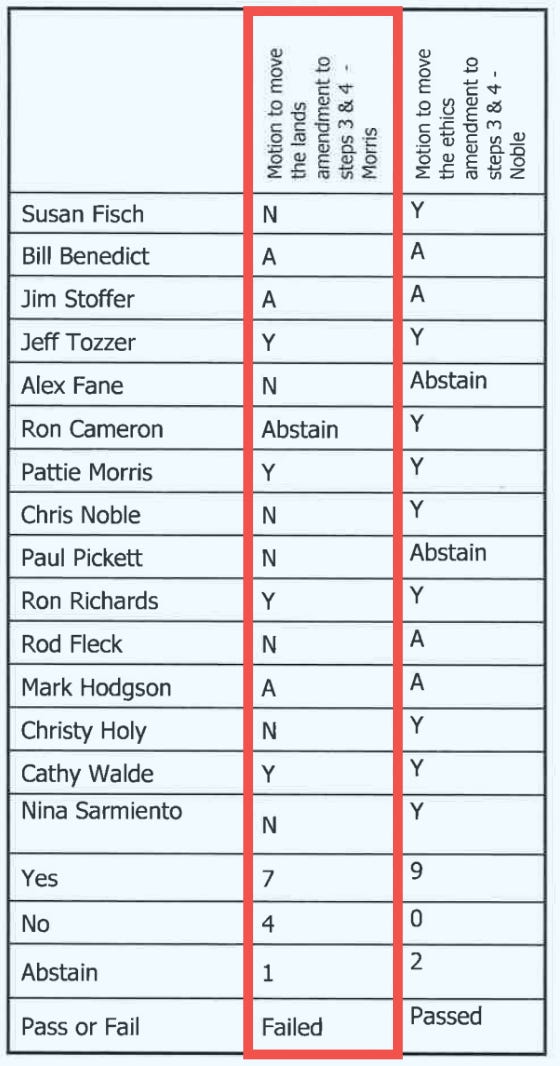
A citizen body already asked for this. In 2025, a Charter Review Commission amendment would have required the Comprehensive Plan to contain standards for responding to these federal notices. It failed 4–7 on November 10, 2025 (minutes).
On December 22, 2025, the commission did send the Board a resolution recommending that it “develop policies and procedures for responding to requests” on land transfers that would affect the county’s “taxing, revenue raising, legislative, regulatory, and/or law enforcement jurisdiction.”
The Board wrote a strong letter to the BIA. It should put that same thinking in its own plan.
Write them before the record closes
The county’s Comprehensive Plan page says written comments are accepted “up to the public hearing before the BOCC and any continuances thereafter.” Keep writing, the commissioners are still reviewing the comprehensive plan.
Who to write:
Bruce Emery, Director of Community Development, who runs the update: bruce.emery@clallamcountywa.gov
Loni Gores, Clerk of the Board, who sends your comments to all three commissioners (Ozias, Johnson, and French): loni.gores@clallamcountywa.gov
Use the subject line: “Comprehensive Plan Update – public comment.” Say where you live. Keep it short and specific.
Asks you can copy:
Restore the deleted protections: Policy 15 in Sec. 31.03.415, which keeps trust-land commercial development from justifying commercial zoning next door; Blyn Policy 4 in Sec. 31.03.435 (police and fire impacts); and the casino-sprawl policy in Sec. 31.03.425. At minimum, explain each deletion on the record.
Don’t adopt the Tribe’s statements as county policy: If Policy 8.6 adopts the Hazard Mitigation Plan by reference, add language saying each jurisdictional annex reflects that government’s own statements and is not county policy. Or leave the annexes out of the Land Use Element.
Put the BIA letter’s analysis in the plan: Add a section on what trust transfers do to jurisdiction, zoning consistency, services, and the tax base, using the same figures the Board sent the BIA in October 2026.
Adopt standards for responding to BIA fee-to-trust notices, as the Charter Review Commission recommended on December 22, 2025, including the payment-in-lieu-of-taxes and consistent-land-use conditions the Board already requested.
Show the public every change made at another government’s request: Publish a list of every policy changed at a tribal or agency request, with the request beside it.
The Tribe did what any good advocate does: it showed up early, wrote things down, and asked for specific changes. We can do the same before the hearing closes.
Commenting at the appropriate time is crucial. Too many people express outrage after the deal is sealed.