

You’ve paid the general contractor. He approved the contracts, signed the checks, and sits on the boards that spend the money. But when a retired county employee with decades of grant and budget experience spent ten months asking why the numbers don’t add up, Mike French told her to call the church and the NGO. Those entities answer to no one—and under French’s leadership, neither does he.
The General Contractor Who Won’t Answer
If you’ve ever built or remodeled a house, you know what a general contractor is. You give them your money. They hire the subs, oversee the work, and answer to you when the countertops are wrong, or the cabinets are falling apart. You don’t get sent to “talk to the counter guy, because you paid the GC.
Clallam County’s commissioners operate the same way—with one critical difference. They take your tax dollars and write the checks, then act as if the work is no longer their responsibility the moment the money leaves the county’s account. Under Mike French’s leadership, that has become standard practice.
He approved $4 million of your money for Peninsula Behavioral Health’s North View complex—housing that prioritizes frequent criminals and people actively using drugs. When residents raise concerns, French’s response is to contact PBH CEO, Wendy Sisk. He did the same during the Towne Road debacle with the Jamestown Tribe: direct your questions to the sovereign nation. NGOs and tribes are under no legal obligation to answer you once the check is cashed. Public records laws do not apply. They can ignore you, and that is legal. French knows this, and he still sends people there.
$118,000 for Three Parking Spaces
The pattern is clearest in the Sequim Safe Parking program.
Commissioner French approved $118,000 for three parking spaces at Trinity United Methodist Church in Sequim.
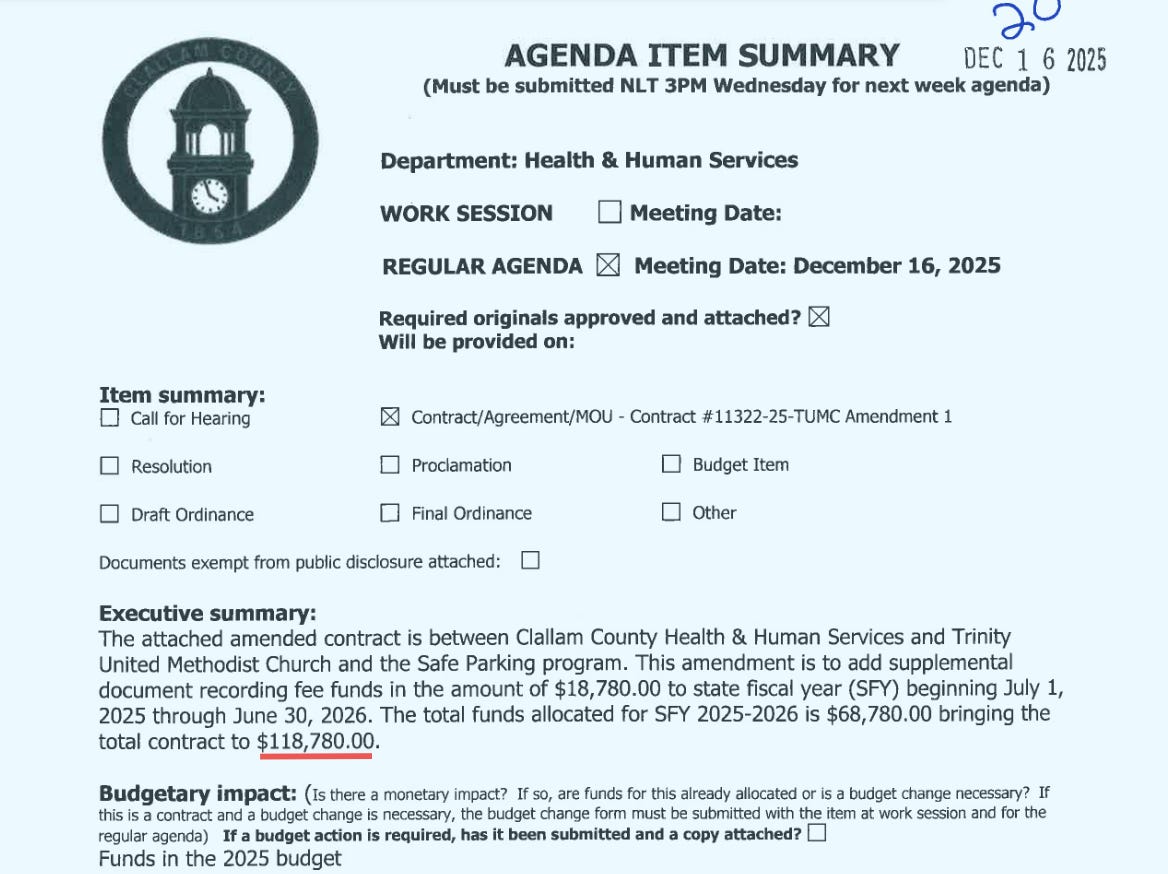
The church then contracts with OlyCAP—an NGO on whose board French himself sits. A retired Sequim resident who goes by CAS (an accountant and auditor by training, with years of county government experience overseeing large public budgets, grants, and contracts in another state) has spent the last ten months trying to reconcile the numbers. The metrics don’t match the grant documents. Payroll records don’t line up with public statements. Roughly 65 percent of the funding is flowing to OlyCAP even though the county’s contract is with the church. Staff has been added beyond what the original grant authorized.
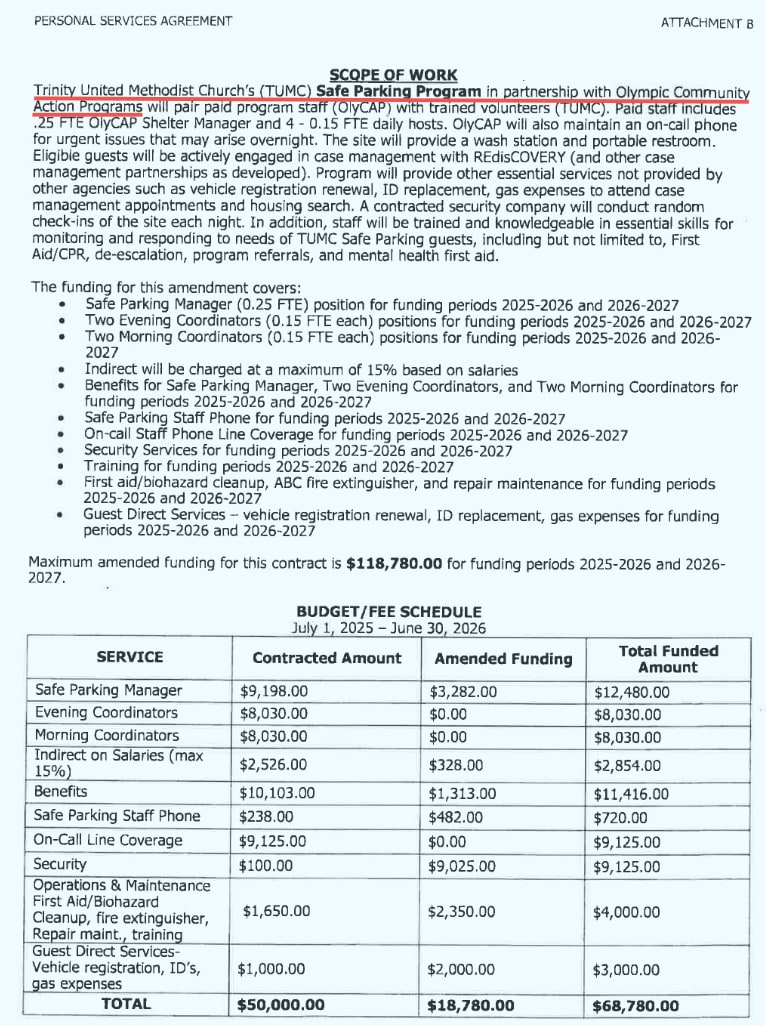
When she raises these points, French and county staff keep sending her back to the church or to OlyCAP. They ignore her or give her the runaround.
Ten Months and Nothing to Show
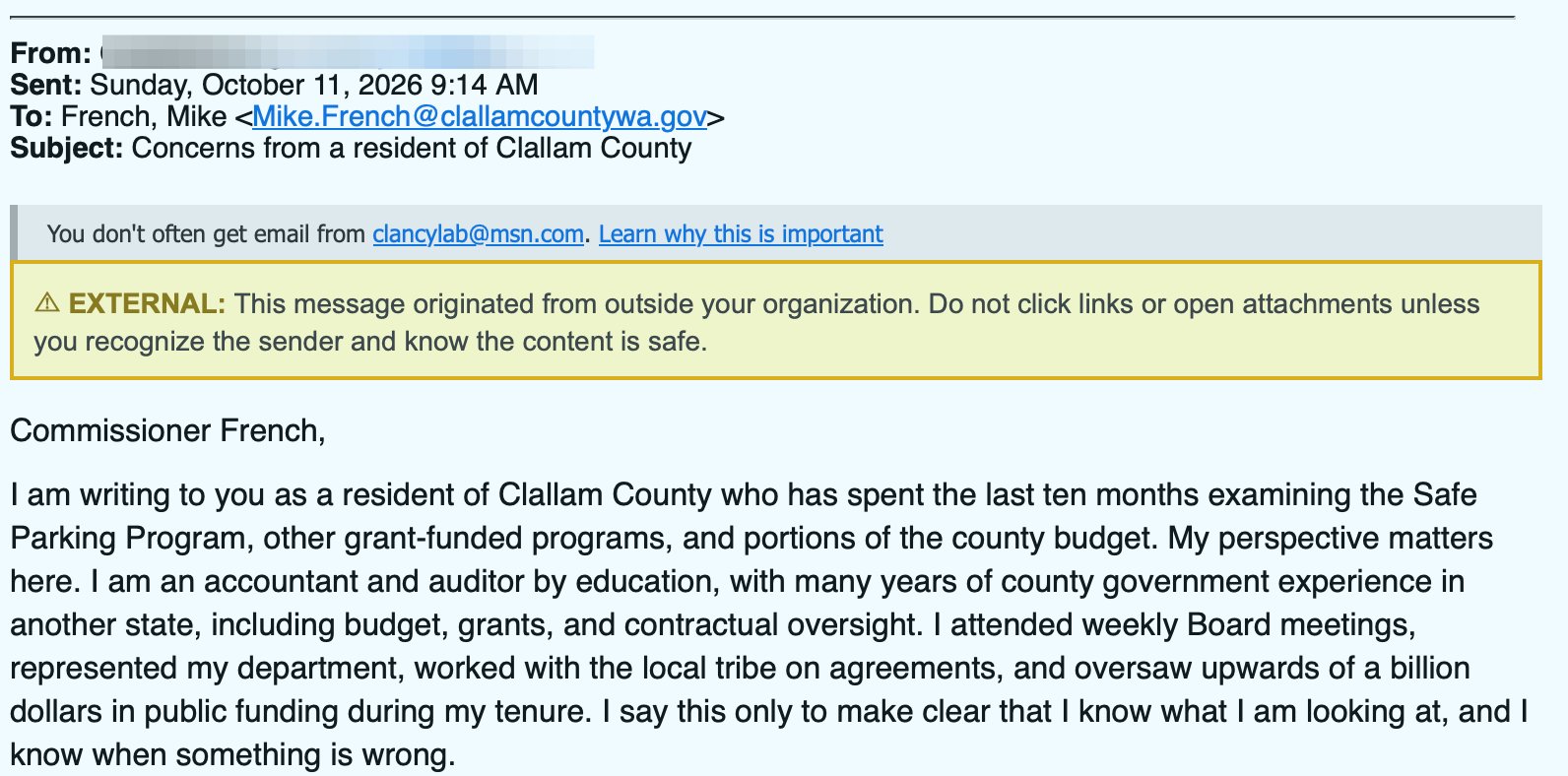
CAS is not a casual critic. She is a retired professional who has sat in the same kinds of rooms French occupies, represented departments at board meetings, negotiated with tribes, and managed public money at a scale far larger than Clallam’s. She has spent ten months on this one program and has nothing clear to show for it. In a recent email, she told French exactly that:
“I am an accountant and auditor by education, with many years of county government experience in another state, including budget, grants, and contractual oversight… I know what I am looking at, and I know when something is wrong.”
She has asked the structural questions that should trigger an internal review:
Who is monitoring a grant whose contract is with the church but whose staff and majority of funding run through an NGO on which the approving commissioner sits?
Why are outside staff being hired when the grant did not authorize it?
Why does OlyCAP’s Viola Ware publicly claim to have “no idea” about funding while payroll records show her name approving related pay?

The Deflection
French’s reply is long, polished, and almost entirely deflective. He points her to a county employee named Christine Dunn for “independent oversight.” He explains that he only approved the money because the church planned to hire a social-service agency. He lectures her on the difference between Monday work sessions and Tuesday voting meetings. He defends the Recompete metrics shift, the OPHS collapse, the prosecutor’s dual role as the commissioners’ lawyer, and past audit findings. He disputes that anything is non-transparent.
What he does not do is answer the questions CAS actually asked. This is the voice of a commissioner who has decided that once the money is out the door, the questions are no longer his problem. It is defensive. It is lazy. It is the opposite of stewardship.
Time for Someone Else
A general contractor who responded to a homeowner the way French responds to a taxpayer would be fired and would likely lose his license. In Clallam County, the same behavior is treated as normal governance. The public is told the Homelessness Task Force will evaluate results someday. Staff will handle oversight. The church or the NGO will explain. Meanwhile, the same circle of people and organizations keep receiving the contracts, and the person who approved them keeps sitting on their boards.
CAS closed her email with a simple observation many residents now share: the last few years have made the county nearly unrecognizable; families are leaving, and without transparency and competent oversight, the people who make a place strong will keep leaving. French’s reply did not engage that point. It redirected.
Taxpayers in Clallam County don't need another explanation for why the subcontractors should answer the questions. They need a commissioner who treats the money as still his responsibility after the check is written. After ten months of a retired professional doing the work the county should have done itself, and after repeated deflections on North View, Towne Road, Safe Parking, and other programs, it is time for someone else to start stewarding your hard-earned money.
The Emails
Commissioner French,
I am writing to you as a resident of Clallam County who has spent the last ten months examining the Safe Parking Program, other grant‑funded programs, and portions of the county budget. My perspective matters here. I am an accountant and auditor by education, with many years of county government experience in another state, including budget, grants, and contractual oversight. I attended weekly Board meetings, represented my department, worked with the local tribe on agreements, and oversaw upwards of a billion dollars in public funding during my tenure. I say this only to make clear that I know what I am looking at, and I know when something is wrong.
I first learned about the Safe Parking Program in the spring of 2025. I had many questions and then started my research. I researched similar programs in Seattle and the greater Seattle area. What I found was troubling: the advertised success of those programs did not match the actual outcomes. They served far fewer people than promised, and the reasons ranged from staffing failures to design flaws to lack of oversight. That prompted me to look more closely at our local program.
I submitted multiple public records requests, including payroll records. What I was reading in the news, seeing on social media, and hearing from the church, TUMC, did not match the grant documents. That discrepancy alone warranted deeper review. I wrote to you, and you forwarded my inquiry to Holly. We exchanged emails, and in one of her replies her tone was condescending — as though I were a child — and I found that inappropriate. I let it go and asked further questions, waited a month for a response, until I had to inquire again. She apologized and answered, which led me to more questions, and I have since, for now, given up. It appears any question will be answered with “something.”
The issues I am raising are not minor. They are structural, procedural, and compliance‑related. The kinds of issues that, in any well‑run county, with proper grant management, would trigger immediate internal review, corrective action, and in some cases suspension of funding until compliance is restored.
Just days ago, WorkSource advertised for a Safe Parking monitor — one hour a day. The grant did not include hiring outside staff. Was a grant modification done? Who authorized this? This may not be a large dollar amount, but it shows the lackadaisical attitude toward grants in this county. This is a pattern.
The county is the grantor. Once state‑mandated document recording fees reach Clallam County, as you know, the county becomes responsible for administering, monitoring, and ensuring compliance. That is the county’s duty. And that is precisely where the problem lies.
The contract which I have thoroughly read is between TUMC and the county, not OLYCAP, yet OLYCAP staff are being used for the program and roughly 65% of the funding is going to OLYCAP. Who is monitoring this grant? The absence of oversight is not a small administrative oversight — it allows programs to drift, change direction without approval, and operate without accountability.
One of the most troubling moments occurred during a BOCC meeting I attended. Viola Ware and staff were present to accept an award. A question was asked about the funding for the Safe Parking Program. She stated she had “no idea” about the funding. She deceived the Board and every resident of this county. I have payroll records showing her name approving payroll for OLYCAP staff — which is part of the program’s funding. Either she is oblivious to what she is signing, or she has delegated approval authority without oversight. Neither is acceptable. These are documented facts.
Moving on, I reviewed the material findings from Serenity House. Their corrective actions include enrolling financial staff in training through 2026. These findings were significant and should alarm the county, even when funding is pass‑through. Competence matters. There were repeat findings. How does payroll become a finding? Longevity in a position does not equal competence, and we have seen that play out in multiple areas of this county.
At the recent Homeless Taskforce meeting, Sharon Maggard stated they have corrected the findings. The corrective action for staff enrolled in further training is a positive. But why were staff without grant and accounting knowledge hired in the first place? And now Serenity House is in the red but seeking to expand. Too much is taken on without addressing existing problems. Securing grants can be good, but racing for more funding can be detrimental. Internal controls should have been in place from the beginning.
I do not always attend BOCC meetings in person, but I find the procedures lacking. When I attended weekly meetings in my former county, every agenda item had a department head present to answer questions. Many questions you receive are beyond your knowledge, which is understandable and while Mr. Mielke is present, it would be more appropriate to have department heads there. Governmental accounting and public policy can be difficult concepts for the public to understand. Wouldn’t it behoove you to make this process more accessible and understandable for your constituents?
Now to OPHS. That was an absolute, horrific outcome for this county. We are now limping along without an animal control officer, temporarily. I watched the animal advisory meeting last week. The increase in animal abuse, lack of training for deputies who will fill the duties — none of this is being addressed. I doubt anyone in this county has heard of “The Link,” the National Link Coalition, which connects animal abuse to domestic violence, child abuse, elder abuse, and even homicide. I spent years studying this and started the first collaborative task force in the nation educating on this topic as well as the investigation of cruelty cases and prosecution of such cases. Deputies need training. Some deputies are afraid of dogs. What happens when a dog is shot because a deputy did not know how to handle the situation? The county is sued. Has the county considered the liability in having deputies without the proper training answering these calls? Training records are the first thing examined.
As you are aware, OPHS, had a contractual agreement for many years. When everything fell apart, why was a national organization not called in to investigate? They do this free of charge. Deputies could not investigate this, and our prosecutor’s office does not employ investigators. A proper investigation with collected evidence could have been handed to the prosecutor. Instead, nothing. Again, I have experience, this was done in the county I worked for. The case was investigated by a national organization, who had the experience, knowledge to handle such an investigation, and ultimately given to our prosecutors. They prosecuted and the defendants were sentenced for the crimes they committed.
I am thankful for the groups stepping in, but this is not a long‑term solution. Has the Board reached out to Ron Allen for assistance in funding a shelter? This has been done in other counties in this state and across the nation, reaching out to the local tribes. I have not heard this discussed. I applied for the animal advisory board but was turned away, even when one position, at large, was filled by a rescue. I provided my experience, but was summarily dismissed. Yet this week, there is a resolution to change the board’s name — as though that is the priority and why not a change in the number of at large positions, when they are seeking members?
The county also had ARPA findings. There is a common thread here, and the majority of residents have no idea what is happening with their tax dollars. Have these findings been addressed? I find conflicting information on that regarding county policy.
And the William Shore Pool, which you sit on the Board of — we are still waiting to hear if charges will be filed in that investigation which was handed to the AG. In all honesty, our prosecutor, as he has stated publicly, could have walled off staff to prosecute that case, but the path of least resistance was taken and given to the AG. Letters to the AG go unanswered. Will we see justice served in this county for that?
With that said, this county operates in a unique and problematic position: the Prosecutor serves as the legal counsel for the Commissioners. There is a blatant conflict in that structure. I do not understand why this county does not have a separate county legal counsel. This arrangement restricts potential cases that, in reality, should be investigated and prosecuted within this county. As you know, optics in government matter, and what we see now — as in past cases, which I do not need to list — is that we should have had an investigator here in the county and a prosecutor to handle these matters. Instead, cases are moved out of the county because of the “conflict of interest” repeatedly stated by our Prosecutor, even though he has publicly said he can wall off prosecutors to handle such cases. Why is that not done? What residents see are cases sent off to the state, where they rarely, if ever, result in justice. What does that say about leadership in this county?
As you have probably heard, there have been rumblings about a Public Integrity Unit (PIU). When this was briefly mentioned at a BOCC meeting, Commissioner Ozias quickly responded, “We have an auditor’s office.” When I heard that, I thought: he has no clue what a PIU actually is. The appropriate response would have been, “Thank you, I will look into what that is.” Instead, it was summarily dismissed.
Once again, based on experience, a Public Integrity Unit would bring accountability locally when it is needed most. As an example, some years back I knew two people who attempted to report theft by a county employee here. They first went to the Sheriff’s Office and were turned away. They then went to the Prosecutor’s Office and were also turned away. They looked to the State Attorney General, but learned that the AG receives roughly 2,000 cases a month. How would something so small ever be reviewed? What happened? The employee continued the behavior and has now retired.
Has the county ever conducted an assessment of the potential losses this county has suffered — theft, misuse of county vehicles, timecard fraud, and more? Certified fraud examiners estimate losses in government agencies can modestly range from 3–7%. Our county cannot afford any type of loss. Depending on the situation, insurance may cover some of it, but that does not solve the underlying problem. And what about employees who witness wrongdoing but feel hamstrung because they know nothing will be done?
We could easily add such a unit, and of course cost is the first concern raised. But I would ask: how can a county not afford to implement such a unit? A law enforcement officer (even retired) with the authority to execute search warrants and make arrests, paired with a prosecutor on an on‑call basis — no benefits, no full‑time staffing — is not an unreasonable structure. Why something like this has not been included is beyond me. It is something that should be seriously considered in this county.
And now, Recompete. Where do I even begin? To the general public, this program sounds like a pot of gold. But just one layer beneath the surface, it is administratively heavy and deeply concerning. At a recent BOCC meeting, you mentioned that the projected number of jobs had been reduced due to a “change in the program.” That was it. No explanation of when the change occurred, why it happened, or what specifically was altered. Where are the details?
We are now in Phase Two, from my understanding. What program changes were made that reduced — and continue to reduce — the number of people who will be employed as a result of $35 million dollars? Again, we see redundant work, multiple websites, a lack of true metrics, and very little information provided to the public, as though the entire program is a secret.
I will add a positive: the added security in the county building. The first time I walked in the building, I was very surprised there was no security. I worked in a county where an unsecured building used for a Christmas party became the site of a terrorist attack that killed 14 county employees and injured 22. Our department, as well as the county I worked for, worked with the FBI and federal agencies through that process. It was absolutely horrific; I have no words. Security matters. A minor inconvenience is worth protecting employees and the public. Thank you.
In my opinion, this county has far too many NGOs operating with little transparency or accountability. The same circle of people run the same programs with little oversight. The public sees it. And the look does not encourage trust with the leaders in this county.
Commissioner, you sit on the OLYCAP board and many others. I do not expect you to know every detail, but given the volume of public concern, I hope you and the boards are having meaningful internal discussions. That is responsible leadership.
I am not native to this area, but family members have been here since 1972 until they passed. I have spent a great deal of time on the peninsula over the years. I chose to retire here. But the last ten years — especially the last few — have made this county nearly unrecognizable. Families are leaving. I know three personally. These are families we need — small business owners, community contributors — and the policies of this county are driving them away.
I want this county to succeed. I want families to stay. I want small businesses to thrive. I want programs to work. But without transparency, accountability, and competent oversight, this county will continue losing the very people who make it strong.
If you have read this far, thank you. I do not want to be one of the families leaving, but I give this county a couple more years.
Respectfully,
CAS
Clallam County Resident
Hi,
Christine Dunn is the County employee who manages and provides independent oversight over the funding for the Safe Parking Pilot program (christine.dunn@clallamcountywa.gov). A note: I would not have approved the funding for that program if the local church had not been planning on contracting with some local social service agency who had experience and available staff to help them manage the program. I think creating a safe parking location without appropriate oversight and intervention from trained social service professionals would’ve been a mistake. It’s a pilot project, so your point about “is it effective” is a very good point and the results will be evaluated by our Homelessness Task Force, County staff, and the Board of Commissioners.
Our department heads do generally attend our board meetings. Many times, they do so from their offices via Zoom so that they can monitor the meeting while doing other work. It’s also noteworthy that we divide our weekly business into two meetings; on Monday, we discuss each item in detail, with Department heads present to present the issue and answer questions. On Tuesday, we vote on the item (generally with a week in between in case changes are needed and to provide the public more time to provide comment). If you only attend the Tuesday meeting, you’re only seeing half of the process.
Washington State law directs the County Prosecutor to provide legal representation to the County and its elected and appointed officials. When they have a conflict of interest, they state that conflict and arrange for outside counsel. This is normal practice in Washington State.
With regard to OPHS, an organization losing its Executive Director and reducing services and closing facilities does not necessarily mean crimes were committed. In this case, our Sheriff is who contracted with OPHS for animal control services and was in charge of managing the contract. They were the closest to the situation and would certainly have referred charges to the County Prosecutor if they felt that fraud had been committed.
With regard to Recompete, at the meeting your referred to, I provided a long and detailed explanation of why the metrics that EDA and our local coalition is tracking have changed since we first applied for the funding. We proposed certain metrics when we applied; some of the investments we proposed were not funded; in light of that, EDA suggested different metrics which we agreed to. The investments that were not funded were both job creation projects (an expansion of the Port Townsend Boatyard, and an industry-focused innovation center focused on creating jobs in the forest products industry). That left our Coalition with no direct job creation projects, and so our original metric of “how many jobs were directly created” was not an appropriate metric. Instead, we’ve shifted to tracking overall employment in multiple sectors (manufacturing, trades, forest products, maritime services, etc) to see if the investments we’re making in our workforce are translating to more overall employment. I strongly dispute that this program is not being run transparently. Our staff has made multiple public presentations; and we have a public website that displays our annual report with all available data (recompetewa.org/media-reports).
Washington State’s Auditor (sao.wa.gov) is fundamentally a public integrity office. They have statutory authority to provide oversight over public agencies, and investigate fraud, as they did with the William Shore pool situation. In that case, evidence was turned over to the authorities and the AG’s office is investigating. I’ve met with the AG’s investigator multiple times and helped them acquire all the documentation they need to assist them in determining whether or not to file charges. In the case of the County’s ARPA finding, that was one finding that was quickly resolved by the County with a change in policy. ARPA was a very unique program that happened during a very unique time in American history, and I believe that the County has provided an incredible amount of transparency with how our ARPA funding was programmed and spent. Most of that work happened before I was a Commissioner.
Mike French
Clallam County Commissioner
(360) 912-2267
Just nauseating reading how all this money is being paid out through political cronyism.
I take issue with French being compared to a GC Jeff. In the old westerns they would have labeled him a bandit. CAS has exposed his two faced responses and I commend her for her due diligence. I think French should have a wanted poster at the post office. Incompetence is only a crime when it’s on purpose. This is another scam by the leftist criminals that run our CC. The church should lose its non+profit status and pay property taxes they are exempt from.