

DNR’s Elwha draft would take 2,180 acres of working trust timber offline — land that already helps pay for Crescent schools, Fire District 4, County Roads, the Port, the library, and Olympic Medical. The 171-page report can name a lichen and a butterfly, but it never adds up the lost revenue or the 1,904 timber jobs tied to this industry. You have until 11:59 p.m. Friday, November 13 to tell them the economic chapter is missing.
Public comment on the draft closes at 11:59 p.m. on Friday, November 13, 2026. That is three days from now. If you care whether Clallam County’s junior taxing districts keep the timber checks that help pay for school levies, fire protection, roads, the port, the library, and hospital care, this is the week to say so.
DNR has already sent a courtesy reminder: the draft legislative report is posted, and comments are being taken until Friday night at wadnr.commentinput.com.
The draft report is DNR’s answer to a $250,000 proviso in the 2025 capital budget. The assignment was to inventory ecological and conservation values on DNR-managed land in the Elwha watershed and identify acres that might become a Natural Area Preserve or Natural Resource Conservation Area. It was not an assignment to measure what the trust beneficiaries would lose. Commissioner of Public Lands Dave Upthegrove’s office wrote a 171-page draft that can name a lichen and a butterfly. It cannot, or will not, name a dollar amount.
What DNR wants to lock up
DNR manages about 7,700 acres of trust land in the Elwha watershed — roughly 4 percent of the whole watershed, but a working piece of the local timber base. About 2,130 of those acres are Common School Trust, which helps pay for public K-12 school construction statewide. About 5,570 acres are State Forest Transfer Trust, managed for Clallam County and the junior taxing districts in the tax areas where the trees stand. DNR names those Elwha beneficiaries in the draft itself: the County Roads District, the Port of Port Angeles, the North Olympic Library District, Hospital District 2, Crescent School District, and Fire District 4.
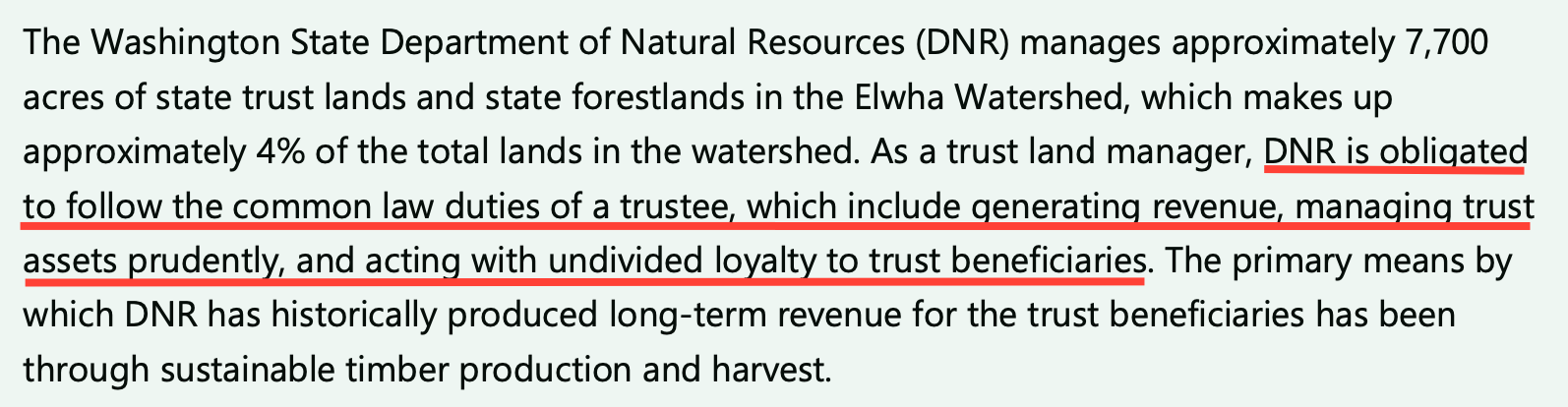
DNR knows what those lands are for. The draft recites the agency’s common-law trustee duties: generate revenue, manage the assets prudently, and act with undivided loyalty to the beneficiaries. It says the primary way DNR has met that duty is sustainable timber harvest.
Then it recommends taking a large bite out of that base.
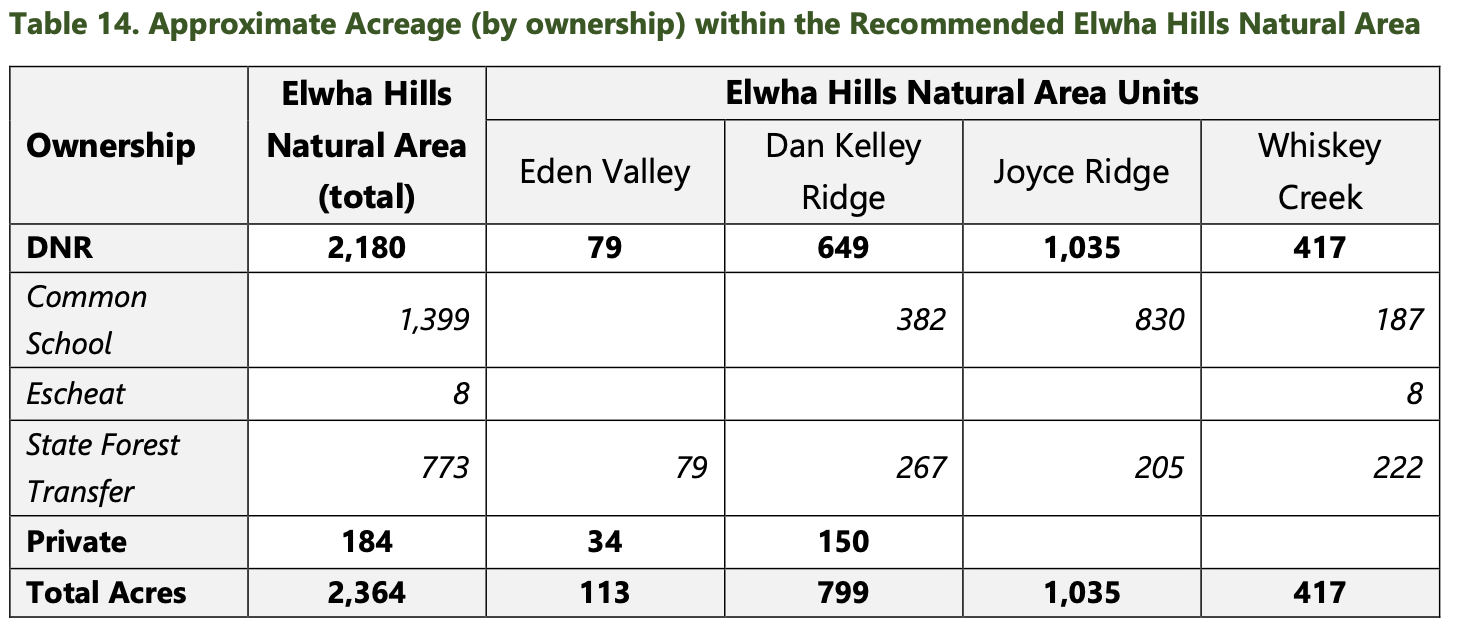
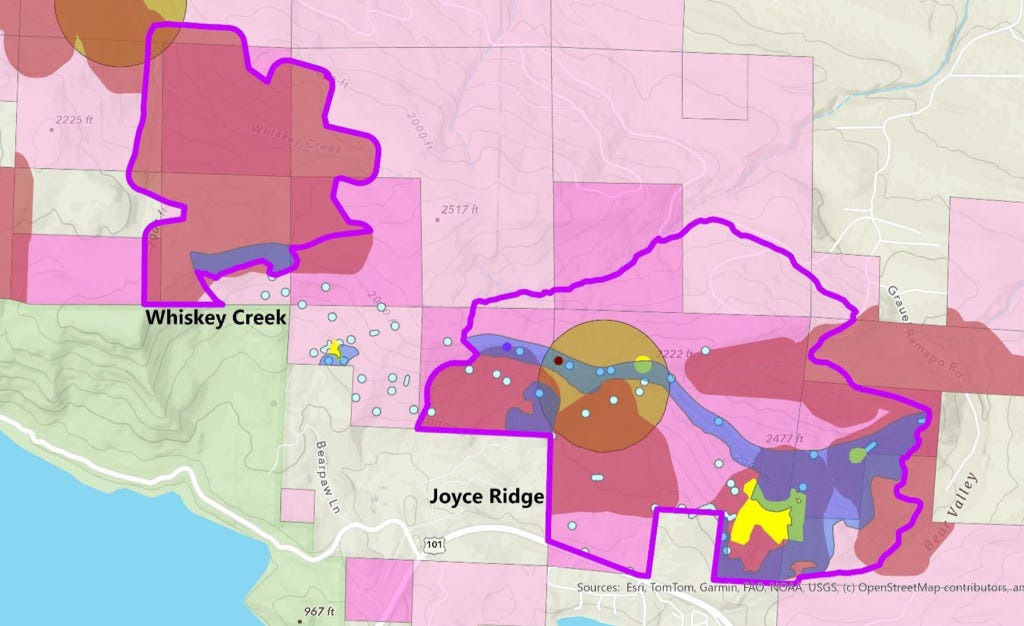
The Washington Natural Heritage Program wants a new “Elwha Hills Natural Area” of about 2,364 acres in four separate units. About 2,180 of those acres are DNR trust land — roughly 28 percent of everything DNR manages in the watershed. Another 150 acres already belong to the Center for Natural Lands Management. About 34 acres are private land at Eden Valley.
The four units are:
Eden Valley, 113 acres, proposed as a Natural Area Preserve
Dan Kelly Ridge, 799 acres, proposed as a Natural Resource Conservation Area
Joyce Ridge, 1,035 acres, proposed as a Natural Area Preserve
Whiskey Creek, 417 acres, proposed as a Natural Area Preserve
Natural Area Preserves are the stricter box. Recreation is generally not allowed. That is the proposed designation for about 1,565 acres. NRCAs allow only “low-impact” use; mountain biking is not assumed and would be decided later, after the land is already locked up.
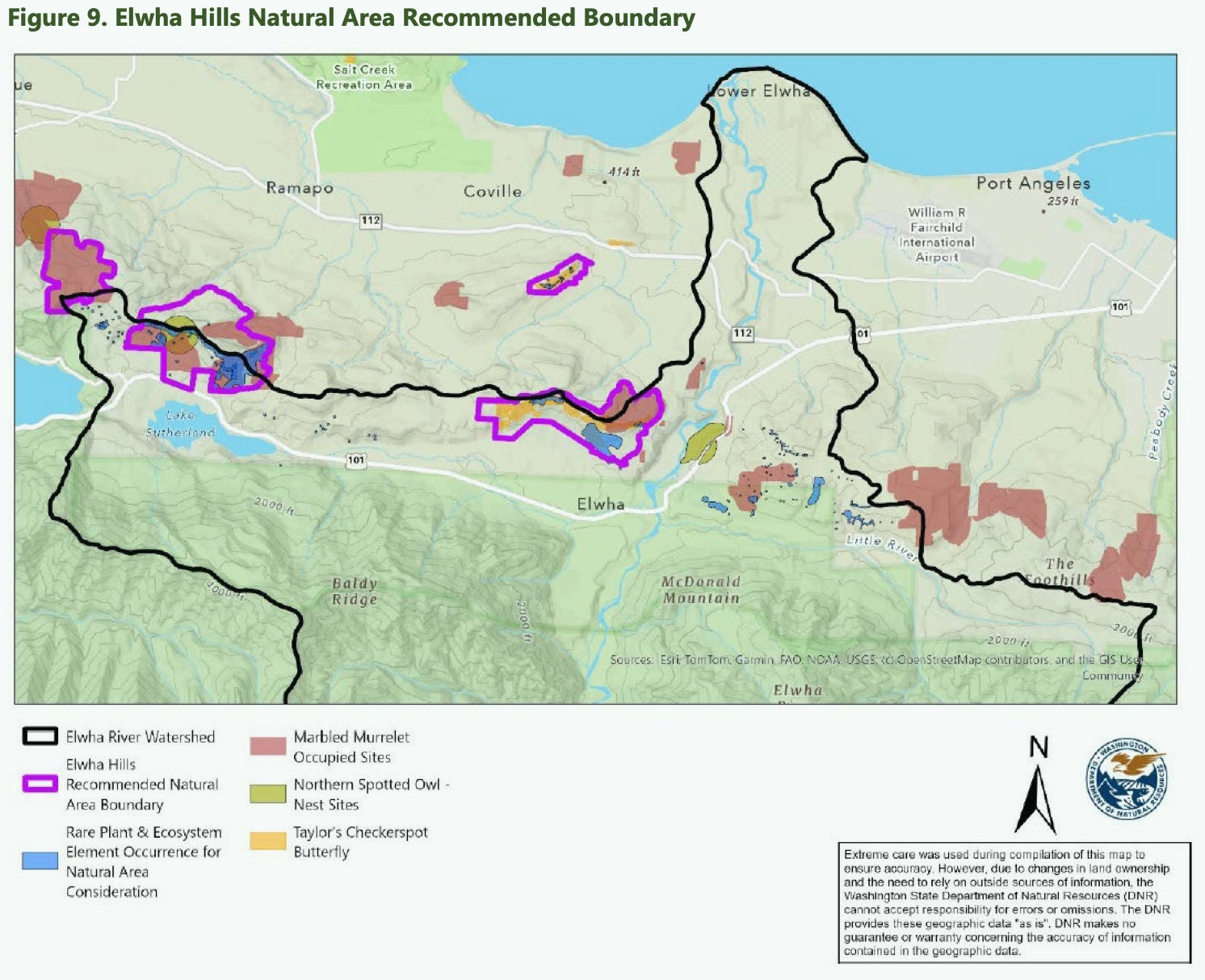
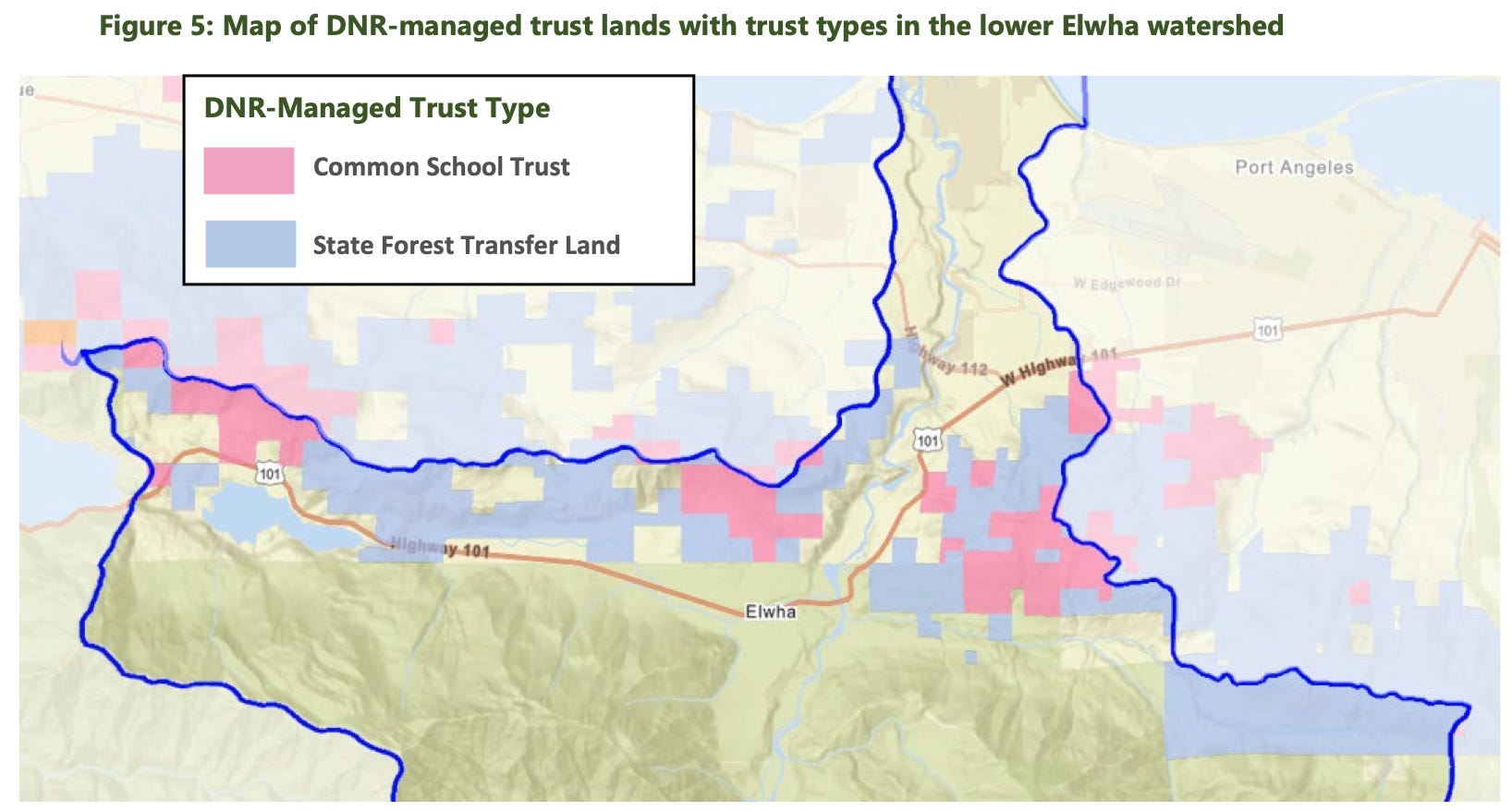
The draft does point to real, documented species: Taylor’s checkerspot butterfly (mentioned 47 times), marbled murrelet (27 times), northern spotted owl (17 times), rare plants (44 times) and lichens (60 times), a state-endangered grassland, and a state-threatened dry-forest type.
An honest reading should list all that. The policy choice is still to convert working trust assets into a conservation designation. Science can tell you what lives on a hillside. It cannot excuse ignoring the bill.
The money these districts already live on
Clallam County’s treasurer publishes exactly what DNR timber sales send to local districts. The 2024 Tax and Timber Report covers distributions from 2018 through 2023. DNR manages about 93,000 acres of State Forest Transfer land countywide. After DNR takes its management fee, currently up to 25 percent, the rest is paid to the County Treasurer and spread to the taxing districts in that tax area according to their levy rates.
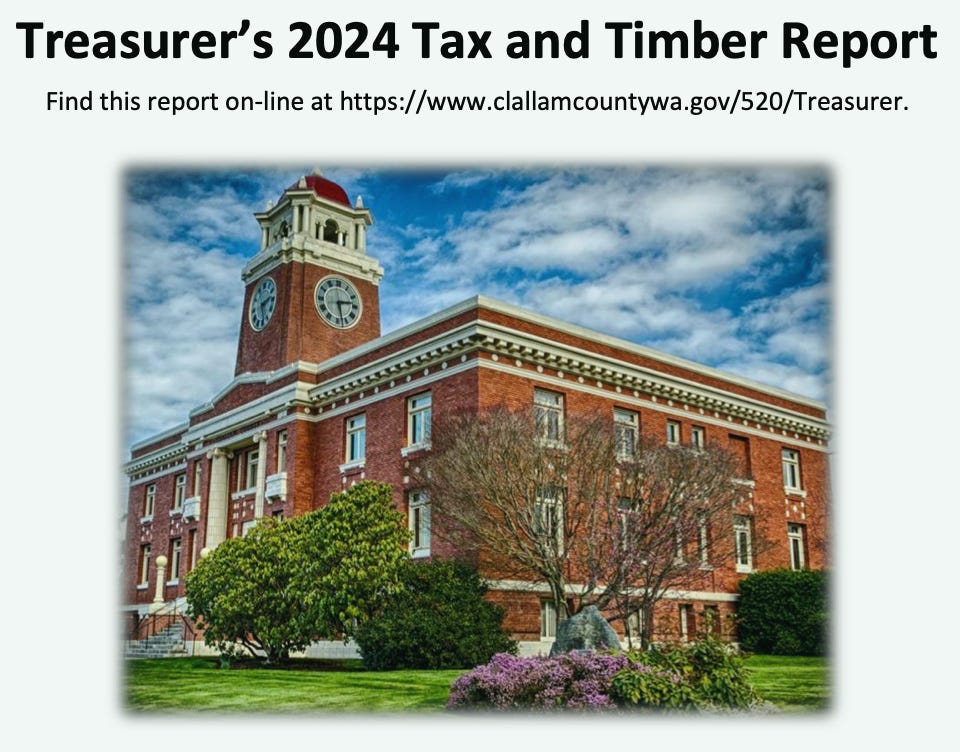
In 2023 alone, those DNR timber distributions totaled $10,029,286.98 countywide. The six junior and local beneficiaries DNR lists for the Elwha transfer lands received:
County Roads: $1,015,535.24
North Olympic Library District: $382,725.61
Crescent School District: $315,089.73 ($255,091.17 for maintenance and operations and $59,998.56 for capital)
Hospital District 2 (Olympic Medical): $310,628.45
Fire District 4: $194,657.73
Port of Port Angeles: $139,491.85
That is $2,358,128.61 in a single year to the very districts DNR says benefit from Elwha transfer lands.
Timber checks can vary. 2023 was a strong year. Across 2018 through 2023, the same table still shows serious money, year in and year out:
County Roads averaged about $660,000 a year (from $318,399.21 in 2018 to more than $1 million in 2023)
North Olympic Library averaged about $246,000 a year
Crescent School District averaged about $214,000 a year, M&O and capital combined
Hospital District 2 averaged about $165,000 a year
Fire District 4 averaged about $128,000 a year
The Port of Port Angeles averaged about $89,000 a year
Countywide, DNR timber distributions to Clallam districts averaged about $5.92 million a year over that six-year stretch. And the money has not dried up. DNR’s Clallam County 2025 fourth-quarter income report said $9,551,558.00 had accrued for the county in calendar 2025, with another $11.49 million in state-forest timber still under contract at year’s end.
Two facts have to be held at the same time. First, those treasurer figures are countywide. They come from all of Clallam’s state forestlands, not only the Elwha. The Elwha’s 5,570 transfer acres are about 6 percent of the county’s transfer base. Second, DNR is proposing to lock up 2,180 trust acres in and around that watershed — about 28 percent of the DNR acres it manages there — and it never says how many of those 2,180 acres are county transfer land versus Common School Trust. The Common School acres do not show up as a line item on the county treasurer’s timber table; they feed statewide school construction. Either way, the acres come out of a trust.
No honest writer can turn that into a “this proposal costs $X next year” headline, because DNR refused to run the numbers. Harvest value depends on which stands, whether they are already tied up by the Habitat Conservation Plan or the marbled murrelet strategy, and when they would have been sold. That is exactly why a 171-page legislative report that recommends a new natural area, and then says nothing about lost board feet, lost stumpage, or lost levy support, is not a complete report. It is a conservation recommendation with the economic chapter torn out.
What can be said without guessing is this: once those acres are designated and acquired as a natural area, they stop producing timber receipts for Crescent classrooms, Fire District 4, hospital care, library hours, port operations, and county roads. A Trust Land Transfer check, if one ever arrives, is a one-time political appropriation. A working trust forest is a renewable revenue stream.
The jobs attached to those trees
Timber is not an abstraction on a DNR map. It is payroll.
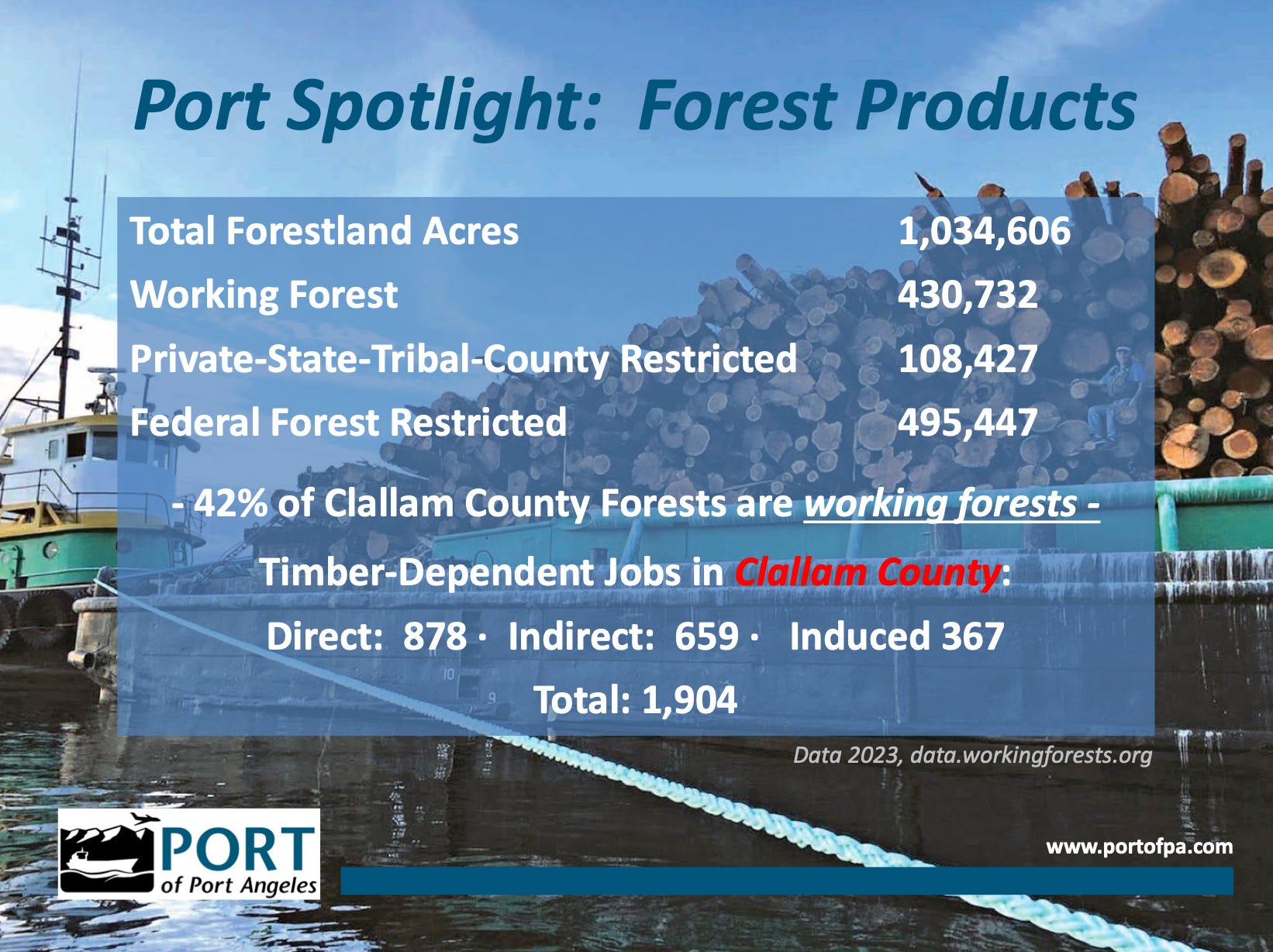
A 2024 Port of Port Angeles presentation cited 2023 figures from data.workingforests.org: Clallam County had 1,904 timber-dependent jobs. That includes 878 direct jobs paying an average of $84,331, or about $74.0 million in direct wages; 659 indirect jobs paying an average of $48,633, or about $32.0 million; and 367 induced jobs paying an average of $29,814, or about $10.9 million. All together, the Port reported about $117.0 million in timber-dependent labor income.
Those direct jobs are the people who find, fell, yard, and haul the logs. The indirect jobs are the truckers, mechanics, fuel dealers, equipment vendors, road builders, and suppliers who keep a sale moving. The induced jobs are what happens when that paycheck is spent at the grocery store, the coffee stand, and the cafe. DNR’s own draft notes that timber harvest on these lands is followed by replanting, that the agency maintains a forest-road system and rock sources, and that it also leases brush and bough harvest for the floral and decorative trade. That is more local work, not less.
This county has already watched that payroll shrink. The Forks Forum reported that the August 2024 closure of Port Angeles’ McKinley Mill took nearly 500 direct and indirect jobs with it. Taking more federal- and state-encumbered trust acres permanently off the harvest schedule does not rebuild a mill. It starves the remaining woods work of future volume.
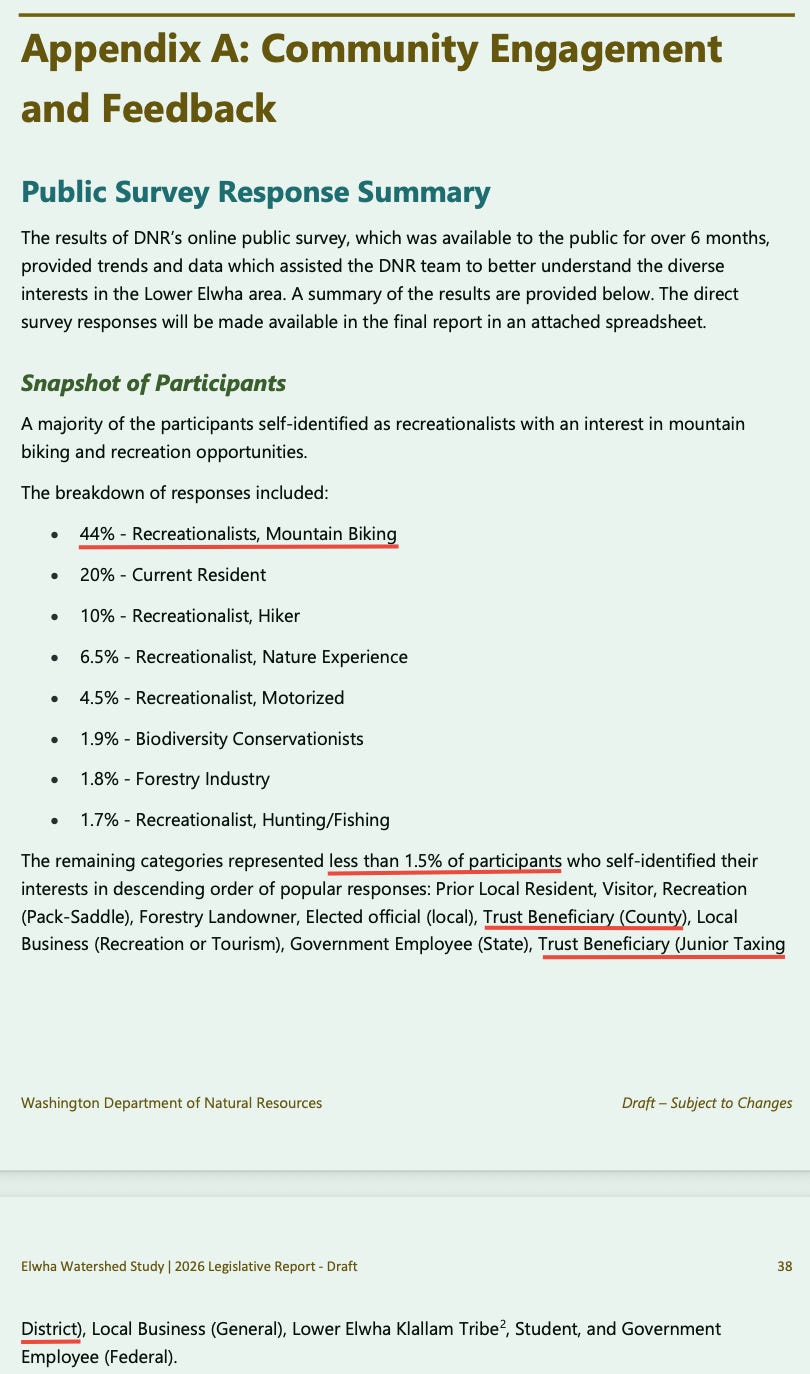
DNR’s public survey gathered more than 1,200 responses. Forty-four percent came from mountain bikers. Recreation ranked as the top concern. Trust beneficiaries and junior taxing districts showed up in the leftover categories under 1.5 percent. The loudest voices in a recreation-heavy survey are not the same thing as the people who depend on a timber receipt to keep a fire engine staffed or a school levy whole.
Replacement money is a hope, not a guarantee
DNR is careful to say this report covers only the first three of seven steps in creating a natural area. Next come a formal recommendation to the Natural Heritage Advisory Council, a public meeting in Clallam County, and a decision by Commissioner Upthegrove. If he issues a Commissioner’s Order, DNR’s conservation staff would then apply for Trust Land Transfer money and/or a Washington Wildlife and Recreation Program grant “to acquire the lands from the Trust beneficiaries.” The next sentence is the one that should be boxed on the page: “If funds are awarded,” the deals get done, and the Natural Areas Program takes over.
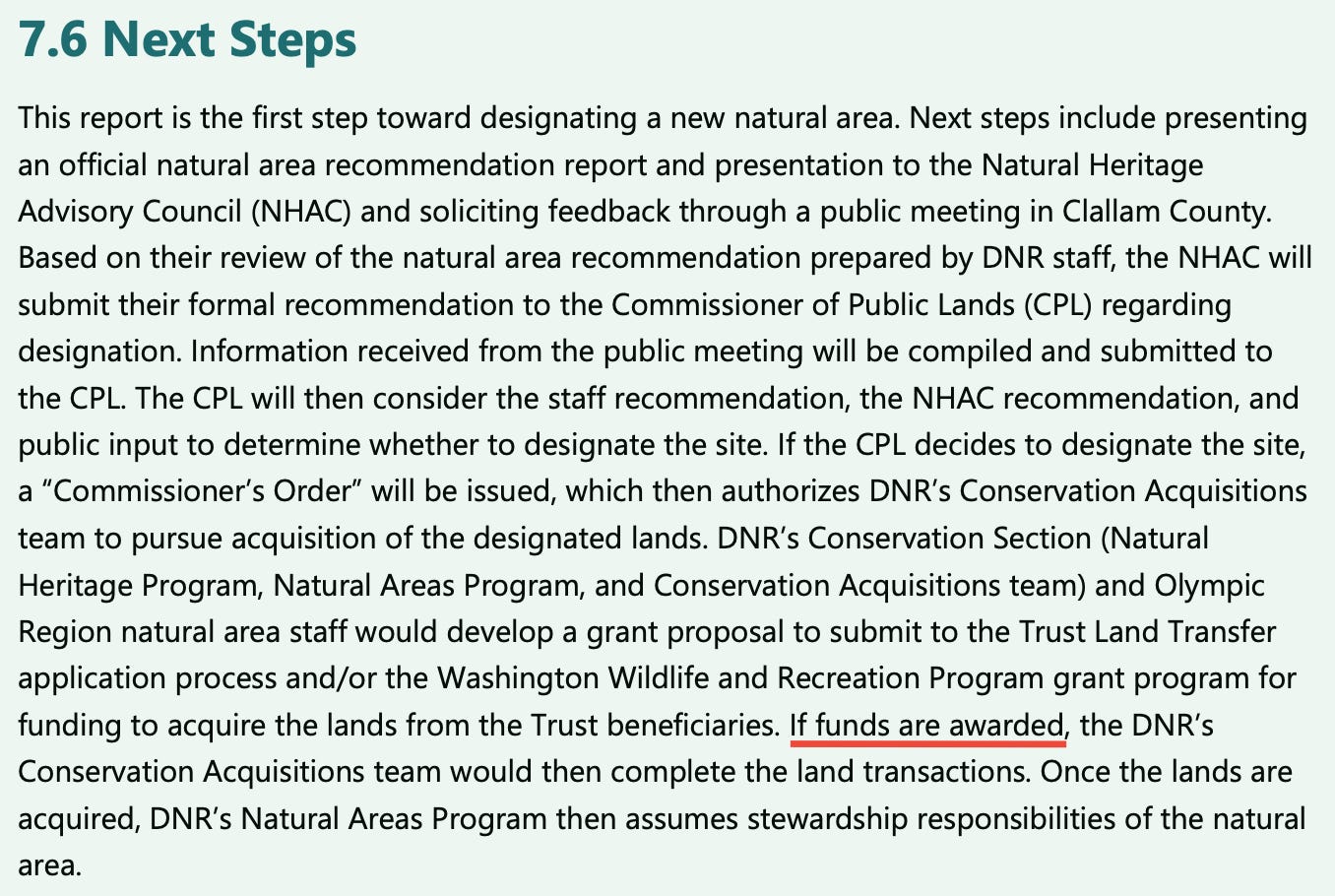
“If” is doing a lot of work here. Trust Land Transfer is a statewide competition for a limited pot of money. It is the same pot that paid for this $250,000 study. Even a full buyout, on a good day, substitutes a one-time check for decades of future harvests, road work, replanting, and the local jobs that ride along with them. On a bad day, the designation lands and the replacement money does not.
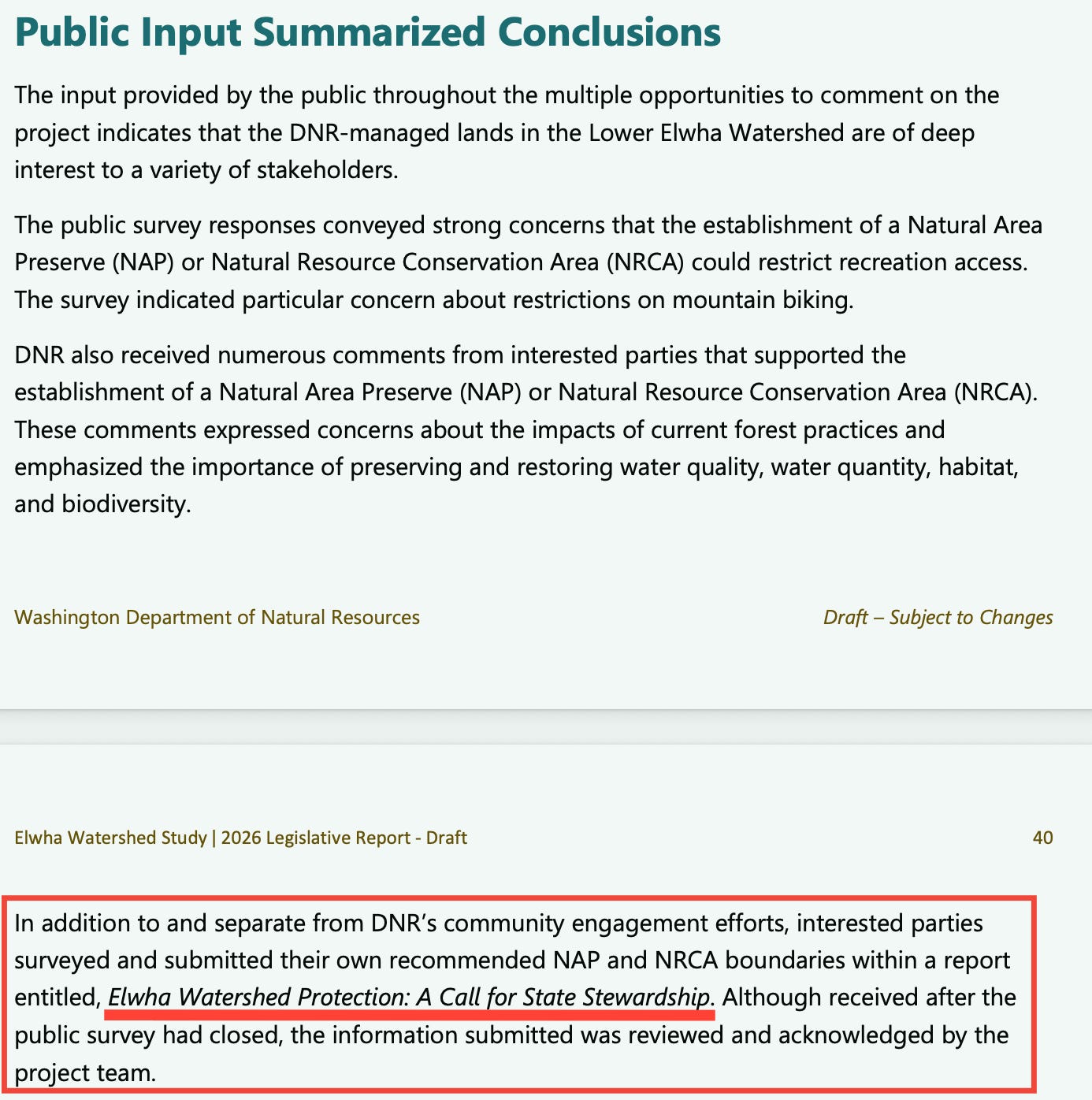
The outside pressure campaign is not a mystery. After the public survey closed, DNR “reviewed and acknowledged” a separate report titled Elwha Watershed Protection: A Call for State Stewardship (recently reported by CC Watchdog here). That August 2026 document came from Earth Economics, Earth Law Center, the Center for Responsible Forestry, the Elwha Legacy Forests Coalition, and the Legacy Forest Defense Coalition — the same network that has been pushing to take Elwha trust land off the harvest schedule. They wanted a larger lockup: a Mt. Sutherland preserve plus a watershed-scale conservation area covering Dan Kelly Peak and Indian Creek, Dry Hill, Little River, and the river mouth. DNR did not photocopy that map. It proposed four smaller, species-driven units and even trimmed part of Joyce Ridge “to accommodate Trust interests.” The destination is still theirs: a new natural area on land that now owes a living to schools, fire districts, and roads.
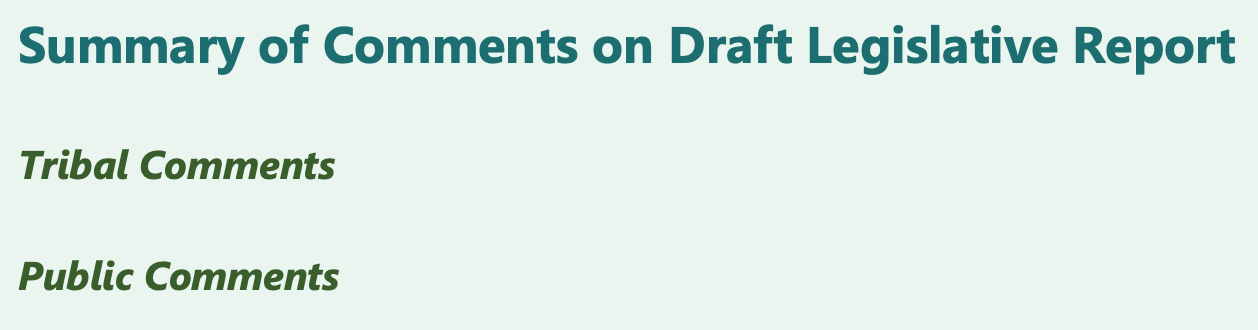
The tribal story here is not a land transfer. DNR consulted the Lower Elwha Klallam Tribe, shared draft boundaries early, and gave the Tribe an exclusive two-week look at this draft from October 16 to November 2 — a window the general public did not get. DNR also says it “did not receive direct feedback from the Tribe regarding cultural information to be included in this report” and points readers to the Tribe’s website. In the draft posted for all of us, the headings “Tribal Comments” and “Public Comments” are still blank.
The proposal also wanders outside the watershed the Legislature told DNR to study. About 41 percent of the “ecological boundary,” or 1,233 acres, sits outside the Elwha. Eden Valley is “well outside” it. A significant part of Joyce Ridge is outside it. Whiskey Creek is “almost all” outside it, and DNR admits that the outside portion “has not yet been surveyed” by the Natural Heritage Program or its contractor — yet the draft still recommends it as a 417-acre preserve.
Say something before Friday night
This report, by itself, does not create the natural area. That is true, but it is not a reason to wait. The recommendation is now on paper and headed to the Legislature by December 1. After that, the Natural Heritage Advisory Council, a Clallam County public meeting, and Commissioner Upthegrove decide whether to put these acres on the path to permanent conservation status.
DNR found room in 171 pages to name a lichen and a butterfly. It never found room to count the stumpage, the timber checks, or the 1,904 jobs that ride on this industry. Tell them to add up the cost before they take the acres — comment here — by midnight on Friday, November 13.
DNR can count every lichen and butterfly twice. It cannot unwrite the duty it already has to the trusts.
Dave Upthegrove is a committed climate change/environmental zealot. The fix is in.