

Most people know the county commissioners and the sheriff. Far fewer know that the planning director is elected, that PUD commissioners can clear $60,000-plus with benefits, or that fire and hospital boards control millions while taking only modest per diems. Here’s exactly what every elected seat pays—and why more residents should consider running.

Full-Time County Executive and Judicial Positions
Clallam County is one of seven home-rule charter counties in Washington. Under the charter, salaries for the major elected executives are set as fixed percentages of a Washington State Superior Court judge’s salary. That benchmark is currently $237,460 a year (effective July 1, 2025, set by the independent Washington Citizens’ Commission on Salaries for Elected Officials). It is scheduled to rise to $244,631 on July 1, 2026.
These full-time positions receive employer-paid family healthcare (medical, dental, and vision), life and disability coverage, and enrollment in the state pension system (PERS Plan 2 or 3, or LEOFF Plan 2 for the sheriff). They are also covered by paid family and medical leave and the WA Cares Fund.
Prosecuting Attorney (95% index): $225,587 / year ($18,798.92/mo)
District Court Judges – Dist. 1 & 2 (treated at the 95% index): $225,587 / year ($18,798.92/mo)
County Sheriff (72% index): $170,971 / year ($14,247.60/mo)
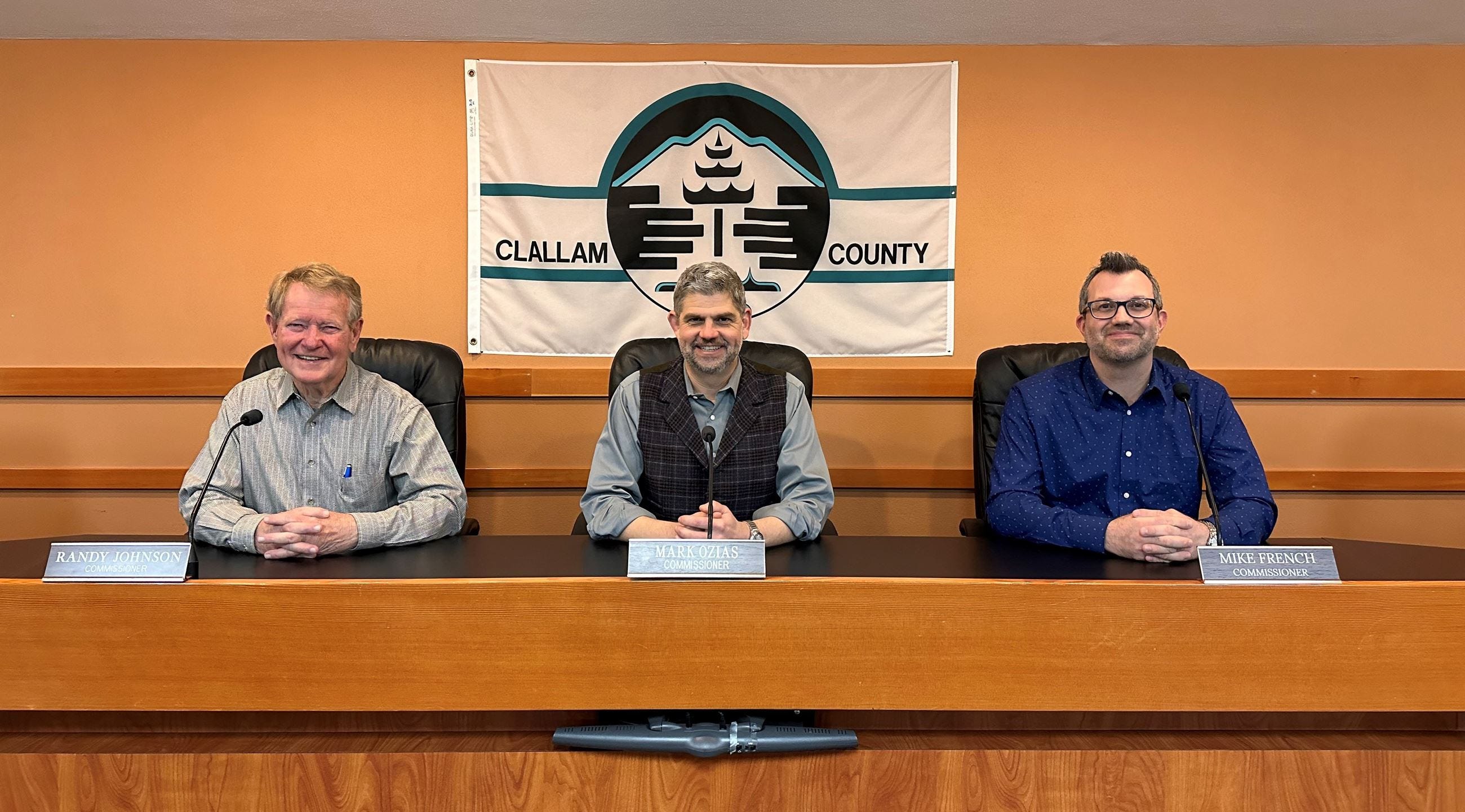
Board of County Commissioners – Dist. 1, 2, and 3 (50% index): $118,730 / year ($9,894.17/mo)
County Assessor (50% index): $118,730 / year ($9,894.17/mo)
County Auditor (50% index): $118,730 / year ($9,894.17/mo)
County Treasurer (50% index): $118,730 / year ($9,894.17/mo)
Director of Community Development (DCD) (50% index): $118,730 / year ($9,894.17/mo)
Two local quirks stand out. Clallam County is the only county in the nation where the planning and zoning director (DCD) is an independently elected official rather than an appointed department head. And while most Washington counties elect their Superior Court Clerk, Clallam’s charter made both the Clerk and the County Administrator appointed roles.
Special Purpose Districts (Where Tax Dollars and Levies Are Decided)
Beyond the courthouse, local property taxes and service fees are governed by independent special-purpose district boards. Commissioners on these boards are elected to staggered six-year terms. Meeting per diems are set by the state Office of Financial Management. Under the current adjustment (WSR 23-23-158, effective 2024–2028/2029), the rate is $161 per day for official meetings and services, with statutory annual caps.
Public Utility District No. 1: Three commissioners (East, Central, and West End districts) receive a statutory base salary of $3,238 per month ($38,856 a year) plus $161 per day in meeting per diems. Total cash compensation is capped around $61,396 a year. They are also eligible for full health, dental, and PERS retirement benefits—the only special-district board in the county that combines a base salary with comprehensive benefits.
Fire Protection Districts (FD 1–6): Commissioners receive $161 per day for meetings and official business, capped at $15,456 a year, plus travel expense reimbursement. No base salary or health benefits.
Public Hospital Districts (District 1 – Forks/West End; District 2 – Olympic Medical Center): Same $161/day per diem, capped at $15,456 a year. Reimbursement only.
Local School Boards (Port Angeles, Sequim, Crescent, Cape Flattery, Quillayute Valley): Directors typically serve as civic volunteers. State law authorizes up to $50 per day from local excess levy funds, capped at $4,800 a year. No benefits.
Conservation and park districts: Expenses only.
These boards set rates, approve budgets, and decide levies that show up on every property-tax statement, yet most residents never see a candidate forum for them.

Port of Port Angeles Commissioners
The Port of Port Angeles is governed by three elected commissioners (Districts 1, 2, and 3) who serve staggered six-year terms. They set policy for the port’s marine terminals, airport, industrial properties, and economic-development efforts, and they approve the budget and property-tax levy.
Under RCW 53.12.260 (as adjusted for inflation by OFM effective 2024), Port of Port Angeles commissioners currently receive:
A monthly salary of $360 ($4,320 per year)
$161 per day in meeting/official-duty per diem (subject to the statutory annual cap)
Reimbursement for actual travel and business expenses
Recent local reporting confirms the $4,320 annual figure for Port of Port Angeles (and Port of Port Townsend) commissioners. Like other special-purpose district boards, they do not receive health or retirement benefits as part of the position. Commissioners may also voluntarily waive all or part of their compensation by written notice.
This places the Port seats in the same general range as city councils—modest stipends designed to offset the time of part-time civic service rather than provide full-time compensation.
City Councils (Port Angeles, Sequim, Forks)
Under the Washington Constitution, city councils that set their own pay cannot increase it mid-term. Raises take effect only when a new term begins (or when an independent citizens’ salary commission sets the amounts).
City of Port Angeles (council-manager form): Mayor $1,300/mo ($15,600/yr); Deputy Mayor $1,200/mo ($14,400/yr); Councilmembers $1,100/mo ($13,200/yr). Travel expense reimbursement only; no PERS. These rates apply to terms that began on or after January 1, 2024.
City of Sequim (council-manager form): Set by an independent salary commission. As of 2026: Mayor approximately $662/mo ($7,944/yr); Deputy Mayor approximately $530/mo ($6,360/yr); Councilmembers approximately $386/mo ($4,632/yr). Travel expense reimbursement only.
City of Forks (mayor-council form): The city’s official website currently lists the mayor and five council positions as unpaid. Older surveys also showed no compensation. Any stipends would be set by local ordinance and are modest if they exist at all.

If You Don’t Like How It’s Run, Run for Office
A lot of citizens feel disconnected from local government. They don’t realize these boards exist, what they control, or how the compensation and benefit structures compare with typical private-sector wages on the Olympic Peninsula.
Full-time county roles are career positions with solid pay and comprehensive benefits. PUD seats are a hybrid—part-time on paper, but with a base salary, per diems, and full benefits that can push total value well above $60,000. Most fire, hospital, school, and city seats are civic service roles whose stipends mainly offset time and expenses.
Demystifying the numbers is the first step. The next step is more qualified local candidates stepping up, challenging incumbents, and holding every taxing district accountable to the people who fund it. Filing deadlines and open seats are public. The barrier is usually just knowing the job exists.
Jeff who and the hell would run for office in CC? After watching the abuse you and Jake endured in I CANT phantom a conservative candidate that would be up for the task. The personal smears that were leveled on u are criminal. The good old boy dems are in control of the system and the media. Thank you for CCWD that we have a voice that exposes the corruption. That said these culprits make too much money as u have noted in today’s article.